The First Slash of the Knife on a Kakadu Afternoon
The first thing you notice is the silence — a heavy, wet blanket of it that settles over your shoulders the moment the campervan’s engine dies. It’s punctuated by the clatter of a cockatoo in a paperbark tree, the distant splash of something you tell yourself is a turtle, and the low, vibrating hum of a billion insects tuning up for the evening shift. The campervan sits on a patch of red dirt at a designated camp a stone’s throw from a billabong in Kakadu, and the surface of the water is the colour of a bruised sky, reflecting the last gold of the day. You always stay longer than you planned.
Forget the fillets bought plastic-wrapped at a supermarket. The barramundi you’re after here — caught yourself (with the proper Northern Territory licence, naturally) or bought from a roadside seller or the Cooinda Lodge store — is a creature of mud and muscle. It tastes of the river system it came from: clean, sweet flesh with a firmness that holds up to fire. You’ll want a whole fish, scaled and gutted, somewhere around a kilogram. Anything smaller is fiddly; anything larger risks being underdone in the middle while the skin chars to a bitter crisp. The campervan’s two-burner stove, that humble workhorse of aluminium and butane, is about to become the most valuable piece of back-country equipment.
Preparation is a quiet, deliberate affair. You’ll need a sharp knife, a cutting board that hasn’t touched raw chicken in the last three days, and a roll of heavy-duty aluminium foil. Lay the barramundi on the board and score the skin three times on each side — diagonal slashes through to the bone, which let the heat penetrate and stop the flesh from curling. Now, here’s the trick that separates a camp cook from someone who just eats the packet noodles: stuff the cavity. You’re in Kakadu, so the stuffing is a tribute to the landscape. A handful of wild-growing saltbush leaves if you’ve foraged them (and you know what they look like, or you’re pretty sure you do — until you’re standing in front of a plant you’ve only seen in a blurry photo on your phone), or more prosaically, a bunch of fresh coriander, a sliced lemongrass stalk, and a good squeeze of lime. Rub the outside of the fish with a slick of oil — peanut or canola, something with a high smoke point — and season the scored flesh generously with salt. This isn’t the time for delicate finishing salt; you want it to stick and crust.
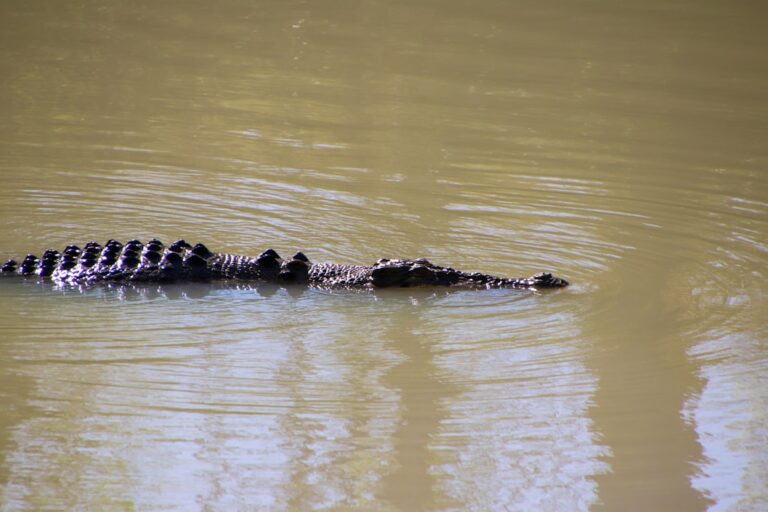
The stove setup matters more than you’d think. Position the campervan so that the cook station is as far from the water’s edge as the lead allows, and never, ever cook directly on the ground within a few meters of the bank. This isn’t paranoia; it’s basic territory etiquette. You are a visitor in the home of saltwater crocodiles, and the smell of cooking oil and fish flesh carries on the evening air like a dinner bell. The old-timers and rangers will tell you that a croc’s sense of smell is acute, and the last thing you want is to create an association between the sound of a hissing stove and the promise of a meal. Keep your station clean, your scraps bagged and sealed in a secure bin inside the van, and wash your hands and cutting board well away from the water’s edge, pouring the grey water into a designated container, not the billabong.
Heat the pan — a heavy cast-iron skillet is ideal, but any non-stick frying pan with a thick base will do — over a medium flame. You don’t need the inferno you’d use for a steak. Fish demands a gentler hand. Add a splash of oil and let it shimmer. When it’s hot, lay the barramundi in the pan, skin-side down. The first instinct will be to fiddle, to poke, to lift a corner and peek. Resist. Let it cook undisturbed for four to five minutes, depending on the thickness. The skin is ready when it releases from the pan without tearing — a clean, confident lift when you slide a spatula under. Flip it with the care you’d use to turn a sleeping child, and cook the other side for another three minutes. The flesh should be opaque and just flaking at the thickest part of the fillet behind the head.
Now, a confession: you will probably overcook the first barramundi on a camp stove. Everyone does. The fish is so lean and the heat from a portable burner so difficult to regulate that the margin between perfectly cooked and dry is about forty-five seconds. The workaround is to finish the fish in a foil parcel. Once both sides are seared to a golden-brown crust, wrap the barramundi loosely in a double layer of foil with a splash of water or white wine and a knob of butter. Clamp the foil shut, lower the flame to its smallest setting, and let it steam for another two minutes. This gentle finishing heat coaxes the last of the opaque flesh to flake without the direct heat drying it out. The result is a fish with a crisp, salty skin and a succulent interior that pulls apart in thick, pearly sheets.
You’ll eat it with your fingers, standing at the fold-down table attached to the side of the campervan, watching the light drain from the sky. The billabong in front of you is no longer a mirror; it’s gone black and deep, and the only movement is the occasional ripple that you choose to believe is a bream rising for a bug. The air is thick with the smell of paperbark smoke from someone else’s fire two campsites over, and the barramundi tastes of lime and the faint, grassy note of the lemongrass. There is a cold beer in the other hand, condensation beading on the bottle, and the first stars are punching through the violet above.
The Jim Jim Road Corrugations and a Fridge Full of Fish
But the cooking is only half the story. The other half is a question of logistics and respect for the country you’re in. Kakadu operates on a rhythm of seasons that predates any calendar you own. The dry season, from May to October, is your window: the humidity drops, the roads open, and the billabongs shrink to their most concentrated, fish-filled forms. The wet season, from November to April, is a different beast entirely — roads flood, parks close, and the barramundi disperse into the vast, swollen floodplains. You can still camp then, if you’re properly equipped and fearless, but you’ll be fishing in a soup of muddy water where the crocs are even more unpredictable. Stick to the dry.
The campervan is the key to this whole enterprise. A 4WD is almost non-negotiable on Kakadu’s unsealed roads — the corrugations on the Kakadu Highway heading toward Jim Jim Falls will rattle the fillings out of your teeth and the hinges off a standard two-wheel-drive. A well-equipped campervan, like those from Britz or Apollo that you can pick up in Darwin, gives you the independence to chase the best billabongs. You’ll want one with a decent-sized fridge and freezer compartment, because the barramundi needs to stay cold from the moment you acquire it until you cook it. Leave it in a warm esky for six hours, and you’re playing a risky game with food safety in the tropical heat. Freeze it solid if you can, and let it thaw slowly in the fridge compartment over a day. The texture stays firmer that way.
Water management becomes a new obsession. You’ll carry your own drinking water, but for washing fish and gear, you’ll rely on the bore water at designated campgrounds or the treated water at places like the Mardukal Park Village. Never assume a billabong is safe to drink from or even to wash dishes in — the same bacteria that make the water look inviting can lay you low for days. And that water used to rinse the lime juice off your hands? It goes into a sealed container, not onto the ground. The crocs aren’t the only thing you’re protecting; the fragile ecology of these waterways, with their water lilies and their ancient freshwater turtles, depends on every visitor treating the water as sacred.
Under the Fig Tree, a Pair of Jabirus
There’s a particular evening that lingers. You’ve driven down a track that the map barely acknowledges, following a ranger’s tip about a billabong that doesn’t appear on the tourist brochures. You park under a massive, spreading fig tree, and the air is thick with the scent of ripening fruit. The bank is sandy here, not muddy, and the water is gin-clear over a bed of ironstone pebbles. You set up the stove on a flat rock, far from the waterline, and cook the barramundi as the sun turns the escarpment on the far side of the billabong a deep, smouldering orange. A pair of jabirus, tall and stately, stalk the shallows on the opposite bank, completely unbothered by your presence. When you slide the fish onto your plate, the skin is crackling, the flesh is releasing steam in a fragrant cloud. A distant dingo calls to the darkening sky.
And what of the crocs? They are there, in the back of your mind, as constant and respectful as a presence in the room you’re too polite to stare at. You follow the rules: you don’t approach the water’s edge to wash your hands, you don’t leave fish scraps on the bank, you don’t dangle your feet in the billabong after a hot day’s driving. You treat the water as a border between two worlds — yours and theirs — and you don’t cross it. The barramundi came from this water, but you are a guest, a temporary resident, passing through. The crocs don’t want you; they want the barramundi you’ve already taken. But they are opportunistic, and a human crouched at a stove smells a lot like a potential mistake. So you stay alert, you keep your distance, and you cook with a respect that borders on reverence. It’s not fear; it’s the kind of awareness you feel when you’re fully, wakefully present in a wild place.
When the meal is done, you scrape the plate clean — no scraps left behind — and seal the bones and skin in a zip-lock bag to be disposed of in the rubbish bin back at the main campground. You scrub the pan with sand and a minimal amount of biodegradable soap, and pour the rinse water into the grey-water tank. You pack the stove away, storing the butane canister safely, and sit in the fold-out chair with a cup of tea, watching the stars multiply until the sky is a salted tapestry. The billabong has gone completely dark, a black mirror reflecting the Milky Way. And somewhere out there, just below the surface, the crocs are doing what crocs have done for a hundred million years — waiting, watching, breathing, silent.
This is the art of cooking a barramundi on a camp stove in Kakadu. It’s not complicated. It’s not gourmet. It’s a conversation between you, a fish, a few coals, and a landscape that has been perfecting this moment for millennia. The next time you see a barramundi on a restaurant menu, you’ll smile, because you know what it takes to cook one properly, in the place where it was born. You’ll know the ritual. And you’ll know the silence that comes after.