The sulfur smell hit before I saw anything. Not the distant, theoretical smell you read about in guidebooks. A real, physical presence that settled in the back of the throat like a layer of fine grit. I was still a hundred metres from the rim of Kawah Ijen when the first whiff of it came through the edges of the gas mask I’d rented at the bottom, and I remember thinking: this isn’t working as well as I’d hoped.
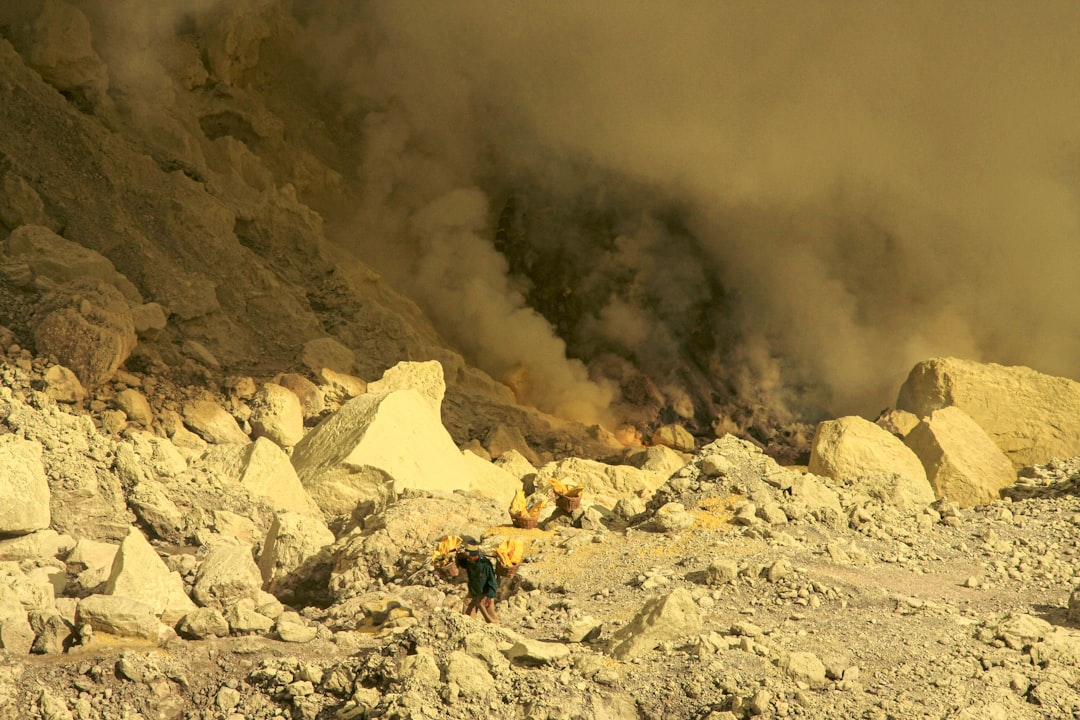
The climb up had been straightforward enough in the dark. A steady two-hour trudge up a well-worn path, headlamp illuminating nothing but the boots of the person in front of me and the pale limestone underfoot. No views until suddenly there were — the first hint of dawn turning the sky a grey-blue behind the crater’s jagged edge. Miners passed me on their way down, carrying baskets of sulfur crystals slung over bamboo poles. Each one weighed, by rough estimate, somewhere between seventy and ninety kilos. They moved with a gait that looked practiced, shoulders listing slightly to one side, bare feet finding the rocky path without looking.
At the rim, the descent into the crater itself began. This was the part nobody had warned me about. The trail down was loose scree, steep enough that I had to turn sideways and dig my heels in with every step. The gas mask fogged immediately in the humidity of the crater bowl, and I had to stop twice to clear the lenses with the sleeve of my jacket. A man from a tour group behind me was already coughing, pulling his mask off and on, trying to find a seal that didn’t make him feel like he was breathing through a pillow.
At the bottom, the famous acid lake spread out in front of me, a milky turquoise that looked more like something from a chemical processing plant than a natural body of water. The surface was perfectly still, reflecting the sky above it in a way that felt almost deliberate, as if the lake itself was watching. Its pH hovers around zero, locals tend to say — acidic enough that any organic matter that falls in simply dissolves. I didn’t test this.
The sulfur blue flames were toward the far end of the crater floor, near a cluster of vents where the yellow mineral had built up into stalactite-like formations over centuries. Getting close enough to see them clearly meant navigating a field of jagged sulfur deposits that crunched underfoot like broken glass. The gas mask, at this point, had become more of an inconvenience than a help. The filter was old, the fit was poor, and every time I exhaled, the mask would balloon slightly at the cheeks, letting in a thin stream of unfiltered air that tasted like the world’s most aggressive struck match.
But the flames themselves were worth the discomfort. They moved in a way I hadn’t expected — liquid, almost, flickering across the surface of the vents like something alive. The colour was an electric blue, not the deep orange of a campfire or the yellow-white of a gas stove. More like the light from a welding torch, but softer, somehow less aggressive. I stood there for a long time, maybe twenty minutes, watching them dance. A miner nearby was breaking off another chunk of sulfur with a metal bar, the sound ringing out across the crater floor. He didn’t seem interested in the flames. He’d seen them every day for the past twelve years.
The miners are the real story of Kawah Ijen, and everyone who visits knows this. They work without masks, or with the same cheap cloth masks that tourists rent for a few thousand rupiah, hauling sulfur up the crater walls in the dark for about the same price a tourist pays for a bottle of water at the top. I counted one man making three trips in the time I spent down in the crater. Each load probably weighed more than I did. He was shirtless, sweating heavily in the pre-dawn chill, and when he passed me, he nodded without breaking stride.
At some point, I realized the mask had stopped working entirely. The smell of sulfur had become so pervasive that I couldn’t tell if it was still leaking in or if my sense of smell had simply given up and gone on strike. I pulled the mask off and took a breath. It was sharp, acrid, the kind of air that makes your eyes water and your lungs feel like they’re trying to turn inside out. But it didn’t kill me. I took another breath. Then another. The miners around me were breathing this same air, every day, for years. The least I could do was make it through a morning.
I climbed back out of the crater at around eight in the morning, just as the first tour buses from Surabaya were arriving. The parking area near the entrance had transformed while I was below — quiet darkness had given way to a small carnival of vendors selling instant noodles, coffee, and cheap gas masks in plastic packaging. A group of European tourists were arguing with a guide about the price of a sulfur sample. The negotiation was loud, theatrical, and lasted about ten minutes before someone handed over fifty thousand rupiah for a lump of yellow rock that would probably sit on a shelf in Berlin until someone threw it out.
I sat on a low stone wall near the entrance and ate a banana I’d brought from my guesthouse. The sulphur smell clung to my clothes, my hair, the inside of my nostrils. I could still taste it at the back of my throat. A man from a nearby tour group offered me a cigarette, and I declined in sign language that seemed to amuse him. We didn’t share a language, but he pointed at my gas mask — which I was still holding, by one strap, like a dead bird — and made a face that clearly communicated his opinion of the equipment. I nodded. He laughed.
On the drive back to my guesthouse in Banyuwangi, the driver stopped without warning at a small roadside warung and pointed at a sign advertising soto ayam. He didn’t explain, just got out and walked inside, and after a moment’s hesitation, I followed. The soup was served in a bowl the size of my head, steaming, yellow with turmeric, filled with shredded chicken and glass noodles and a soft-boiled egg that broke open when I poked it with a spoon. I ate it on a plastic stool while chickens wandered around my feet. The driver ate two bowls in the time it took me to finish one, then lit a clove cigarette and stared at the road with the particular stillness of someone who spends most of his life waiting for other people.
I asked him, through a mix of broken Indonesian and hand gestures, how many times he’d made the drive to Ijen. He held up all ten fingers, twice, then shrugged as if to say: more than that. I couldn’t tell if he meant twenty, or two hundred, or just a lot. It didn’t matter. The road knew him better than he knew it.
Back at the guesthouse, I showered twice and still smelled sulfur when I lay down for a nap. The mask sat on the chair by the window, a sad little piece of rubber and plastic that had done almost nothing to protect me. I didn’t throw it out. It felt wrong to discard something that had been part of the experience, even a bad part. Instead, I hung it on the balcony railing, where a gecko immediately crawled inside it and refused to come out for the rest of the afternoon.
The next morning, I woke up early and drove back toward the mountain. Not to climb it again — once was enough for a while — but to see the coffee plantations at the base, where the volcanic soil supports a different kind of agriculture entirely. The coffee here is good, grown in the shadow of the crater that gives the whole area its character. I bought a bag of beans from a woman who roasted them on a metal tray over an open flame, her daughter watching from a hammock strung between two trees. The beans were dark, oily, with a smoky undertone that reminded me, inevitably, of sulfur. I drank a cup on the spot, standing in the dirt, and it was the best coffee I’d had in months.
What I keep coming back to isn’t the blue flame itself or the acid lake or any of the things that appear in the photos. It was the moment of complete silence that settled over the crater just before dawn, when the miners had mostly gone up and the tourists hadn’t yet come down, and I was standing alone on a slope of broken sulfur rock with the gas mask dangling uselessly from one hand. The air was still bad. The mask was worse. But for a few minutes, none of that mattered. There was just the flame, the lake, and the feeling of being somewhere the rest of the world hadn’t quite reached yet.
The bag of coffee beans made it home with me. I keep it in the freezer, and every time I open the bag, the first thing I smell is not coffee but something sharp and mineral, like an echo of the crater itself. It’s not unpleasant. It’s just a reminder: the detail that changes everything wasn’t in any of the brochures.

📷 Photos: Mario La Pergola (Unsplash), Mario La Pergola (Unsplash)