The dried-seafood streets of Hong Kong’s Sheung Wan district smell exactly the way you’d expect something that’s been dehydrating for decades to smell. It’s not unpleasant, exactly, but it’s specific — a dry, saline weight that sits in the back of the throat, more mineral than fish. Shark fin in glass cases. Sea cucumber the size of a forearm. Abalone stacked like poker chips, each one worth more than a good dinner in most cities. We’d come for none of these things. We’d come for the scaffolding.
It was a Tuesday in late November, the kind of cool, clear afternoon that Hong Kong does better than almost any city — the humidity finally gone, the light sharp enough to cast real shadows. The bamboo scaffolding around the restoration of Man Mo Temple on Hollywood Road had been visible from half a kilometer away, a pale brown cage wrapped around a building so old the stones looked soft. We’d watched a man in a tank top and rubber sandals scramble up the vertical poles without a harness, carrying a bundle of bamboo on his shoulder, and we’d followed him — not because we had permission, but because he didn’t seem like the kind of person who would stop to ask.
That’s how we met Mr Cheng, though “met” is generous. He was sixty-three years old, he told us later, and he’d been tying bamboo since he was fifteen. He didn’t speak English. We didn’t speak Cantonese beyond the two phrases we’d learned from a YouTube video the night before. But scaffolding has its own language, and we both understood it enough: we pointed at the poles, he pointed at the nylon straps he was using to bind them, and eventually he shrugged and gestured for us to stand back and watch.
The technique hasn’t changed much, as far as anyone can tell. A bamboo scaffold starts with vertical poles — kwaang, Mr Cheng called them — set into the ground or anchored to a building’s facade. Then horizontal runners, then diagonal braces, then the working platforms. The binding is done with nylon straps these days instead of the traditional bamboo strips, a concession to safety regulations that most of the old-timers accept reluctantly. “The plastic doesn’t stretch like bamboo does,” Mr Cheng said, through a younger worker who translated. “It holds tighter, but it also fatigues. You can’t trust it the same way.”
That distinction — between what’s safer and what’s trusted — is at the heart of why this trade is disappearing. Hong Kong’s Buildings Department still approves bamboo scaffolding for most construction and renovation projects under six stories tall, but the number of certified taat kung has been dropping steadily for years. We’d read somewhere that there were close to five hundred left, maybe more, though no one we spoke to could confirm that number. “Fewer every year,” said a foreman at a worksite on Des Voeux Road, wiping his hands on a rag that was already grey with dust. “The young people don’t want to learn this. It’s not glamorous work, and it’s dangerous if you make a mistake. But it’s also —” He paused, searching for the word. “It’s also very old. Very Hong Kong.”
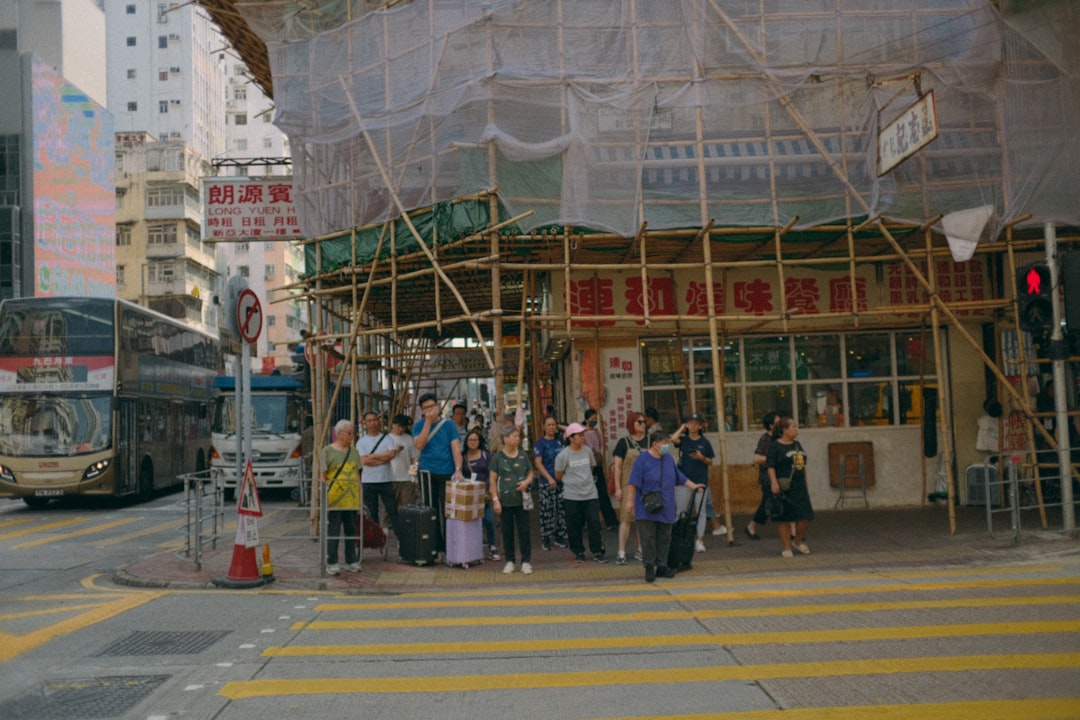
Des Voeux Road is where the dried-seafood trade concentrates, a narrow strip of the city that feels like it belongs to a different century. The shopfronts are open to the street, their goods displayed in glass cases and wire baskets. The air is thick with the smell of dried scallop — conpoy — and the sound of Cantonese opera drifting from radios. We’d come at midday, when the delivery trucks were unloading and the foot traffic was at its heaviest. A woman in a floral apron was haggling over a bag of dried squid. A man with a clipboard was counting crates of abalone. Above them all, a bamboo scaffold rose four stories, tied to the facade of a building that housed a dried-shark-fin wholesaler on the ground floor and three floors of storage above.
We climbed the scaffold — carefully, with Mr Cheng’s permission — and found ourselves in a world that looked nothing like the street below. Up there, the bamboo creaked under our weight, a sound that seemed to come from the building itself rather than the structure we were standing on. The poles were lashed together at intervals of about a meter, the knots pulled tight enough that the bamboo bent slightly where the strap crossed it. The platform we stood on was made of planks lashed to the horizontal runners, none of them perfectly level, all of them flexing as we shifted our weight. It was not comfortable. It was not something we’d do again without a helmet and a harness. But it was also the most honest we’d ever felt about any structure we’d ever stood on.
Bamboo scaffolding has a peculiar quality that steel scaffolding doesn’t. It moves. It bends. It groans under load. Most engineers would call this a weakness, but the old scaffolders see it differently. “Bamboo tells you when it’s tired,” Mr Lam said through a translator. He was seventy-one, retired, but he still came by the worksites to check on his former apprentices. “Steel doesn’t speak. It just breaks. Bamboo talks to you first.” He showed us a pole that had started to split at one end, a hairline crack that ran about fifteen centimeters along the grain. “This one is fine for another week, maybe two. After that, you replace it. But you have to look. You have to know what you’re seeing.”
The looking is the part that takes years to learn. A good scaffolder can assess a building’s facade in minutes — which surfaces can bear load, which corners need reinforcement, where the wind will catch and where it won’t. The traditional method uses no plans, no drawings, no calculations on paper. It’s all in the hands and the eyes. A few universities in mainland China have tried to document the techniques, filming the old scaffolders as they work and trying to codify the rules, but the project has been slow. “You can’t learn this from a video,” Mr Lam said, and his translator shrugged as if to say he’s right. “You have to feel the tension in the strap. You have to hear when the bamboo is seated properly. The hand knows things the brain doesn’t remember learning.”
That afternoon, we walked the length of Des Voeux Road twice, from the Central Market end to the Western Market end, counting the scaffolds. There were seven. Two were active, with workers climbing them. Three were empty, their platforms bare. Two were half-dismantled, the bamboo already stripped away and stacked on the pavement for collection. The whole street, it seemed, was in a state of gradual transformation — the old trades fading, the new ones waiting in the wings, and the bamboo scaffolding holding everything together while the change happened.
The dried-seafood trade itself is also in decline. Younger Hong Kongers don’t cook with shark fin and sea cucumber the way their grandparents did, and the international bans on shark finning have put pressure on the wholesalers. But the shopfronts on Des Voeux Road persist, selling to an older generation that still remembers when these ingredients were a marker of prosperity, a way of showing you’d made it. The abalone sellers do well during Lunar New Year, when the price of a good can of the stuff can reach several thousand Hong Kong dollars. The rest of the year is quiet.
It was in one of these quiet shops that we met Mrs Fan, who had been selling dried scallops from the same stall for thirty-eight years. She told us that her father had started the business in the 1960s, when the street was so busy you could barely walk through it. “Now it’s tourists and old ladies,” she said, picking a piece of conpoy out of a basket and handing it to us. “Smell this. That’s the smell of my childhood.” It was faintly sweet, faintly fishy, with something almost floral underneath — not aggressive, like the shark fin, but subtle, like a memory of the sea rather than the sea itself. “The young people don’t know this smell. They think everything comes in packets.”
From her shop, we could see the bamboo scaffold on the building across the street, and the two things — the dried scallops and the bamboo — began to feel like part of the same story. Both are old. Both are being replaced. Both are still here, in this narrow stretch of the city.
We spent the rest of the afternoon at a worksite on Wing Lok Street, where a crew of five was dismantling a scaffold that had been up for three months. They worked in reverse order from how they’d built it: first the planks, then the horizontal runners, then the diagonals, then the vertical poles. Each piece of bamboo was inspected as it came down, set aside for reuse if it was still sound, stacked for disposal if it was cracked or split. “Nothing goes to waste,” the foreman said, handing us a piece of bamboo that had been cut to a specific angle at one end. “See how the end is tapered? That’s so it fits into the socket of the next pole. Every piece is made for its position. If you mix them up, they don’t fit.”
We asked him how long he thought the trade would last. He looked at the pile of bamboo at his feet, then at the building he’d just finished working on — a mid-century commercial block that was being converted into co-working space. “Maybe another twenty years,” he said. “Maybe less. The bamboo will always be here, because it’s cheaper and faster than steel, and because the government approves it. But the people who know how to do it properly — they’re not training enough new ones. When we’re gone, the buildings will still get scaffolded. But it won’t be the same.”
That evening, we walked back toward Sheung Wan Station as the streetlights came on and the dried-seafood shops pulled down their metal shutters. The bamboo scaffolds were still there, visible against the sky, the naked poles catching the yellow light and casting long, thin shadows across the pavement. In the quiet of the evening, they looked less like construction equipment and more like something grown from the buildings themselves — a ribcage, a skeleton, a structure that was both temporary and ancient. We thought about Mr Cheng’s hands, Mr Lam’s warning about the plastic straps, Mrs Fan’s conpoy, the foreman’s certainty that the trade would not outlive him. And we thought about the fact that the best way to see a city, sometimes, is not from its landmark buildings or its famous viewpoints, but from forty feet in the air, standing on a platform made of bamboo and nylon and trust, feeling the whole thing shift beneath your feet and knowing that someone, somewhere, still knows how to tie a knot that will hold.

📷 Photos: Ricky Wijaya (Unsplash), Jordan Merrick (Unsplash)