We were already lost, which turned out to be the best way to arrive in Tam Coc. The sun had burned off the morning haze but not yet turned punishing, and somewhere between the turnoff for Bich Dong Pagoda and a dirt track that dead-ended at a neighbor’s duck pond, we had stopped pretending we knew where we were going. The bicycles were rented from a guesthouse near the main road—two rusty city bikes with baskets that rattled over every bump—and we had set out with a photocopied map that showed things that no longer existed.
The laughter came from a woman in a conical hat, knee-deep in a flooded paddy, who watched us reemerge from the same dead-end lane for the second time. She didn’t speak English, and our Vietnamese was limited to the wrong tones for hello, but she gestured toward the mountain behind her with her chin, then made a paddling motion with both hands. The sampan. That’s what we were supposed to find.
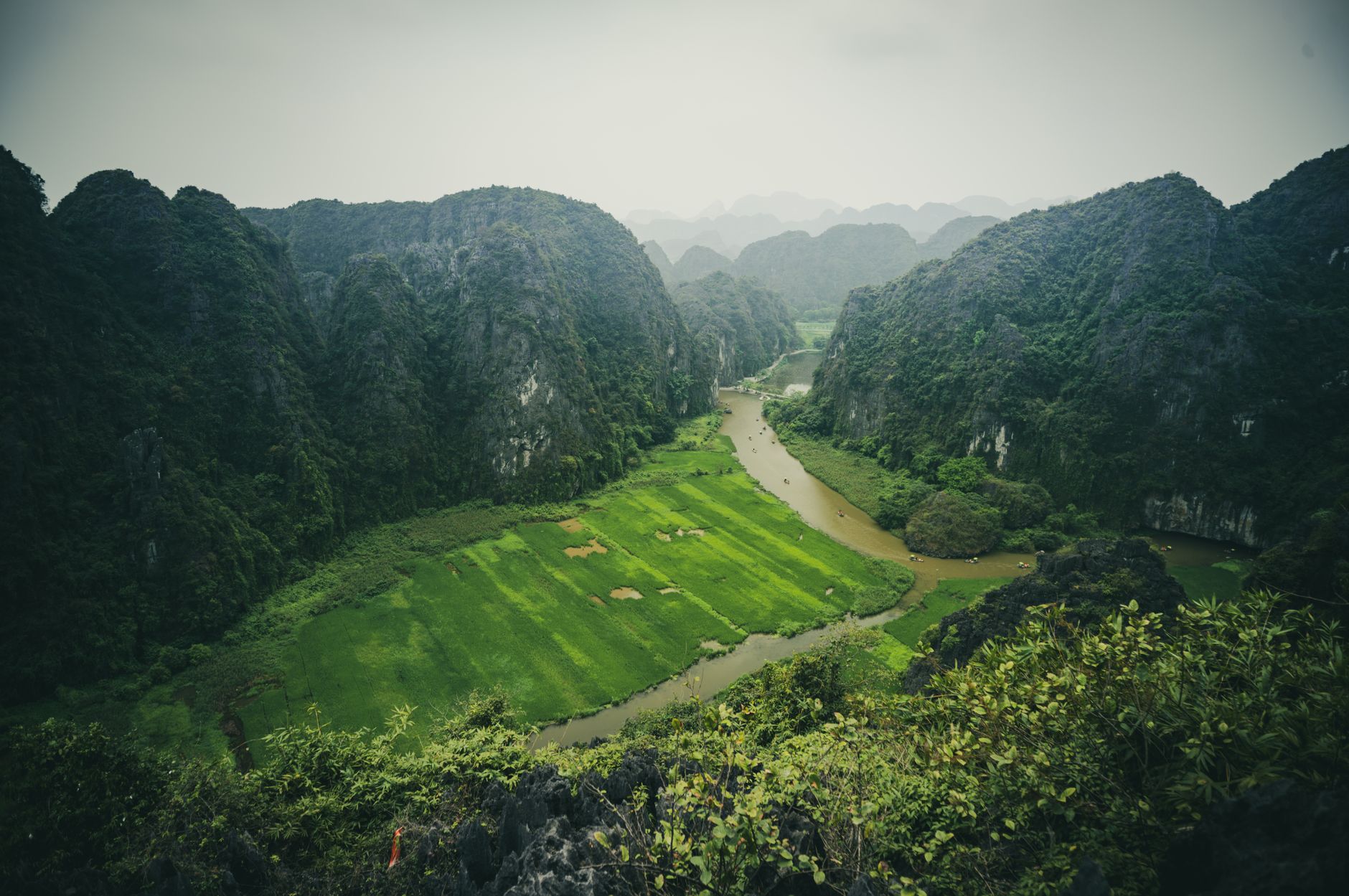
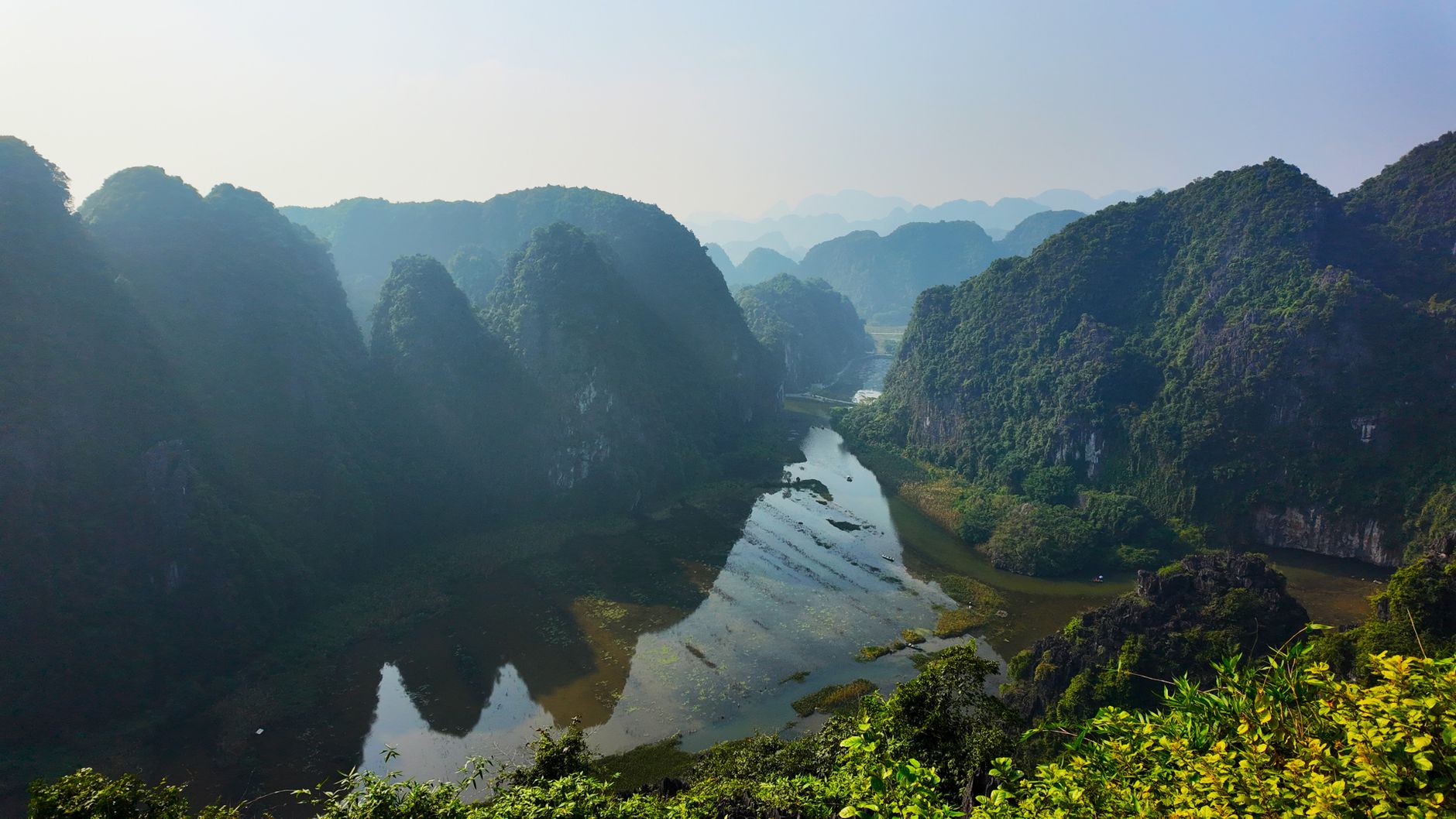
Tam Coc is a river valley in Ninh Binh province, about two hours south of Hanoi. Most visitors arrive on day tours from the capital, bused in for a two-hour boat ride through the limestone karsts and a lunch of goat meat and rice, then bused back out before dusk. The landscape is spectacular in the way that Ha Long Bay is spectacular—towering rock formations rising out of flat green water—except here, the water is a river and the karsts are surrounded by rice paddies instead of open sea. The photographs that circulate online tend to be shot from a drone or from the water itself, with a single sampan framed against a cave entrance, the light hitting just so.
What the photographs don’t show is the quality of the silence at five in the morning, when the only sound is a rooster that has lost track of time and the distant clank of a Buddhist temple bell from somewhere up in the cliffs.
We had planned for two days, which felt like an extravagance for a place most people see in four hours. The first morning, we woke before dawn and cycled toward the water without a specific destination, following the narrow canal that runs parallel to the main river. The rice was in its early green stage, not yet tall enough to hide a crouching person, but already dense enough to sway in unison when a breeze passed through. The light came slowly, first a gray-pink wash behind the karsts, then a sharper gold that picked out the terraces one by one. We stopped at a point where the canal bent around a rock face and just watched the color change—not photographing, not planning the next move, just letting the morning happen.
It was a Wednesday. The weekend crowds from Hanoi turn the main boat dock into a scrum of tour operators waving laminated price sheets and shouting over each other, but on a weekday in late April, we had the canal almost to ourselves. A single sampan passed us, the rower using her feet to work the oars in the local style, her passenger a French woman reading a paperback in the shade of the canopy. They disappeared around the bend, and for the next hour, we saw no one.
The midday heat sent us back to the guesthouse, where the owner, a retired schoolteacher named Linh, insisted we eat lunch with her family. She served a dish she called “mountain goat stir-fry” that turned out to be chewy and fragrant with lemongrass, alongside a bowl of green papaya salad that was aggressively sour and exactly what the heat demanded. “You are the first guest this week who did not ask for pizza,” she said, in English that was careful and precise. “The others, they come from the city and they are afraid of the local food. But you ride bicycles. So you are not afraid.”
We asked her about the best spot for sunset. She told us to go to the pagoda, but not the one on the tourist map—the one further up, the one that requires walking your bike up a rocky slope. “Most people stop at the first temple,” she said. “They do not know there is a second one.”
The climb was steep enough that we abandoned the bikes halfway and continued on foot, the path narrowing to a stone staircase cut into the hillside. The first pagoda was modest and empty, with a single monk sweeping the courtyard. He nodded at us but did not speak. We kept climbing.
The second pagoda was essentially a cave shrine, built into the hollow of the karst itself. Inside, the air dropped ten degrees, and the only light came from a few flickering oil lamps and the opening at the far end, which framed the valley below like a proscenium. We sat on a stone ledge and watched the shadows lengthen across the paddies, the water turning from green to bronze to a deep, almost iridescent blue. A group of Vietnamese tourists arrived just as the light was at its best—a family with a grandmother who carried a small stool and set it up at the cave mouth to watch the sunset. Nobody took a photograph. They just sat and looked, and so did we.
The second day, we booked a sampan.
The boat ride through the three caves is the central experience of Tam Coc, and it is also the most commercialized. A ticket costs 150,000 dong—about six dollars—plus another 120,000 for the boat itself, which holds two passengers and one rower. The rowers, almost all women, use their feet to work the oars, a technique that frees their hands for eating, drinking, or in one case, knitting a sweater while navigating a current. Our rower was a woman in her fifties named Thuy, who wore a camouflaged jacket over her ao dai and kept up a running commentary in a mix of Vietnamese and hand gestures.
She pointed out the herons nesting in the limestone, the spot where a French documentary crew had spent three weeks filming, the cave where the river runs completely dark for a couple hundred meters. That last part was the surprise. The caves themselves are low enough that you have to duck your head, and the darkness is absolute until your eyes adjust. The sound changes—the slap of the oars against the water becomes louder and more hollow. The air smells of bat guano and wet rock, not unpleasant but unmistakable.
Midway through the second cave, Thuy stopped rowing and let the boat drift. She pointed up at the cave ceiling, where a single shaft of light penetrated through a hole in the rock. “Dragon’s eye,” she said, or something that sounded like that. The light hit the water in a perfect circle, and for a few seconds, everything was still—the boat, the echo, the smell of damp stone. Then she started rowing again, and we emerged into the afternoon sun as if waking from a nap.
The photographs came later. And they are fine. The early-morning rice terraces, the karsts in silhouette, the sampan framed against the cave mouth—all of it is photogenic enough to make anyone look like they know what they’re doing. But the memory that holds is not a photograph. It is the sound of Thuy humming a folk song while her feet worked the oars, the tune barely audible over the water, and the realization that she was not performing for us. She was just singing, the way people do when they have done this route a thousand times and are no longer looking at the scenery.
We had planned to leave by early afternoon, but Linh convinced us to stay for one more meal. “The best time,” she said, “is when the light is almost gone. You will see the fireflies.” We had never seen fireflies before, not in any numbers, and the skepticism must have shown on our faces. She laughed again—the same laugh we had heard on the first morning, from the woman in the paddy. “You will see,” she said.
We ate a dinner of fried rice and a fish that had been caught that afternoon, then walked out to the paddies as the last light drained from the sky. For maybe twenty minutes, nothing happened. The frogs started their chorus, a bullfrog somewhere downstream sounding like a broken string instrument. Then the fireflies emerged. Not a few, but hundreds, rising from the rice in a slow, drifting cloud, their light pulsing in a rhythm that seemed almost synchronized. They floated across the paddies and up toward the karsts, the whole valley flickering like a badly tuned television. We stood there for an hour, the mosquitoes doing their worst, and watched them until the moon rose high enough to dim their glow.
In the morning, we cycled back to the guesthouse to return the bikes, and Linh offered us a cup of the local green tea. “You are lucky,” she said. “It will not be like this for long. Next year, they will build a road to the second pagoda. That is what they say.” She shrugged, as if to say this was inevitable, a cycle as predictable as the rice harvest.
We took the afternoon bus back to Hanoi, the landscape flattening as the karsts receded behind us. The bus stopped at a roadside restaurant where the toilet was a hole in the ground and the coffee came with condensed milk in a plastic cup. The other passengers were mostly farmers bringing produce to the city, and nobody spoke. A rooster in a cage near the back of the bus crowed once as we pulled away.
📷 Photos: Hugo Guillemard (Pexels), Duong Nguyen (Pexels)