The first refusal came through the screen door, polite but final. I’d been told by three different people at the Malacca morning market that Madam Lim—she was always just Madam Lim, never by her full name—made the best Nyonya laksa in the district, and that she sometimes let visitors watch. But the woman who appeared at the door of the pre-war shophouse on Jalan Tukang Emas had the calm, unimpressed look of someone who had been asked this favor before and had already decided the answer was no. “Not today,” she said, and closed the screen.
I’d flown to Malaysia specifically to understand how home cooks in Malacca’s Peranakan community maintain recipes that date back three or four generations, without any written record. The cookbook version of Nyonya laksa—the one tourists find at Jonker Street night markets, the one with coconut milk and a predictable orange sheen—bears almost no relation to what families actually eat. That much I knew before I arrived. What I didn’t know was how hard it would be to get past that screen door.
The second attempt came through a neighbor, a retired schoolteacher named Aiko who ran a small batik shop two doors down. She’d overheard me asking at the coffee shop and took pity on my situation. “She won’t let anyone in,” Aiko said, wiping dust off a display of sarongs. “But if you come back at four, her son brings her groceries from the market. He might talk to you.”
That was how I met Lim Kok Beng, a quiet man in his late forties who worked as an accountant in Kuala Lumpur and drove down every Saturday with fish and belacan and fresh turmeric from the wet market near his office. He didn’t seem surprised that a stranger was waiting outside his mother’s house. “She doesn’t teach the recipe,” he said, setting down a plastic bag heavy with blue ginger. “She won’t even let me watch, and I’m her son.”
The laksa problem in Malacca is partly a tourism problem, but it’s also a family problem. Recipes that have survived the twentieth century are now facing a different kind of pressure: the demand to become legible, photographable, reproducible at scale. The version served at the popular stalls along the river—the ones with laminated menus and English descriptions—has been simplified in ways that remove the labor that made it distinctive. They blend the rempah finer, skip the step of frying the paste until the oil separates, dilute the coconut milk to reduce cost. The result is a dish that looks right but tastes like a summary of itself.
I waited three days. On the fourth afternoon, a heavy tropical rain forced the shophouse’s front door open and I found myself standing under the awning, soaked, while Madam Lim peered out at me with something that might have been resignation. She gestured with her chin toward the back of the house.
Her kitchen was not designed for efficiency. The stove was a single gas burner set on a concrete counter. The mortar was dark with age, its surface worn concave from decades of use. A plastic tub held live blue swimmer crabs, their claws clicking against the sides. She did not offer me tea. She did not explain what she was doing. She simply began, and I watched.
The first thing she did that I had never seen in a restaurant kitchen was treat the coconut milk as two separate ingredients. The first pressing—thick, almost cream—went into a small bowl and was set aside. The second pressing, thin and watery, went into the pot first, with the rempah. “The fat doesn’t want heat right away,” she said, without looking up. “It splits. You have to let the spices wake up first in the thin milk. Then the thick goes in at the very end, off the fire.”
In every Nyonya laksa I’d eaten before that afternoon, the coconut milk had been a single ingredient, added at a single point in the process. Her method produced a broth that was layered rather than blended—the spice hit came first, the richness arrived later, and the two never collapsed into each other. It was the kind of structural detail that doesn’t survive scaling up. No restaurant kitchen has time for two kinds of coconut milk.
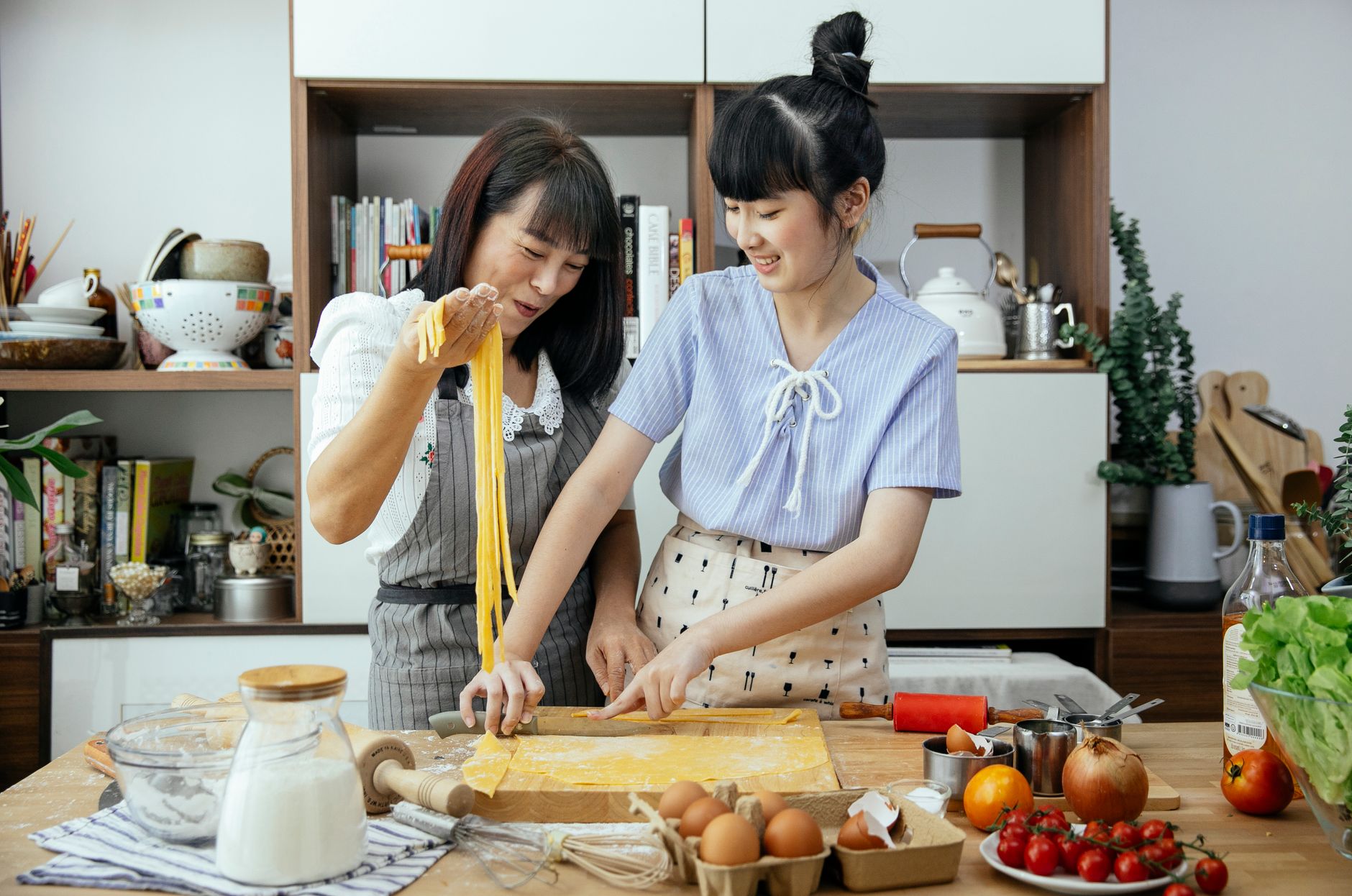
The rempah took an hour. She ground the ingredients in three stages: dried chilies and belacan first, then fresh turmeric and galangal and blue ginger, then the shallots and garlic last. Everything went through the mortar, not a blender. When I asked why, she made a face that suggested the question itself was a sign of my limitations. “The blender heats it,” she said. “The heat changes the taste before it even hits the pan. You don’t want the transformation to happen early.”
There’s a specific smell that fills a Peranakan kitchen when the rempah hits hot oil, and it’s not the same as laksa paste from a jar. The belacan—fermented shrimp paste that most commercial kitchens now buy pre-toasted—releases a funk that is almost challenging at first, then softens into something deeper. She fried the paste for nearly twenty minutes, stirring constantly, until the oil began to separate from the solids and pool at the edges of the pan. This was the moment, she said, when the paste was alive. “If you don’t wait for the oil, the paste sits in the broth like a guest who hasn’t been introduced. It doesn’t belong.”
The broth was assembled in a separate pot. The thin coconut milk went in first, then the fried rempah, then a stock she had made from the crab shells and dried shrimp. She let it simmer for exactly as long as it took to peel a bowl of prawns—maybe twelve minutes—and no longer. “Overcook the thin milk and it breaks,” she said. “You can’t fix it.”
The noodles were not the thick yellow ones I’d expected. She used laksa noodles—coarse, translucent, made from rice flour—but she did something I hadn’t seen before: she blanched them in boiling water for exactly forty-five seconds, then shocked them in cold water immediately. “They keep their bite,” she said. “Soggy noodles mean the cook doesn’t respect the starch.”
When the bowl was assembled, she ladled the broth over the noodles and then, off the heat, stirred in the thick coconut milk. The effect was immediate: the broth turned opaque, the color shifted from a clear red to a creamy orange, and the fragrance thickened. She added a dollop of the remaining thick milk on top, a gesture that seemed almost ceremonial. Then she handed me the bowl and walked out of the kitchen.
Eating it was a different experience from eating laksa in a restaurant, because the temperature was doing something I couldn’t quite map. The broth was hot but not scalding, the noodles were cool from the rinse, and the thick coconut milk on top was practically room temperature. The contrast created a sequence of sensations rather than a single uniform heat. Each spoonful delivered the spice first, then the seafood, then the cool starch, then the fat. It was like a dish that moved through time instead of presenting itself all at once.
I asked Kok Beng later, as he was packing the car to return to Kuala Lumpur, whether his mother had ever considered writing the recipe down. He laughed. “She says the recipe lives in the mortar. You can’t write down how hard to press, or how long to wait for the oil to come out. That’s not a measurement. It’s something else.”
That’s the part that most food writing misses about Nyonya cooking, and about Malacca’s Peranakan kitchens generally. The assumption is that the secret is in the ingredient list—that if you could just get the proportions right, you could reproduce the dish anywhere. But Madam Lim’s laksa wasn’t a matter of proportions. It was a matter of sequence and temperature and timing, none of which can be captured in a recipe card. The thick coconut milk at the end. The two-stage grinding. The cold-water rinse. The twelve-minute simmer. These are not ingredients. They are decisions.
The rain had stopped by the time I left. The shophouse was dark except for a single light in the kitchen. Aiko was closing her batik shop and waved as I passed. “She let you in?” she said, surprised. I nodded. “Then you ate well tonight.”
The next morning, I went back to the market, bought blue ginger and fresh turmeric, and spent an hour trying to replicate the rempah in my hotel room using a mortar I’d borrowed from the front desk. The paste was grainy, the oil never separated, and I gave up after forty minutes. I ate noodles boiled plain with soy sauce for dinner. It was a bad meal, but it was honest about what I’d failed to learn.
📷 Photos: Katerina Holmes (Pexels), Katerina Holmes (Pexels)