The Shift That Happens After Midnight in Hanoi
The Shift That Happens After Midnight in Hanoi
The last of the day-trippers peel away from the Old Quarter around eleven, sometimes later on weekends, when the beer corners stay crowded past midnight and the backpacker strip on Ta Hien still hums with cheap glasses of bia hoi. But by one in the morning, the city begins to sound different. The motorbike horns thin out. The sidewalks, which during the day function as a kind of organized chaos of parked scooters, plastic stools, and street vendors, become emptier. And that is when a second Hanoi emerges — one most visitors never see, because they are asleep or heading back to their hotels.
The street-food guides tend to mention pho as a breakfast food, and they are not wrong. Families eat it before work. Students grab bowls between classes. But the pho at four in the morning, served under a single fluorescent bulb on a folding table, belongs to a different economy entirely. It is not for tourists. It is for the night-market workers who have just finished hauling stock, the taxi drivers who operate the city’s night shift, the fruit sellers who set up at the wholesale market before dawn. A bowl at that hour costs about the same as a midday bowl — forty to sixty thousand dong, roughly two to two-fifty — but it tastes different, not because the recipe changes but because the context does.
The workers do not linger. They eat quickly, heads down, steam rising into the cool air. A bowl of pho bo, beef pho, arrives with broth that has been simmering since the previous afternoon, bones and charred onion and star anise having given everything they had over twelve hours. The noodles are fresh, flat, soft. The beef is sliced thin and cooks in the residual heat of the broth. No one takes a photo. No one asks for the recipe. The transaction is simple: eat, pay, leave.
Corner of Hang Ma and Nguyen Sieu, After Midnight
Hanoi’s night market runs along Hang Dao Street from Friday to Sunday evening, drawing crowds that swell into the thousands. But the real action happens after the stalls close, around midnight, when the vendors begin packing unsold goods into bags and loading them onto motorbikes and small trucks. Some of them head straight to the noodle stalls tucked into alleyways off Hang Ma Street, where the lights are dimmer and the clientele is exclusively people who have just finished a shift.
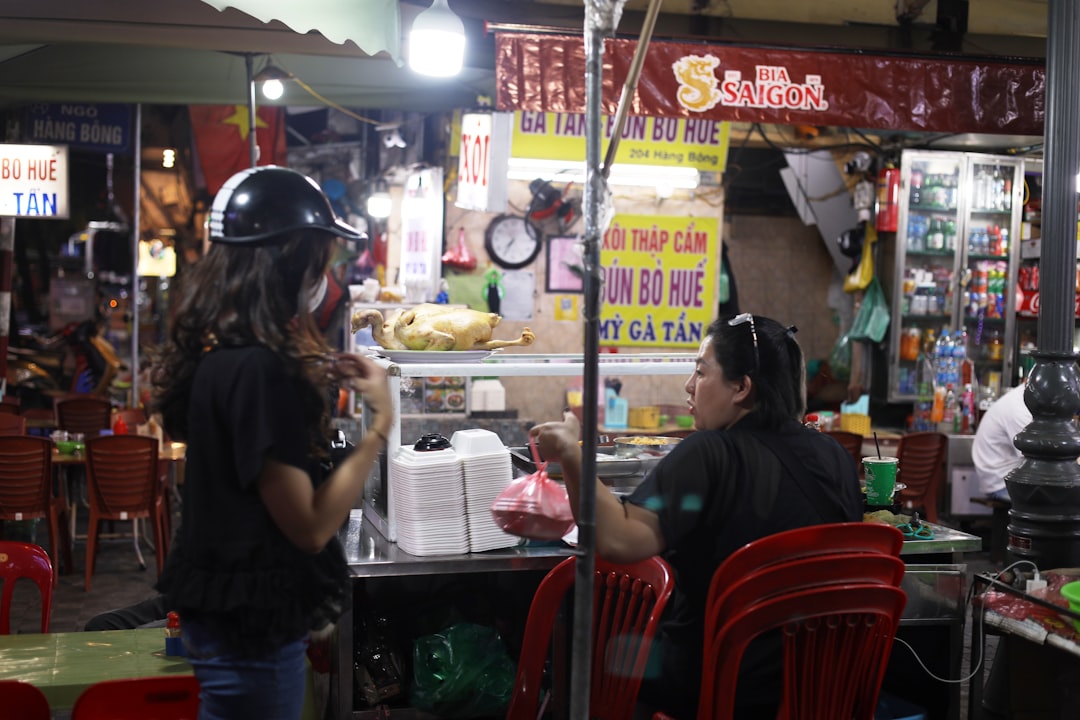
One such stall operates from a narrow doorway at the corner of Hang Ma and Nguyen Sieu. There is no sign — just a plastic board propped against the wall listing pho and bun cha and a pot of broth visible through the entrance. A woman in her fifties, who has been running this spot for twenty-two years, ladles broth into bowls with the efficiency of someone who has done it tens of thousands of times. She does not advertise. She does not need to. Her customers find her by habit.
The night-market workers arrive in waves. The first wave comes just after midnight, mostly younger vendors carrying empty cash boxes and tired eyes. They order extra noodles and extra chili. The second wave comes closer to three in the morning, when the wholesale fruit sellers from the Long Bien market finish their buying and need something warm before the morning rush. By four, the third wave — taxi drivers, security guards, hospital staff coming off night shifts — fills the stools again. The stall owner knows most of them by face if not by name.
The Broth at 4 a.m. Is a Different Thing
A bowl of pho at a reputable daytime restaurant in Hanoi is a carefully calibrated thing — the broth clear, the beef arranged in a neat fan, the herbs presented on a separate plate. At 4 a.m., the presentation relaxes. The broth might be cloudier from having sat longer. The beef might be added less deliberately. But the flavor, if anything, concentrates. The bones have given more. The spices have had more time to marry. The stall owner is not trying to impress anyone; she is trying to feed people who need to eat and move on.
The difference registers most clearly in the aroma. A bowl that has been simmering since the afternoon carries a deeper, almost caramelized note from the onions and ginger that have been charring at the bottom of the pot for hours. The fish sauce, added in small increments throughout the day, has integrated rather than sat on top. The chili oil, made fresh each evening in a small wok behind the stall, is still fragrant — not just spicy but aromatic, with the scent of frying garlic still clinging to it.
A first-time visitor who stumbles onto this scene might feel like an intruder. The workers glance up, register the unfamiliar face, and return to their bowls. No one is hostile, but no one is solicitous either. The stall owner will serve anyone who orders, but the menu is not explained. The prices are not listed. The assumption is that the customer already knows what they want and how much it costs. A foreigner who hesitates too long will be met with the patient but firm expectation of a decision.
The Price of Not Knowing
A photographer named Yusuf, who had been documenting Hanoi’s street life for a month, made the mistake of ordering without specifying the type of beef. The stall owner asked him something in Vietnamese twice; he did not understand either time. She served him a bowl with tendon and tripe, which he ate anyway, because sending it back was not an option. The texture was chewy and unfamiliar, and he finished the bowl only out of politeness. Later, a taxi driver at the next table explained through broken English that the owner had asked whether he wanted rare beef or well-done. Yusuf had missed both chances to clarify. The lesson, he later said, was not about the tendon — it was about paying attention when the person serving you is trying to communicate something specific.
The cost of that bowl was fifty thousand dong, the same as any other. The cost of the misunderstanding was a meal that did not match what he had wanted, which is a small price for a lesson that stuck.
Long Bien Market, Foot of the Bridge
The late-night pho stalls are not evenly distributed. They cluster in areas where night workers pass: near the Long Bien market, along the train tracks that cut through the Old Quarter, in the alleyways around the main hospital on Tran Hung Dao Street. A few operate from permanent storefronts. Most are mobile — a cart, a pot, a stack of plastic bowls, a single gas burner — set up on a sidewalk that during the day belongs to someone else entirely.
The stall near the entrance to Long Bien market, at the foot of the bridge, is one of the most consistent. It opens at midnight and closes at six in the morning, serving a stream of market workers who come carrying bags of dragon fruit, durian, and longan. The broth here is beef-based but includes pork bones for extra body, a blend that some pho purists frown upon but that the market workers prefer for its richness. The stall has no chairs — customers stand at a waist-high counter or eat perched on the back of their motorbikes. A bowl costs forty-five thousand dong, five thousand less than the Old Quarter average, because the owner, a former market worker herself, keeps prices low for people she considers colleagues.
Further south, on Pho Hue, a stall that has operated for thirty years attracts a different crowd: night-shift nurses, security guards, and the occasional musician leaving a late gig. The stall opens at 3 a.m., not earlier, because the owner says the broth needs the full fifteen hours to be ready. She is known for her garlic vinegar, which she ferments herself and serves on the side in a small bowl. Regulars add it generously. Newcomers who try it without warning find their sinuses clearing instantly.
The Friction of Eating Where You Are Not Expected
Not every late-night bowl is a romantic encounter with local culture. Some are difficult. The language barrier is real. The seating, if it exists, is hard plastic and low to the ground, designed for smaller frames. The lighting is harsh — a bare bulb that casts the scene in a flat, unflattering yellow. The noise from passing motorbikes, which never fully stop in Hanoi, makes conversation impossible. And the food, for all its depth, is served in a bowl that has been washed in a bucket of cold water and dried with a rag that has seen better days.
A visitor who expects a sanitized version of street food — the kind served at cooking classes or featured in glossy magazine spreads — will find the reality jarring. The broth might have a fleck of char from the pot. The chopsticks might be mismatched. The stall owner might not smile. These are not flaws from the perspective of the regulars, who value speed and consistency over presentation. But they can feel like rejections to someone who has not internalized how the system works.
The friction is not something that resolves neatly. A traveler named Renata, a graphic designer from São Paulo who spent three weeks in Vietnam, ate at a late-night stall on Hang Bo Street four times during her stay. She never felt welcomed, exactly. But by her fourth visit, the stall owner remembered her order — pho tai, rare beef, extra herbs — and served it without her having to say a word. That was the closest thing to belonging that the experience offered: not warmth, but recognition.
The Shift Back to Morning
As five o’clock approaches, the character of the streets changes again. The night-market workers have mostly gone home. The taxi drivers are finishing their last fares. The fruit sellers have completed their buying and are heading to their stalls across the city. A new wave of people begins to appear: construction workers, bakery assistants, the first office cleaners. The pho stalls that have been running all night begin to wind down. Some close. Others stay open, transitioning smoothly into the breakfast trade.
The stall at the corner of Hang Ma and Nguyen Sieu closes at six. The owner pours the remaining broth into a large thermos, packs the noodles into a plastic bag, and wheels her cart into the doorway where she stores it during the day. By seven, the sidewalk belongs to a different vendor — a woman selling bánh mì from a glass case, who has no connection to the pho stall and does not know who runs it. The two businesses never overlap. The street does not register the transition as significant.
For someone who has been awake since midnight, watching that transition feels like watching the city change clothes. The sounds shift. The light shifts. The smell of beef broth gives way to the smell of fresh bread and grilled pork. By six thirty, the night seems like a different city entirely — one that existed only for those who were there, and that will not be back until the next night falls.
The specific details — the price of a bowl, the name of a street, the expression on a stall owner’s face — start to blur. But the feeling of being there at that hour, eating something that was never meant for them, sits somewhere in the memory, stubborn and unglamorous, waiting to be recalled the next time someone asks what Hanoi was really like.
📷 Photos: Sebastian Zuchmański (Unsplash), Zero (Unsplash)