One Click, One Click Less: The Key Turns in a Kamakura Parking Lot
The key turns in your hand with a satisfying click, and suddenly the entire metropolis of Tokyo is a rearview-memory, shrinking as you merge onto the Tomei Expressway. There’s a particular kind of freedom that hits you when the last skyscraper blinks out of sight and the highway opens up toward the coast — your home for the next fortnight is now the van humming beneath you, and everything you need is within arm’s reach behind the driver’s seat. The first real stop waits just south: Kamakura, that ancient capital where temples cluster among hillsides and the sea air carries the faint ring of temple bells. You’ll navigate off the expressway at the Fujisawa interchange, the road narrowing as it turns into the tree-lined approach to the city, and park your van near the base of the path leading up to the Great Buddha. The bronze figure sits in the open air, fifteen meters of quiet contemplation, his hands arranged in the gesture of meditation as if he’s been watching a thousand years of travelers come and go. From here, Hase Temple is a short walk up a sloping lane lined with hydrangea bushes — luckily you’re not here in peak bloom season, so the crowds are manageable — and the terrace offers your first real view of the coastline, the Pacific stretching out in a sheet of grey-blue. The light is already changing by the time you head back to the van, the afternoon sun casting long shadows across the temple grounds, and you make the short coastal drive to Enoshima. Your first night’s camp, Enoshima Campsite in Fujisawa, is perched near the shore, and you’ll park on a gravel pad with the sound of waves as your soundtrack. The campsite is basic but functional — flat ground, a shared toilet block, and a tap for water — and you’ll quickly learn the first rule of campervanning in Japan: if your van doesn’t have a shower (and most rental vans here don’t), you plan your evenings around an onsen visit. Fujisawa has a public bathhouse just a ten-minute walk from the campsite, and the ritual of soaking in the hot water after a day of driving, sitting on a low stool scrubbing the travel dust from your skin, becomes the grounding rhythm of your evenings from here on out. Dinner is simple: soba noodles you boiled on the van’s single-burner stove, dressed with soy and a dash of the sesame oil you picked up at a convenience store near the rental depot, eaten cross-legged on the floor of the van as the sun sets pink over the Pacific.
Morning comes early on the coast, light filtering through the van’s curtains as the first fishing boats head out from Fujisawa harbor. You’ll break camp quickly — the routine becomes second nature by day two — and point the van west on Route 134, the road hugging the shoreline before turning inland through the foothills of Mount Fuji. The mountain appears gradually, a pale grey shape through the morning haze, then sharpens into focus as you climb toward Lake Kawaguchi. The Chureito Pagoda is your first stop, a five-story structure perched on a hill above the lake, and you’ll climb the hundreds of steps with a knot of other early risers, everyone silent except for their breathing. The view from the top is the one you’ve seen in photographs, but the real thing has dimensions no image can capture — the pagoda’s vermillion pillars against the blue-grey sky, Mount Fuji rising behind it in perfect symmetry, the air so clear you can see the snow cap’s fine crevasses. You spend half an hour here, just sitting on a bench, breathing, before the tour buses start arriving. The drive around the lakes is where the van truly earns its keep. You can pull over whenever the view demands it — and it demands it often — at Lake Kawaguchi’s north shore, at the narrows between Lake Yamanaka and Lake Saiko, at any of the unmarked turnouts where the mountain reflects in the water. Near Lake Yamanaka, you’ll find Oshino Hakkai, a set of eight spring-fed ponds fed by snowmelt from Fuji, their water so clear you can count the pebbles at the bottom. A short walking path connects the ponds, passing through a small village where farmers sell wasabi root and pickled vegetables, and you can fill your water bottle at one of the springs — it’s some of the sweetest water you’ll ever taste, cold and mineral-clean. Tonight you’re at Lake Yamanaka Auto Camping Ground, one of the better-equipped campsites in the area, with proper shower facilities (a luxury you won’t take for granted), a small shop selling firewood and basic provisions, and pitches that face directly toward the mountain. You cook a proper meal tonight — local pork from a butchers you found near Kawaguchi station, grilled over a small portable barbecue, served with rice and a simple cucumber salad dressed with rice vinegar and salt. As darkness falls, the temperature drops sharply, and you zip yourself into your sleeping bag watching the silhouette of Fuji against a star-strewn sky. The mountain’s presence so vast it feels like you’re sleeping under its protection.
Day three takes you into the Izu Peninsula, and the road changes character entirely. The Izu Skyline is a winding ribbon of asphalt that cuts through the highlands, offering views of the Pacific on one side and the mountainous interior on the other, the road rising and falling through forested ridges. You’ll take it slow here — the curves demand attention, and the scenery demands distraction, and the two impulses need to be balanced carefully. The Jogasaki Coast is your first destination, a stretch of rugged shoreline where volcanic rock meets the sea in dramatic cliffs and sea caves. A walking trail runs along the edge of the cliffs, taking you past tide pools and through a tunnel carved into the rock that opens onto a viewpoint over the open ocean. The wind here is constant and strong, whipping your hair across your face as you watch the waves crash against the black basalt, and you feel the raw edge of Japan’s geography in a way you didn’t in the tame lake district. You drive west after lunch, descending through cedar forests toward Shuzenji Onsen, one of Izu’s most famous hot spring towns. The town itself is compact and walkable, centered around a bamboo grove that rustles in the breeze as you wander the narrow streets. The onsen here are the draw, and you’ll choose a public bathhouse for your evening soak — the indoor pool is too hot to enter slowly, so you lower yourself inch by inch, letting the heat climb up your body until you’re submerged to the chin, the steam carrying the faint mineral scent of sulfur. The campsite for tonight, Shuzenji Onsen RV Park, is a small operation run by an elderly couple who wave you in and show you to your spot — a gravel pad under a persimmon tree, the fruit hanging heavy and orange above the van. There’s a cooking shelter with a sink and a gas burner, and you make use of it for a dinner of udon noodles with a broth you’ve fortified with soy and a splash of mirin, adding sliced green onions and a soft-boiled egg. The night air in Shuzenji is thick with the sound of cicadas and the trickle of the river that runs through town, and you sleep with the van’s windows open, the cool breeze carrying the smell of damp earth and bamboo.
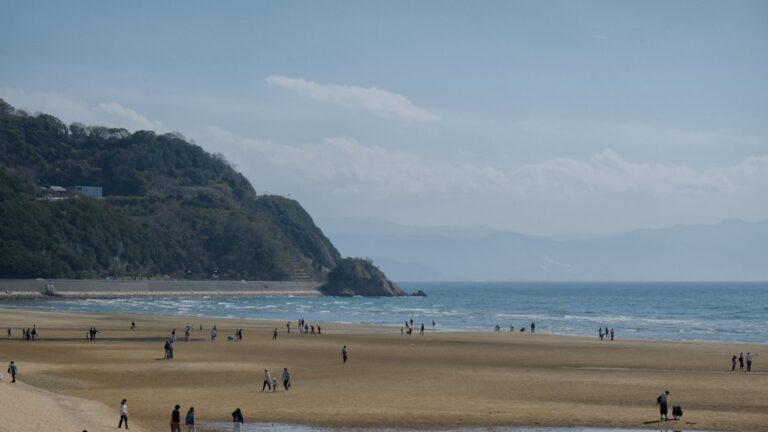
By day four you’re at the southern tip of the peninsula, and the landscape becomes more dramatic with every kilometer. The road down to Irozaki Cape is narrow and winding, the edges lined with camellia bushes that bloom white and pink in patches, and the ocean appears and disappears through gaps in the vegetation. The cape itself is a blunt finger of land pointing south into the Pacific, and a loop trail takes you around its perimeter, past a lighthouse and down to sea-level viewpoints where the water crashes into the rocks with a sound like thunder. The trail is rocky and uneven, and you’ll pick your way carefully, the salt spray cooling your face as you stand at the very tip, feeling like you’ve reached the edge of something. From Izu, you drive west across the base of the peninsula toward the coast of Suruga Bay, your eye scanning the horizon for Mount Fuji, which appears again as you approach Miho no Matsubara. This is one of the classic Fuji viewpoints — a pine grove that lines a long beach, with the mountain rising behind it in a composition so perfect it looks designed. You walk along the sand, the pine needles soft underfoot, watching the sun move across the mountain’s face, the shadows shifting and deepening as the afternoon passes. The drive into Shizuoka city is short, and you arrive at Shizuoka Marina Campground as the light begins to soften into evening. The marina is quiet tonight, just a handful of other campervans and a few local boats bobbing at their moorings, and you cook a dinner of grilled fish — mackerel you bought from a fishmonger near the Irozaki lighthouse that morning, its flesh still firm and glossy — seasoned simply with salt and grilled over your portable stove until the skin crisps and blisters. The onsen tonight is a large public bath near the marina, the kind where old men sit on the edge of the pool talking politics and a television murmurs in the corner, and you soak until your fingers wrinkle and your muscles unknot from four days of driving.
Day five is a long driving day, but the kind of long that feels purposeful rather than punishing. You leave Shizuoka early, heading east on the Tomei before turning south on Route 42, the road tracking the coastline of the Kii Peninsula through a succession of small fishing towns and industrial ports. The landscape changes subtly every half hour — pine forests give way to rice paddies, which give way to rocky shores where the waves break white against dark cliffs — and you find yourself slowing down even where the speed limit permits speed, wanting to absorb it all. By midday you’ve crossed into Mie Prefecture and entered Ise-Shima National Park, a region defined by its jagged coastline, its pearl farms, and the presence of Japan’s most sacred Shinto shrine. Ise Jingu is actually two shrines — the Inner Shrine, Naiku, dedicated to the sun goddess Amaterasu, and the Outer Shrine, Geku, dedicated to the goddess of food and clothing — and you choose to visit Naiku first. The approach is a long walk through a forest of ancient cryptomeria trees, their trunks straight and tall, the ground carpeted with needles that muffle your footsteps. The shrine itself is a simple wooden structure, rebuilt every twenty years in a ceremony called Shikinen Sengu, and its plainness is its power — no gold leaf, no elaborate carvings, just clean lines and white gravel and the absolute stillness of a place that has been sacred for two thousand years. You walk the circuit, watching the other visitors — a group of schoolchildren in uniform, an elderly woman in a kimono, a young couple in matching yukata — and you feel the weight of continuity, the sense that people have been making this journey for centuries before you, and will be making it centuries after you’re gone. The afternoon takes you to Ago Bay, where the rafts of pearl oysters float on the water in neat rows, and you eat your lunch at a small restaurant overlooking the bay: grilled oysters, served on the half-shell with a squeeze of lemon, their juices running down your chin as you eat standing at the counter. Tonight you’re at Ise-Shima Campsite near Toba, a well-maintained facility with clean washrooms, a coin laundry, and a covered cooking area where you make a final meal of this leg: leftover rice stir-fried with oyster mushrooms and the last of your sesame oil, a bottle of local sake you bought at a roadside stand, and a view of the dark water of the bay as the lights of Toba flicker on across the inlet. You sit on the step of the van, the sake warm in your belly, and watch the stars come out over the Kii Peninsula — five days behind you, nine ahead. The road already pulling at the edge of your thoughts. Tomorrow the coast continues south.