The 4 PM Slick: What Ha Long Bay’s Most Famous Cave Won’t Tell You
The 4 PM Slick: What Ha Long Bay’s Most Famous Cave Won’t Tell You
The concrete steps at Sung Sot Cave—Surprise Cave in English—are not particularly steep. They are not particularly long. But at 4 PM on a Tuesday in late November, they become something else entirely: a hazard dressed as infrastructure. A thin film of moisture, barely visible under the dim cave lighting, turns each tread into a surface that grips rubber-soled shoes about as well as ice grips a tire. The Vietnamese tour guides in their matching blue polo shirts have learned to slow their pace here, one hand on the railing, a practiced shuffle that suggests they’ve seen a few guests make unscheduled contact with the stone.
The moisture isn’t a quirk. It’s a function of physics and timing—two things that become immediately relevant to anyone visiting Ha Long Bay, where the experience of the cave depends less on geology and more on when exactly a person chooses to arrive. “At 8 AM, the steps are dry enough to run down,” says Tran Minh, a boat captain who has been running tours in the bay for 12 years. “By 2 PM, you have to pay attention. By 4 PM, you are buying new pants for your child.” He laughs when he says it, but he’s not wrong.
The Bay That Runs on a Schedule
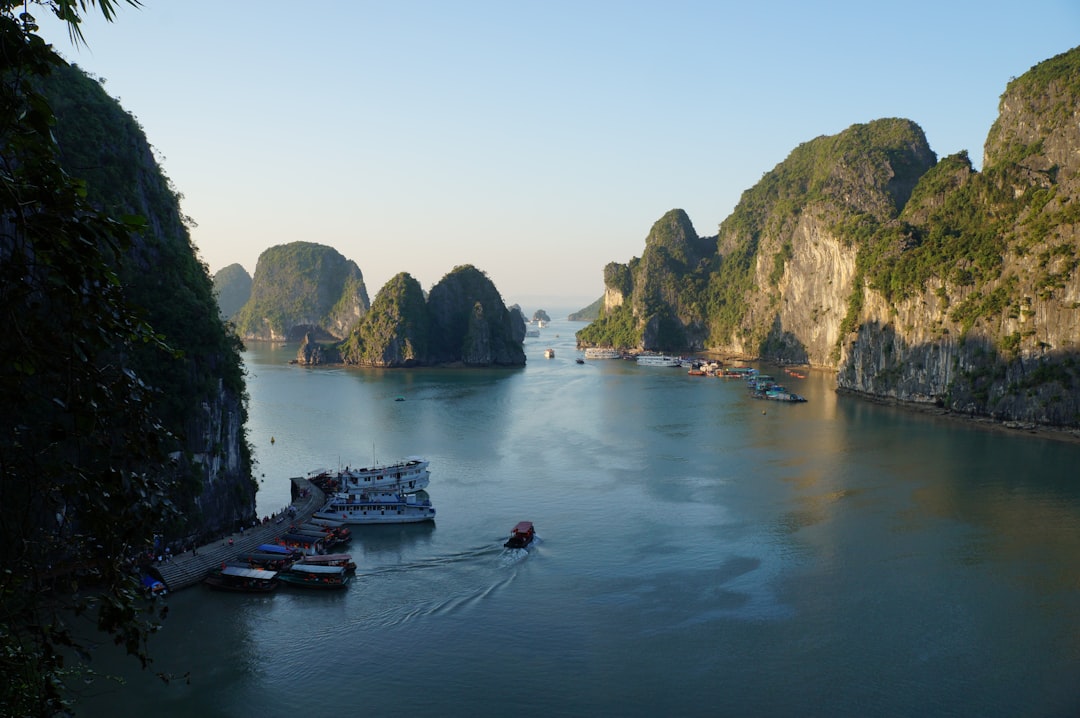
Ha Long Bay operates on a rhythm that most guidebooks mention in passing but rarely explain. The junks and day boats leave from Bai Chay Harbor in waves. The first wave, around 8 AM, carries the independent travelers and the smaller groups. The second wave, between 10 AM and noon, carries the cruise ships’ excursion passengers and the packaged tours from Hanoi. The third wave, around 1 PM, is mostly stragglers and late departures. Sung Sot Cave, the largest and most visited cave in the bay, sees the consequences of this scheduling in real time.
The cave itself isn’t small. Entered via a steep flight of stairs from a floating dock—44 steps, if counting matters—it opens into a series of chambers that the local tourism board describes as “magnificent” and that geologists would describe as a karst solution cave formed over millions of years. The first chamber is the size of a small cathedral, with stalactites that hang like frozen waterfalls. The second chamber is wider still, with a natural skylight that lets in a column of greenish light around midday. The concrete paths and handrails, installed sometime in the early 2000s, make it accessible to most fitness levels.
But accessible doesn’t mean predictable. The cave maintains a constant temperature of roughly 24°C year-round, while the bay outside swings from a humid 30°C in the afternoon to a damp 18°C in the early morning. That temperature differential, combined with the cave’s natural humidity—hovering around 90% most days—produces condensation on every non-porous surface. The concrete stairs, poured decades ago and worn smooth by millions of feet, are the most vulnerable surfaces in the cave. They absorb the moisture not from rain or groundwater but from the air itself, and they release it slowly, creating a slick that appears and disappears on its own schedule.
The 8 AM Window
At 8 AM, the cave is empty. A group of four or five early risers might be the only visitors in the first chamber, their footsteps echoing against the limestone. The concrete steps are cool to the touch and dry enough that a person can walk down them without thinking about foot placement. The condensation hasn’t had time to form yet—the cave walls and the outside air are still close enough in temperature that no moisture settles. The light from the skylight is weak, a diffuse gray-blue, but it’s enough to see the shapes of the formations without the need for the electric lights that the tour companies switch on as their groups approach.
The morning visitors tend to be the ones who paid for the overnight junk trips, the kind that anchor in the bay and serve breakfast at 6:30 AM. They arrive at the cave’s floating dock in small tenders, not the large wooden junks that ferry the day-trippers, and they have the cave to themselves for roughly 45 minutes before the first day boats arrive. “The difference between 8 AM and 10 AM is not just about people,” says a kayak guide who works for one of the smaller tour operators in Cat Ba Town, asking not to be named because she isn’t authorized to speak to press. “It’s about the feeling of the cave. At 8, it’s a quiet place. At 10, it’s a performance.”
The performance includes the inevitable bottleneck at the second chamber’s exit, where the path narrows to a single-file passage. At 8 AM, a person can stand in that passage for five minutes without seeing another soul. At 10:30 AM, the wait can stretch to 15 minutes, with groups pressing in from both sides, cameras held aloft, the air warm with body heat and recycled humidity. The condensation on the steps begins to form around 9:30 AM, faint at first—a surface sheen that looks like a fresh wax—and becomes treacherously slick by 10 AM. The tour guides start their practiced shuffle around that time, and the first “oops” of the day echoes off the walls.
The 4 PM Reality
By 4 PM, the cave has been absorbing moisture for roughly seven hours. The concrete steps are uniformly wet, not from any leak or seepage but from the cumulative condensation of hundreds of visitors breathing, sweating, and walking through the humid air. The temperature inside the cave hasn’t changed—still 24°C—but the temperature outside has dropped as the afternoon sun disappears behind the limestone karsts. The differential is now at its maximum, and the condensation is at its thickest.
This is when accidents happen. A woman in sandals—not the sensible rubber kind, but the flat woven leather kind that cost $30 at a market in Hoi An—slips on the first step of the second chamber’s descent. She catches herself on the railing, but her phone goes airborne, clattering down four steps before landing face-down in a puddle. The screen cracks. The tour guide sighs, not unkindly, and hands her a tissue from his pocket. The phone is dead by the time she retrieves it. The cost of the phone is irrelevant; the cost of the photos she’ll lose is something else entirely.
That specific incident happened on a Tuesday in November, and it’s not unusual. A representative from the Ha Long Bay Management Board, reached by phone but declining to give a name for attribution, confirms that the cave’s maintenance team logs between 15 and 25 slip-and-fall incidents per month during the peak season, roughly half of them occurring between 2 PM and 5 PM. “We have put down rubber mats in the steepest sections,” the representative says. “But the steps themselves—we cannot change the material. The moisture is a natural process.”
The rubber mats exist on roughly 30% of the stair sections, specifically the ones with the sharpest angles. The remaining 70% are bare concrete, polished by decades of foot traffic to a surface that looks smooth but feels like glass when wet. The management board has considered applying a textured coating, but the coating wears off within six months, and the process of reapplying it would require closing the cave for a week during high season—a financial impossibility for a site that sees roughly 2.5 million visitors per year.
The Practical Cost of Bad Timing
The choice between an 8 AM visit and a 4 PM visit isn’t just about safety. It’s about what a person actually sees and experiences. At 8 AM, the cave is quiet enough to hear the drip of water from a stalactite, the sound that gives the bay its name—Ha Long means “descending dragon,” and the drip sounds like the dragon’s tears hitting the stone. At 4 PM, the cave is loud enough that a person next to you has to raise their voice to be heard over the chatter of 200 other visitors.
The photos look different too. The morning light through the skylight is soft and diffuse, good for capturing the textures of the limestone without harsh shadows. The afternoon light is harsher, creating high-contrast images that wash out the formations’ details. The electric lights, which the guides switch on at full brightness for the afternoon crowds, flatten the scene further, making every stalactite look the same shade of amber-tinted gray.
A single entry ticket to the cave costs 120,000 Vietnamese dong—about $5 USD at current exchange rates—and is included in most junk tour packages. A bottle of water at the floating dock costs 20,000 dong. A pair of rubber-soled shoes from a street vendor in Hanoi costs about 150,000 dong. The price of a phone replacement, if the worst happens, is considerably higher.
The Hidden Variable
There is one factor that no guidebook and no tour operator will mention, because it’s not part of the official narrative. The concrete steps at Sung Sot Cave are not just wet from condensation. They are also wet from the cleaning crew, which hoses down the entire path system every morning at 6 AM, before the first visitors arrive. The water dries in most places by 8 AM, but the steps in the deepest chambers, where air circulation is poorest, remain damp for another hour. The condensation then takes over around 9:30 AM, meaning the steps are never truly dry between 6 AM and roughly 10 PM, when the last visitors leave.
A guide named Nguyen—he gives only his first name, and reluctantly—confirms this during a quiet moment between groups. “The cleaning is necessary,” he says, adjusting the brim of his blue cap. “People drop things. Food. Plastic. But the water—it stays. The cave does not breathe like outside.” He doesn’t apologize for the inconvenience. He simply states it as a fact, the way a fisherman states the tide schedule. The cave is wet. The steps are slick. The conditions are what they are.
The Workaround That Works
The visitors who have the best experience at Sung Sot Cave are usually the ones who arrive around 8:30 AM, after the cleaning crew has finished but before the condensation has fully formed. They have roughly 45 minutes of dry-ish steps and empty chambers before the first tour buses from Hanoi arrive around 9:15 AM. The alternative is to arrive around 3 PM, when the day-trippers are starting to leave but the condensation is at its worst—a trade-off that favors solitude over traction.
A pair of Australian travelers, encountered outside the cave’s exit around 11 AM, offer a different approach. They’d booked a private junk for the day, at a cost of roughly $200 per person, and had arranged with the captain to visit the cave at 7:30 AM, before the cleaning crew had even started. “The steps were wet from the hose,” one of them says, tightening the strap on his daypack. “But there was nobody else. We had the whole first chamber to ourselves for maybe 20 minutes.” He pauses, considering. “I’d take wet steps over crowds any day.”
The packing list for the cave is short. Shoes with rubber soles that grip, not sandals. A small towel for drying off after the humidity hits. A phone with a waterproof case or a sturdy screen protector. A headlamp, not a handheld torch, so both hands are free for the railing. The cave has electric lights, but they’re timed to the tour groups—off when no group is present, on when a group enters—and the gap between switch-offs can leave a solitary visitor in total darkness for long enough to make the headlamp worth its weight.
The concrete steps at Sung Sot Cave are neither the most beautiful part of Ha Long Bay nor the most dangerous. They are simply the part that teaches a lesson about timing, about the difference between seeing a place and experiencing it on its own terms. The cave doesn’t care what time a visitor arrives. It’s been dripping water for millions of years, and it will keep dripping water long after the last tourist has slipped, cursed, and limped back to the boat.
The moisture on the steps is not a flaw. It’s a feature of a system that operates on its own schedule, indifferent to human convenience. The question is not whether the steps are wet. The question is whether a visitor arrives with the right shoes, the right timing, and the willingness to shuffle rather than stride.
📷 Photos: LUCAS PRAXEDES (Unsplash), LUCAS PRAXEDES (Unsplash)