The first thing I noticed about Mount Bromo wasn’t the crater or the dawn light or the famous view across the Sea of Sand. It was the sulphur. That sharp, mineral burn hits you before you’re even close to the rim, carried on a breeze that feels colder than the thermometer suggests. I’d read about the sunrise crowds and the jeep convoys and the photographers jostling for position at the viewing platforms. What I hadn’t read anywhere was how much of the experience is shaped by what time you actually arrive — not just at the mountain, but at the whole region.
Most itineraries tell you to stay in Cemoro Lawang, the village perched right at the crater’s edge, and be out the door by 3 AM to beat the crowds to the viewpoint at Mount Penanjakan. I did the opposite. I stayed in a homestay in the lowlands near the village of Wonokitri, an hour’s drive from the national park entrance, and I left at first light instead of in the dark. The jeep driver I’d hired, a man named Pak Yusuf who’d been running trips for seventeen years, raised both eyebrows when I told him I wanted to go at 6 AM. “The buses come at 4,” he said. “Everyone goes at 4.” But he agreed, and the result was something I’d never seen in any of the photos: an empty Sea of Sand. No jeep tracks. No queues. The crater was silent except for the hiss of steam and the occasional clatter of a loose stone falling into the abyss. I stood there for forty minutes without seeing another person. The sulphur smell was still there, but it mixed with morning air in a way that felt less like an assault and more like the mountain breathing.
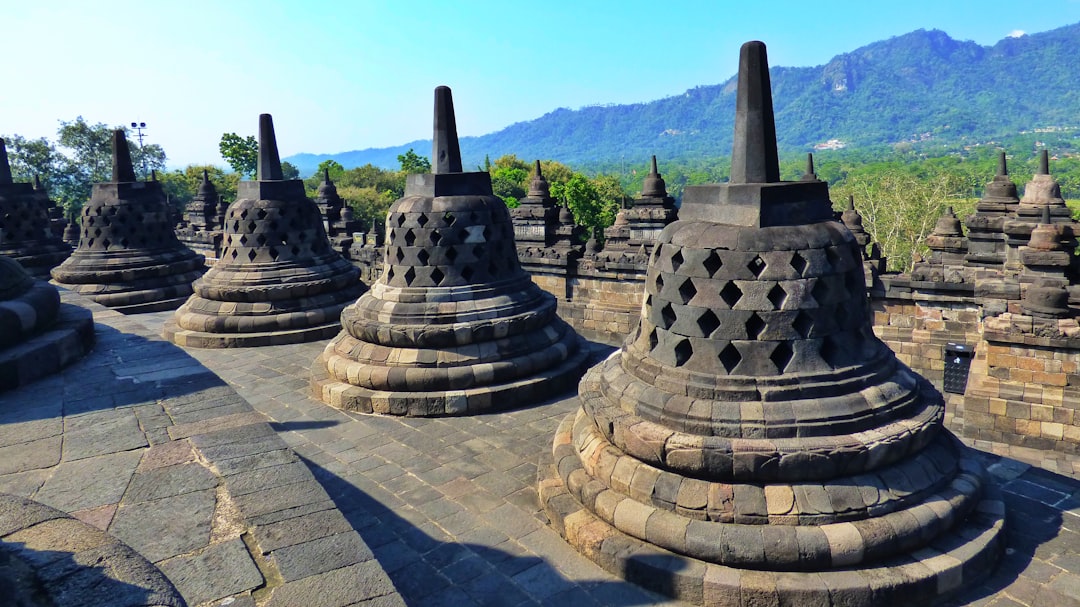
The temples of Central Java present a different kind of timing problem. Borobudur is the obvious one — everyone knows to go at sunrise, everyone gets the same photo of the stupas silhouetted against a pink sky. What fewer people account for is what happens in the hour before that. I arrived at the gate at 4:15 AM, bought the so-called “sunrise ticket” that costs about double the regular entry, and stood in a queue of roughly two hundred people all holding the same plan. The ticket includes a flashlight and a cup of tea. It does not include any system for managing two hundred flashlight-wielding visitors on a narrow stone staircase in the dark. We shuffled upward in a slow, patient line, the beams bobbing against the volcanic stone, and by the time I reached the top the sun was already above the horizon, hidden behind a thick bank of cloud that had rolled in from the Merapi direction. The sunrise was a non-event. What was interesting was what happened after: the cloud burned off by 7:30, the crowds thinned out, and for about an hour I had the upper terraces mostly to myself in the kind of soft, diffuse morning light that photographers actually want. The sunrise-at-Borobudur industry is built on a specific promise that the weather in Central Java doesn’t always deliver. The better bet is to arrive later and stay later.
Prambanan, the Hindu temple complex about forty minutes east of Borobudur, is usually described as the afternoon counterpart — go in the late afternoon, watch the sun set behind the main temples, take the classic shot of Candi Shiva Mahadeva in golden light. I did that on my second visit, and it was fine. But the first visit was more memorable, and it happened entirely by accident. I’d finished Borobudur earlier than expected, the driver suggested we swing by Prambanan on the way back to Yogyakarta, and we arrived at 11 AM on a Tuesday. The heat was punishing. The stone courtyard radiated warmth like a pizza oven. There was almost nobody there — a few Japanese tourists taking selfies in the shade of the main temple, a group of schoolchildren in matching uniforms sitting cross-legged on the grass while a teacher gestured at the relief carvings. I walked around the entire complex in ninety minutes, which is faster than most people take, but the speed was partly an effect of the heat and partly an effect of the space itself: Prambanan is compact, its temples arranged in a tight grid that you can read from any angle. The detail that surprised me was the sound. Between the temples, the wind moves through the carved stone niches in a way that creates a low, almost musical hum. Nobody mentions this in any guidebook I’ve seen. It’s not a feature that’s curated or explained — it’s just a consequence of how the stones are shaped and spaced, and it only becomes audible when there aren’t hundreds of people talking over it.
The volcano that everyone in Central Java talks about, though, isn’t Bromo. It’s Merapi, the active stratovolcano that looms over Yogyakarta. Local wisdom holds that if you want to understand Javanese cosmology — the relationship between the spiritual and the volcanic, the idea that mountains are both literal and metaphorical centers of power — you don’t go to Prambanan or Borobudur. You take a jeep tour to the Merapi lava fields, which sounds like a tourist trap and is, in some respects, exactly that. The jeeps are painted in bright colors, the drivers all have rehearsed jokes, and the trip includes a stop for coffee at a village that was rebuilt after the 2010 eruption. But the lava fields themselves are genuinely strange: a vast, black-smudged landscape of cooled volcanic rock, still warm in places if you press your hand to the ground, with new green shoots pushing up through the cracks. There are no temples here, no cultural heritage markers. It’s raw geology doing what raw geology does, and the Javanese response to it — to continue living on the slopes of a volcano that killed over three hundred people fourteen years ago — is something no guidebook can adequately light up. I asked our driver, a quiet man named Agung, why people stay. He shrugged. “The soil is good,” he said. “And the mountain is our ancestor.”
The logistics of moving between these places involve more friction than most published itineraries acknowledge. The common 10-day plan for Java looks neat on paper: arrive in Yogyakarta, day trip to Borobudur and Prambanan, train to Surabaya, jeep to Bromo, bus to Bali. What the neat version doesn’t tell you is that the train from Yogyakarta to Surabaya, while comfortable and punctual, takes about five hours, and the bus from Surabaya to Bromo takes another four, and the road up to Cemoro Lawang is a winding two-lane climb that will leave you nauseated if you’ve eaten anything in the previous three hours. I booked a private car for the Bromo leg, which cost roughly three times what the bus would have, and I don’t regret it. The bus would have saved money. The car let me stop at a roadside warung in the middle of nowhere — a tiny bamboo shack run by a woman who made mie goreng with an egg cracked directly onto the noodles, served on a banana leaf — that I never would have found otherwise. The food was simple and exactly what I needed, and the conversation, conducted in fragments of Indonesian and hand gestures, was about her son who was studying in Jakarta to become an engineer. She asked why I was traveling alone. I said I liked it that way. She laughed and said her husband would never let her travel alone. We both laughed, and I ate the noodles, and the car continued up the mountain.
One thing I realized late in the trip is that the best time to visit Prambanan is actually during the rainy season, not the dry season that everyone recommends. This sounds counterintuitive until you experience it. The dry season — April to October — brings clear skies and endless crowds. The rainy season, which runs roughly November to March, brings afternoon downpours that clear the place out by 2 PM. I was there in late February, and the pattern was reliable: bright morning, rain around 3 PM, clearing by 5. The ticket office doesn’t close during the rain, and the temples look different in wet stone — darker, more saturated, the carvings sharper against the grey sky. The rain also keeps the moss green on the temple steps, which is a small aesthetic detail but one that matters if you’re paying attention. I sat under the eaves of the Candi Lumbung for about twenty minutes during a downpour, waiting it out with a German couple who were on their honeymoon. They’d planned their whole trip around the dry season recommendation and had been surprised by the rain. I told them it was actually better this way. They looked skeptical. The rain stopped, we walked back toward the entrance through puddles reflecting the sky, and I think they saw what I meant.
The temples themselves are only half the story. The other half is what’s underneath them. Borobudur was built on a hill, not a flat plain, and the foundation consists of a natural rock formation that was carved and shaped before the first stone was laid. You can’t see this from the ground — you have to look at the site from above, or from a drone, or from the hillside across the valley. I climbed the hill opposite the complex one afternoon, a scrubby slope with a small Hindu shrine at the top, and the view from there revealed something the official viewpoint doesn’t show: the entire temple is slightly tilted, aligned not to the cardinal directions but to a specific volcanic peak to the east.
The official literature talks about the nine levels and the three realms of Buddhist cosmology. It doesn’t mention that the whole structure seems to lean toward the mountain, as if the mountain were the real center and the temple just a marker pointing toward it. I don’t know if this is intentional or a quirk of the original construction. But it changed how I understood the site.
The last volcano on the itinerary was Ijen, the sulfur-mining crater in East Java that is famous for its electric-blue flames at night. I’d seen the photos. Everyone has seen the photos. What the photos don’t capture is the sound — the low, continuous rumble of gas escaping from vents in the crater wall, which sounds less like a natural phenomenon and more like a machine running beneath the earth. The hike up is steep but short, about an hour and a half from the parking lot, and the descent into the crater is a scramble over loose rock in near-darkness. The miners work through the night, carrying baskets of sulfur lumps on bamboo poles, making the trip up and down multiple times per shift. One of them, a man named Haris who had been mining since he was nineteen, let me hold his basket for a moment. It weighed about sixty kilograms. He carried two of them per trip. “You get used to it, or something like that,” he said, but the way he said it — not boastfully, just stating a fact — made me believe him in a way that a documentary interview never would have. The blue flames were impressive, a deep chemical glow that no photograph seems to capture accurately. But the thing I remember most clearly is the sound of Haris’s footsteps on the rock as he walked away from me down the slope, the basket creaking, the gas still rumbling, the whole mountain humming like a power station.
Back in Yogyakarta, the last evening before the flight out, I ate at a small restaurant near the Taman Sari water palace that served gudeg — jackfruit cooked in coconut milk and palm sugar, a Javanese specialty that is sweet, savory, and completely unlike anything else in Indonesian cuisine. The owner, a woman who’d been running the place for thirty years, told me that the secret was not the ingredients but the cooking time: eight hours minimum, twelve if you have patience. I asked her how she knew when it was done. She tapped the side of the wok with a wooden spoon and listened to the sound. That was the answer. No timer, no thermometer. Just the sound of a thing telling you it’s ready.

📷 Photos: Tanmay Abhay Mahajan (Unsplash), dzguevara (Unsplash)