The driveway up from the main road is unlit, and the rental car’s high beams catch only the next ten metres of asphalt at a time. I had left the hotel in Yogyakarta at 4:15, which felt aggressive until two other cars appeared behind me at the first junction, their headlights tracing the same route through the dark. Nobody had told me that the local trick was not sunrise itself but the interval between first light and the lifting of the mist — a window that closes faster than most visitors realise.
At the eastern entrance, a security guard waved me toward a parking area already half-full. Not with tourists, I realised, but with staff and early vendors setting up small stalls near the ticket booth. A woman was arranging packets of instant coffee and plastic-wrapped pastries on a folding table, her movements practiced and unhurried. She nodded as I passed, as if to say you’re not early, you’re just on time.
The path from the gate to the main temple platform is a gradual incline through manicured gardens, and in the dark it’s easy to misjudge the distance. I counted my steps at one point, not out of any practical need but because the quiet made counting feel natural — the shuffle of sandals on stone, the distant hum of a generator from somewhere behind the ticket office, the occasional cough of another visitor ahead. The air was cool enough that I’d zipped my jacket to the collar, but the humidity was already present, a weight in the lungs that would only thicken as the sun rose.
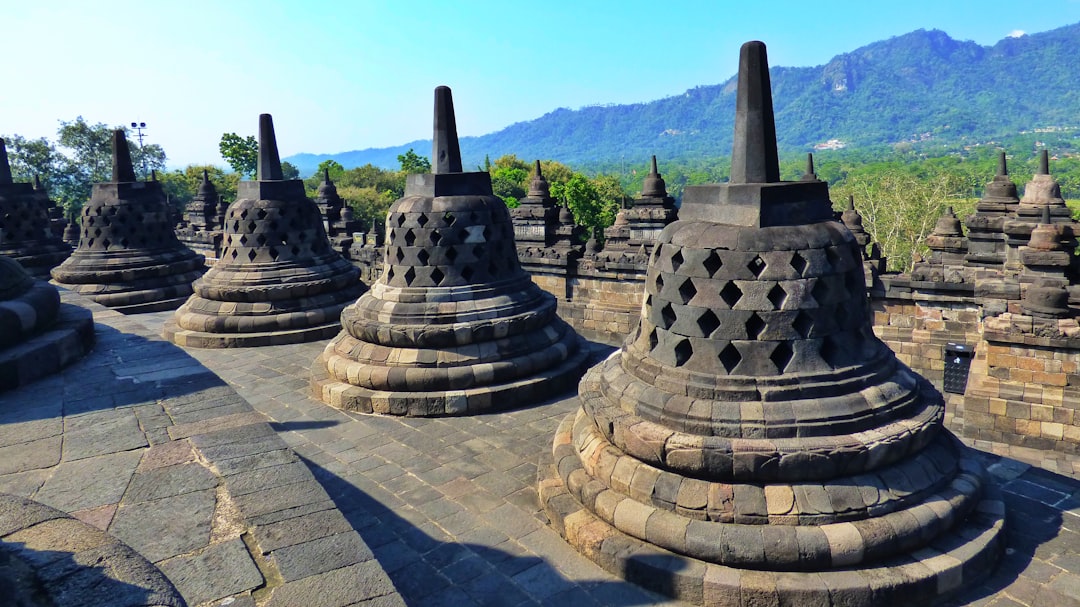
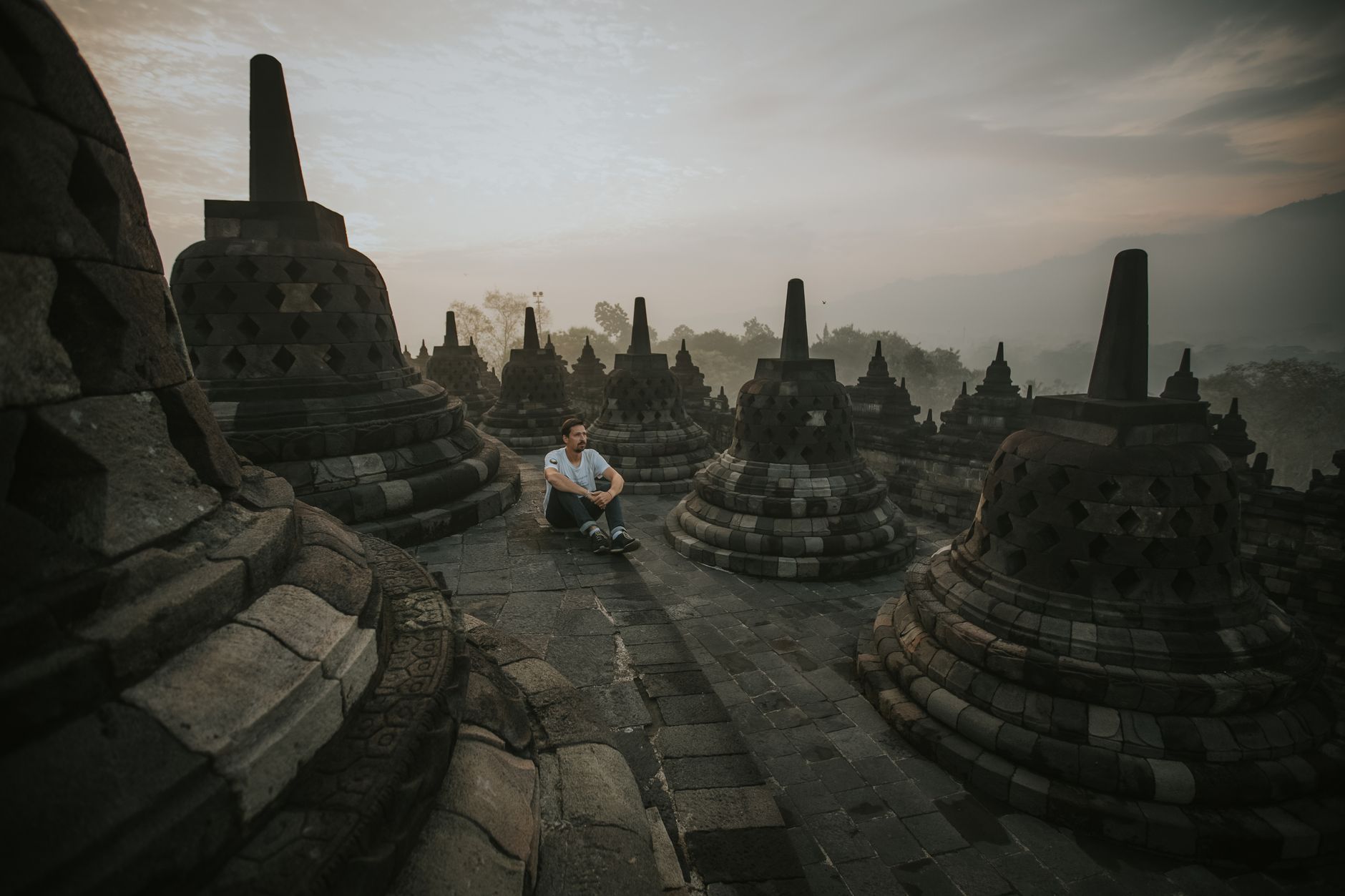
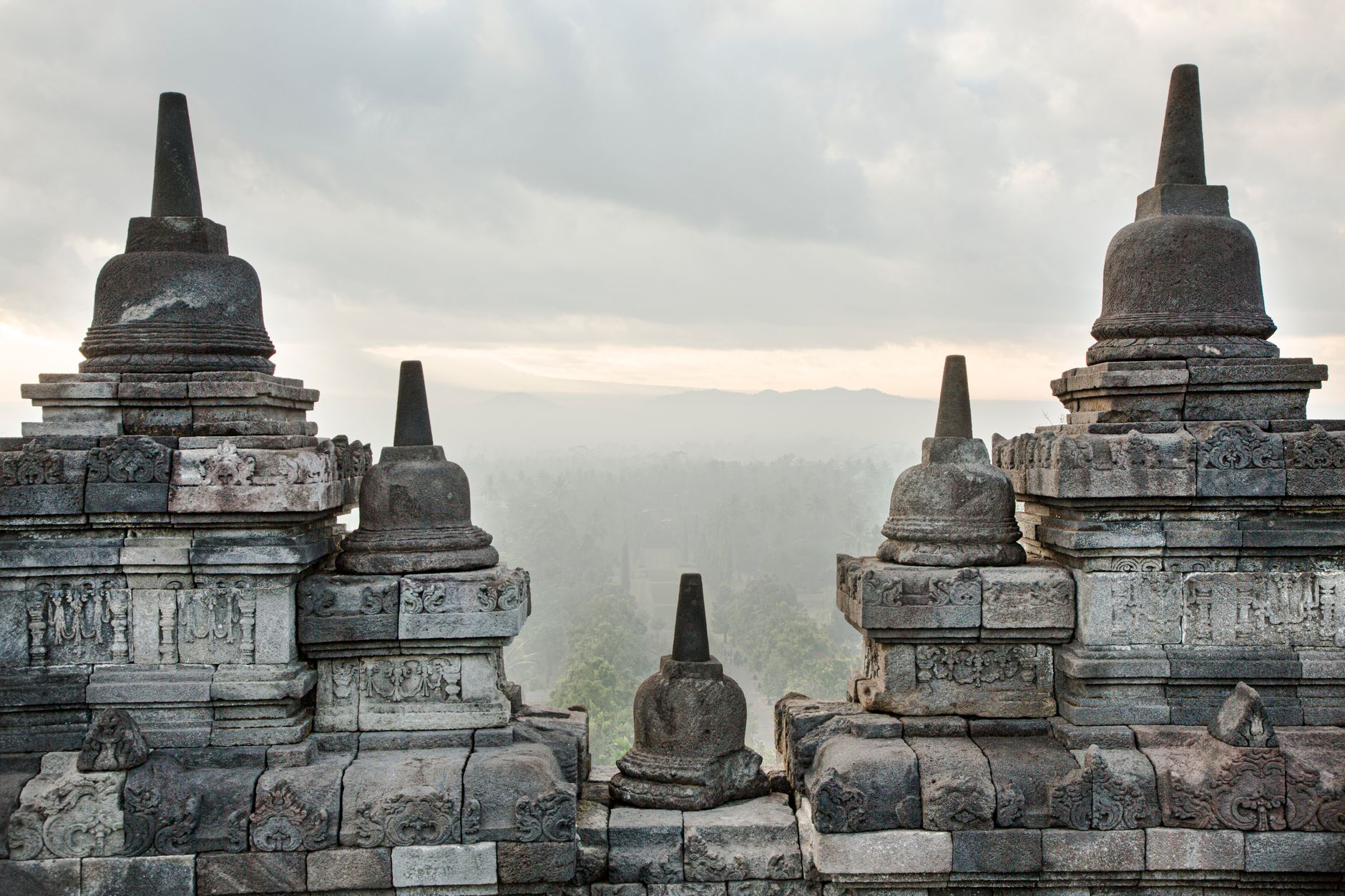
I reached the upper level just as the first grey light began to separate the sky from the silhouette of the volcano to the east. Merapi was visible, just barely, a dark triangle against a slightly less dark horizon. The stupas in front of me — latticed stone bells containing seated Buddhas — were still wholly in shadow. I found a spot at the northern edge of the platform, away from the small cluster of photographers who had set up tripods near the central staircase, and sat down on the damp stone. The surface was cool and slightly rough, worn smooth by centuries of feet but still textured enough to feel through the fabric of my trousers.
For the next twenty minutes, nothing dramatic happened. The light shifted incrementally — a deepening of greys, a softening of edges — but the sky did not turn any of the colours that postcards promise. A man beside me, Japanese, maybe sixty, stood perfectly still with his arms crossed, not once raising the camera that hung from a strap around his neck. I asked him, later, what he was waiting for. He said he had been here three mornings in a row, and that the best view was never the sunrise itself but the moment the mist began to move.
That turned out to be the detail that most coverage misses. Around 5:45, as the sun finally broke the ridge of Merapi’s flank, a low-lying fog that had been invisible in the dark began to rise from the surrounding valleys. It came not as a wall but as a slow seepage, first pooling at the base of the temple steps, then climbing up through the gaps between the stupas. Within minutes, the lower levels of the monument were swallowed. The Buddhas sitting inside their stone cages appeared to float, their torsos emerging from white while their legs disappeared into it. A young woman nearby gasped — an involuntary sound, not theatrical — and I understood why. The effect was not picturesque in the usual sense. It was disorienting, as if the ground itself had dissolved.
The mist cleared in stages, not all at once. The eastern stupas emerged first, then the central dome, then the upper terraces one by one, like a photograph developing in reverse. I watched one particular Buddha — the one at the northern edge of the third terrace, whose hand is visible through a gap in the lattice — reappear from the fog as a single palm, then an arm, then a full seated figure. Fifteen minutes later, the mist was gone entirely, and the temple looked exactly as it does in every brochure: solid, monumental, bathed in golden light. The transformation felt almost disappointing, as if the place had traded its mystery for legibility.
A local guide I met near the western stairway, a man named Yusuf who had been working at the temple for eleven years, told me that most foreign visitors show up at the wrong time even when they arrive early. “They come for the sunrise,” he said, “but they leave just after, when the mist burns off. They miss the best part, which is the next hour.” He gestured toward the rice paddies visible from the upper platform. “The light hits the fields then. It’s not about the temple anymore. It’s about how the temple sits inside everything else.”
I stayed, partly because I had nowhere to be until noon and partly because Yusuf’s point was too specific to ignore. At around 7:30, the sun had climbed high enough to angle down onto the agricultural plain west of the monument. The paddies, which had looked grey and unremarkable in the early light, turned a vivid chartreuse. Small figures — farmers, presumably — moved through the flooded fields, their shadows stretching long behind them. The temple, which had been the entire focus of the morning, became just one element in a wider composition: stone above, green below, the volcano watching from the east. It was a better photograph than anything I had taken during the sunrise itself.
I had assumed, wrongly, that Borobudur was a solo act. The surrounding landscape is not secondary to the monument; it is essential to understanding why the monument was built where it was. The temple sits in a natural amphitheatre formed by two rivers and a pair of volcanoes, and from the upper terraces you can trace the logic of its placement — a high point in the middle of a fertile basin, visible from every direction. Yusuf told me that local farmers still use the temple as a landmark for planting schedules. “When the shadow of the main stupa reaches the river,” he said, “it is time to plant the second crop.” He was not joking, or at least I don’t think he was.
I walked the lower galleries after the crowds had thickened, around 9:30. The bas-relief panels that line the walls are the part of Borobudur that gets mentioned in guidebooks but rarely described with any specificity. There are nearly three kilometres of them, narrating the life of the Buddha and various Jataka tales, and they reward patience in a way the upper stupas do not. One panel, near the southeastern corner, shows a ship with outriggers and a distinctive curved prow — a representation, I later read, of the maritime trade routes that connected Java to India and China. The detail that stayed with me was not the ship itself but the fish carved beneath it, each one distinct in shape and scale, as if the sculptor had studied a market catch and reproduced it from memory.
The heat became noticeable around 10:30. The stone absorbed it and radiated it back, and the white limestone glare made it hard to look at anything for long without squinting. I found shade near the eastern staircase and sat down next to a concession stall that sold cold drinks and small packets of fried tempeh. The vendor, an older woman with a calm, unhurried manner, handed me a bottle of water without being asked, then pointed at my sunburned forearms and shook her head. I bought three bottles and drank them over the next hour, watching the crowds flow past in waves — a guided tour from Surabaya, a school group in matching batik shirts, a pair of European backpackers taking selfies with the same Buddha from every angle.
One thing that surprised me, because I had not read it anywhere, was the sound. Borobudur at midday is not quiet. The stone amplifies footsteps, and the echoes of voices from different terraces layer over each other in a way that makes it hard to tell where any given sound originated. A child’s laugh from three levels below sounds like it is coming from directly behind you. A guide speaking into a microphone on the eastern side becomes unintelligible noise on the western side, a low rumble that mingles with the cooing of pigeons and the rustle of wind through the trees that surround the base. It is not unpleasant, but it is constant, and after two hours I understood why the early morning is so prized: not for the light, but for the silence that attends it.
I left just before noon, driving back toward Yogyakarta along a road that passes through several small villages. At one of them, I stopped for lunch at a warung that had no sign and no menu — just a glass case of cooked dishes and a woman who pointed at a plate of fried chicken and rice and raised her eyebrows questioningly. I nodded, and she reheated the chicken in a small wok of oil, then served it with a sambal that burned in a way that felt personal. The meal cost the equivalent of about a dollar. I ate it on a plastic stool by the roadside, watching motorbikes pass and children kick a deflated football in an empty lot, and I thought about how Borobudur, for all its grandeur, is not the thing that most people in the surrounding area think about on a given day.
Would I go again? Yes, but I would skip the sunrise entirely. I would arrive at 7:00, walk the lower galleries first while the light was still low, then sit on the upper platform at 8:30 when the mist had cleared and the fields turned green and the tour buses had not yet disgorged their full load. I would bring a hat and more water than I thought I needed. And I would stay until the heat drove me away, not because there was more to see, but because the place is different every hour, and the hour most people leave is the hour it begins to make sense as something other than a photograph.
📷 Photos: Roman Kirienko (Pexels), Charl Durand (Pexels)