The stone felt warm already, even at half past five in the morning. I had put a hand flat against one of the Buddha niches on the upper terrace and the volcanic rock held the previous day’s heat like a battery. It was the first thing that surprised me. Everything I had read about visiting Borobudur at sunrise emphasized the cold — the damp chill of the tropical morning before the sun burned through, the way the dew collected on the grass below. Nobody had mentioned that the stone itself remembered what the rest of the air had forgotten.
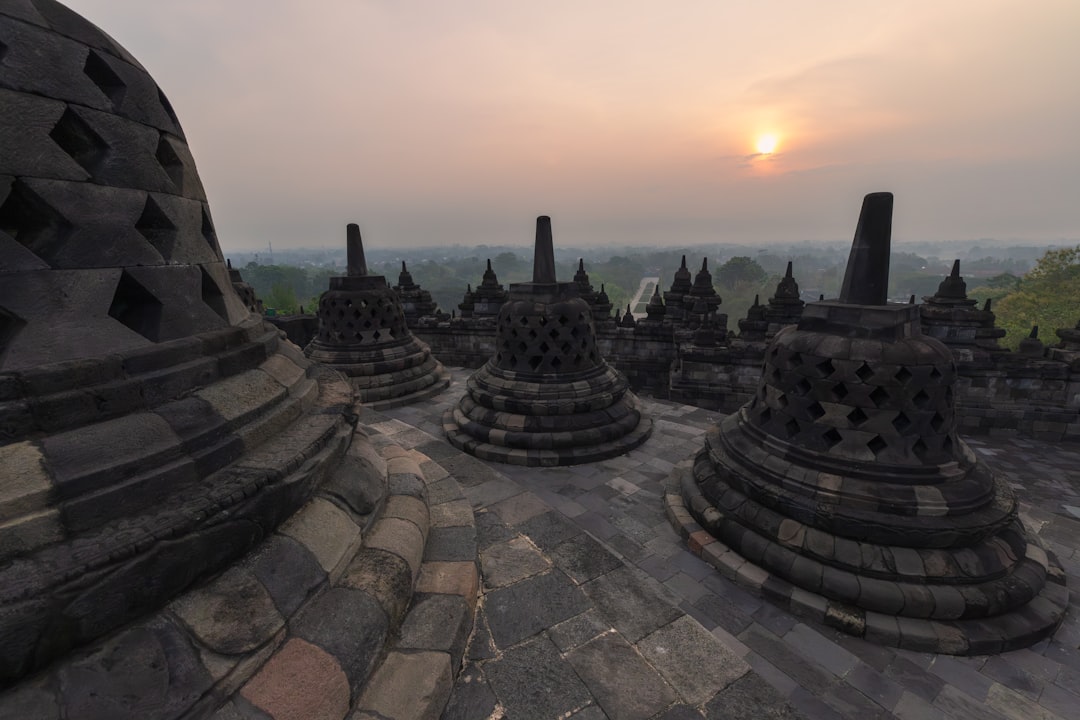
The crowd on the upper terrace was already substantial. Fifty might have been an undercount. People moved along the narrow walkways between the bell-shaped stupas in single file, most of them holding phones up at the same angle, waiting for the same thing. The eastern sky had begun to lighten, but it was a flat, pearly grey with no drama in it. A layer of cloud sat low on the horizon, thick enough that the sun would have to climb well above it before anything started happening. Nobody seemed to mind waiting. The mood was patient, almost polite. People spoke in low voices, as though the place itself demanded a certain volume.
I had arrived on a local bus from the town of Muntilan, where I was staying in a homestay run by a woman named Ibu Sari. The bus had left at four in the morning — not because I was trying to beat the crowds, but because that was simply when the first bus left. Muntilan at that hour was already stirring. A few warungs had their lights on, and the smell of fried tempeh and clove cigarettes drifted from the roadside. The bus took forty minutes, stopping twice to pick up passengers who emerged from the dark without warning, and dropped me at the main entrance to the Borobudur Archaeological Park just as the ticket counter opened.
The ticket cost 375,000 rupiah for a foreign visitor, a fact I had checked beforehand and still found slightly stiff. It included entry to the temple and a guided tour option I declined, preferring to move at my own pace. What it did not include was any guarantee about the view.
The first noise came from somewhere near the central stupa. A man in a bright orange sarong had begun speaking loudly into his phone, his voice carrying across the stone. The tone was argumentative, insistent. A few heads turned. Someone near me muttered something in Japanese — a polite comment, probably. The mood in that small pocket of the terrace shifted. The man finished his call and walked off toward the lower levels without looking back. The silence that followed felt pointed, as though everyone had collectively agreed to pretend the disruption hadn’t happened.
I found a spot near the eastern edge of the terrace, away from the main cluster of photographers. The view from here looked out over the plains of Kedu, a wide green valley dotted with coconut palms and the distant shapes of other hills. Mount Merapi stood to the northeast, its peak hidden inside a cloud bank. The air was clear enough that I could see the rice terraces on the lower slopes, the tiny rectangles of green and brown laid out like a patchwork quilt. A woman selling postcards had set up a small folding table near the stairs. She caught my eye and smiled, then went back to arranging her wares. She was the only person on the upper terrace who looked like she worked here.
The cloud bank did not break. By six thirty, the sun had risen behind it, turning the sky a pale, diffuse white with no colour to speak of. People began to drift away. The photographers with tripods packed their gear. A family posed for a few quick photos in front of the main stupa, then descended toward the lower galleries. The argumentative man in the orange sarong did not reappear. Within twenty minutes, the upper terrace had emptied to maybe a dozen people, most of them sitting on the stone ledges and talking quietly, as though they had decided to stay for reasons that had nothing to do with the sunrise.
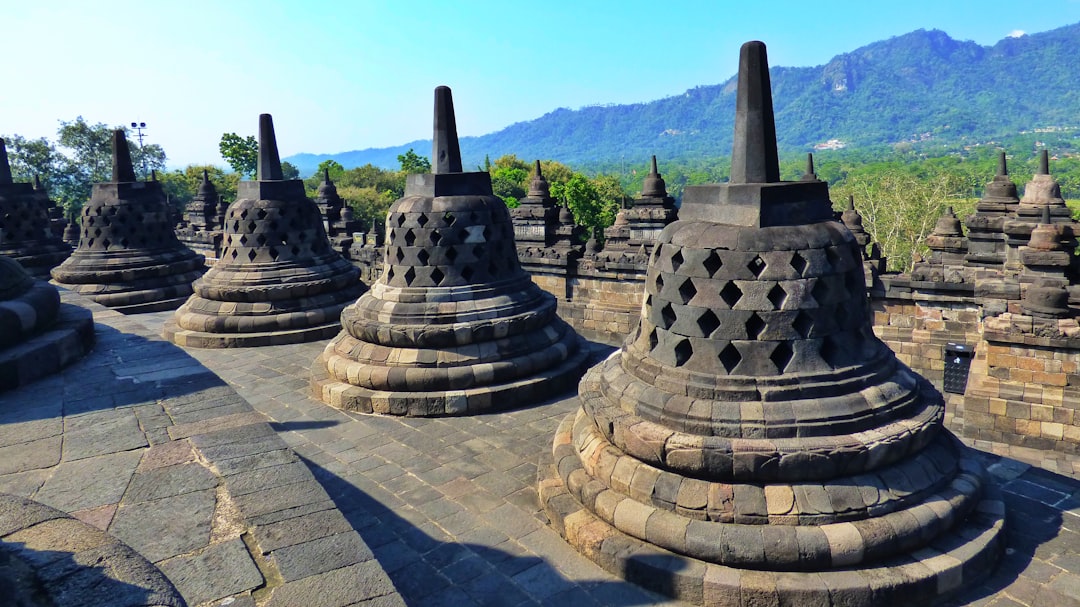
I stayed too. The stone had grown no cooler. I walked the full circuit of the upper terrace, tracing the path that pilgrims would have taken centuries ago, moving clockwise around the nine stacked platforms. The relief carvings on the lower levels told stories from the life of the Buddha — scenes of temptation, meditation, enlightenment — but up here, on the topmost level, there was only the geometry of the stupas and the empty space inside them. Each stupa had a small square opening near the top, and inside each one sat a Buddha statue, cross-legged, hands in different mudras. Some of the Buddhas had been decapitated over the years, their heads removed by looters or museum collectors. The empty shoulders looked almost natural, as though the statues had been designed that way.
A young man approached me from the direction of the stairs. He was wearing a blue polo shirt and carried a small notebook. He introduced himself as Adi, a student from Yogyakarta studying tourism management. He was at Borobudur as part of a class assignment, he said — documenting visitor behaviour for a research paper, something like that. Could I tell him why I had chosen to stay after most of the other visitors had left? I told him I was waiting for the clouds to break. He nodded and wrote something in his notebook. Then he asked if he could take a photo of me standing next to one of the stupas, for his report. I agreed. He took the photo with his phone, thanked me, and walked off in the direction of the lower galleries.
The light shifted around seven thirty. The cloud bank, which had sat immobile over Merapi for the past hour, began to thin at its lower edge. A shaft of sunlight pushed through, hitting the valley floor in a long, angled beam. The effect was subtle — not a dramatic golden glow, just a slight warming of the green. But it was enough to change the atmosphere on the terrace. The remaining visitors stirred. An older woman in a straw hat stood up from her seat on the stone and walked to the railing, shading her eyes with her hand. Nobody said anything, but everyone was watching the same spot.
The clouds did not fully clear. They opened in patches, letting through columns of light that moved slowly across the valley as the wind shifted. The sun itself remained hidden, a diffuse glow behind the grey. But the light that reached the temple complex had a quality I have not seen in any photograph of Borobudur: soft, almost translucent, as though it were passing through a filter. The stone took on a colour that was not quite gold and not quite grey — something in between, a kind of warm neutrality that made the carvings look sharper than they had in the brighter light of the earlier hour.
I walked down to the lower levels. The galleries here are narrower, hemmed in by stone walls on both sides, and the relief carvings cover every surface. The scenes are dense and crowded: musicians, dancers, warriors, ships, elephants, market stalls. A visitor could spend days reading the story they tell and still miss details. I spent maybe forty minutes walking the first two levels, stopping often. The stone here was cooler, shaded by the overhanging platforms above. A small lizard darted across the face of a carving showing a prince in a palace, disappearing into a crack between two stones.
By nine o’clock, the new crowds had arrived. Tour buses pulled into the parking area below, and the sound of their engines drifted up through the trees. A group of schoolchildren in matching red uniforms clattered up the stairs, their voices echoing off the stone walls. The quiet of the earlier hour was gone. I stood at the top of the staircase leading to the upper terrace and watched the flow of people. They moved with the same purpose the earlier crowd had shown, heading for the same vantage points, holding up the same phones. The woman selling postcards had moved her table to the base of the main stairs, catching the new arrivals as they entered.
I sat on a low stone wall near the eastern edge of the lower gallery, out of the main flow of foot traffic. From here, I could see the full shape of the temple rising above the trees — the stepped pyramids of the lower platforms, the graceful bell shapes of the stupas on top, the whole structure emerging from the landscape as though it had grown there. The clouds had begun to break more consistently, and the sun, now fully above the horizon, cast sharp shadows across the stone. The light was ordinary now, the kind of direct tropical sunlight any midday visitor would see. It was fine in its own way, but it carried none of the strangeness of the earlier hour.
I thought about what Adi had asked me, about why I stayed. The honest answer was that I had not come to Borobudur for the sunrise. I had come because the temple was there, because I was in Central Java, because it seemed like the kind of thing a person ought to do. The sunrise was the default, the packaged experience sold by every tour agency in Yogyakarta. I had not resisted it — I had simply followed the path of least resistance, letting the bus schedule determine my timing. What I got instead was something else: a slow, undramatic morning in which the famous view never materialised, and in which the temple itself became more interesting than the postcard version of it.
I stayed another hour. I walked the full circuit again, this time taking the upper level clockwise, the opposite direction from my first loop. The carvings looked different from this angle, the shadows falling the other way. Near the northwest corner, I stopped at a relief panel showing a ship with an elaborate prow, its sails full of wind. A man standing nearby noticed me looking and said, in English, that the carving was based on a type of vessel that had sailed between Java and India somewhere around a thousand years ago. He was Indonesian, maybe in his sixties, wearing a simple white shirt and dark sandals. He told me he lived in Magelang, the nearest city, and came to Borobudur once or twice a month, always on weekday mornings, always after the sunrise tourists had cleared out. “I never go up during the busy time,” he said. “I walk the lower levels. The top is for looking out. The bottom is for looking at.” He smiled, as though he had said something he had said many times before.
The clouds had mostly cleared by the time I left. I took the same bus back to Muntilan, this time in full daylight, the road busy with motorbikes and carts and the occasional goat. Ibu Sari was sweeping the front porch when I arrived. She asked if I had enjoyed the sunrise. I told her about the clouds, about waiting, about the light that eventually came. She nodded as though she had expected as much. “Sometimes the morning is like that,” she said. “The mountain decides.”

📷 Photos: Rowan Heuvel (Unsplash), Rowan Heuvel (Unsplash)