The first thing a visitor notices about hanji is not its beauty but its sound. In Jeonju’s Hanok Village, past the egg bread stalls and the hanbok rental shops, certain narrow alleys carry a dry, rhythmic crackling — the sound of sheets of mulberry paper being lifted, folded, and pressed in the open air. It’s a sound almost entirely absent from the travel brochures, which tend to feature only the finished products: the jewel-toned stationery, the lacquered jewelry boxes, the lampshades that glow like warm milk. The brochures do not mention the noise of making.
Jeonju’s Hanok Village is a living workshop district more than it is a museum. Roughly eight hundred traditional houses line its winding streets, and a significant number of them are not homes or guesthouses but working studios. Paper — hanji — is the thread that runs through many of them. Mulberry bark is boiled, beaten into pulp, mixed with the sticky sap of the hibiscus root, and then — in the oldest method — lifted from a vat on a bamboo screen in a single, continuous motion. A master can tell a sheet’s quality by the way it takes the light. A beginner can tell by how long it takes to dry.
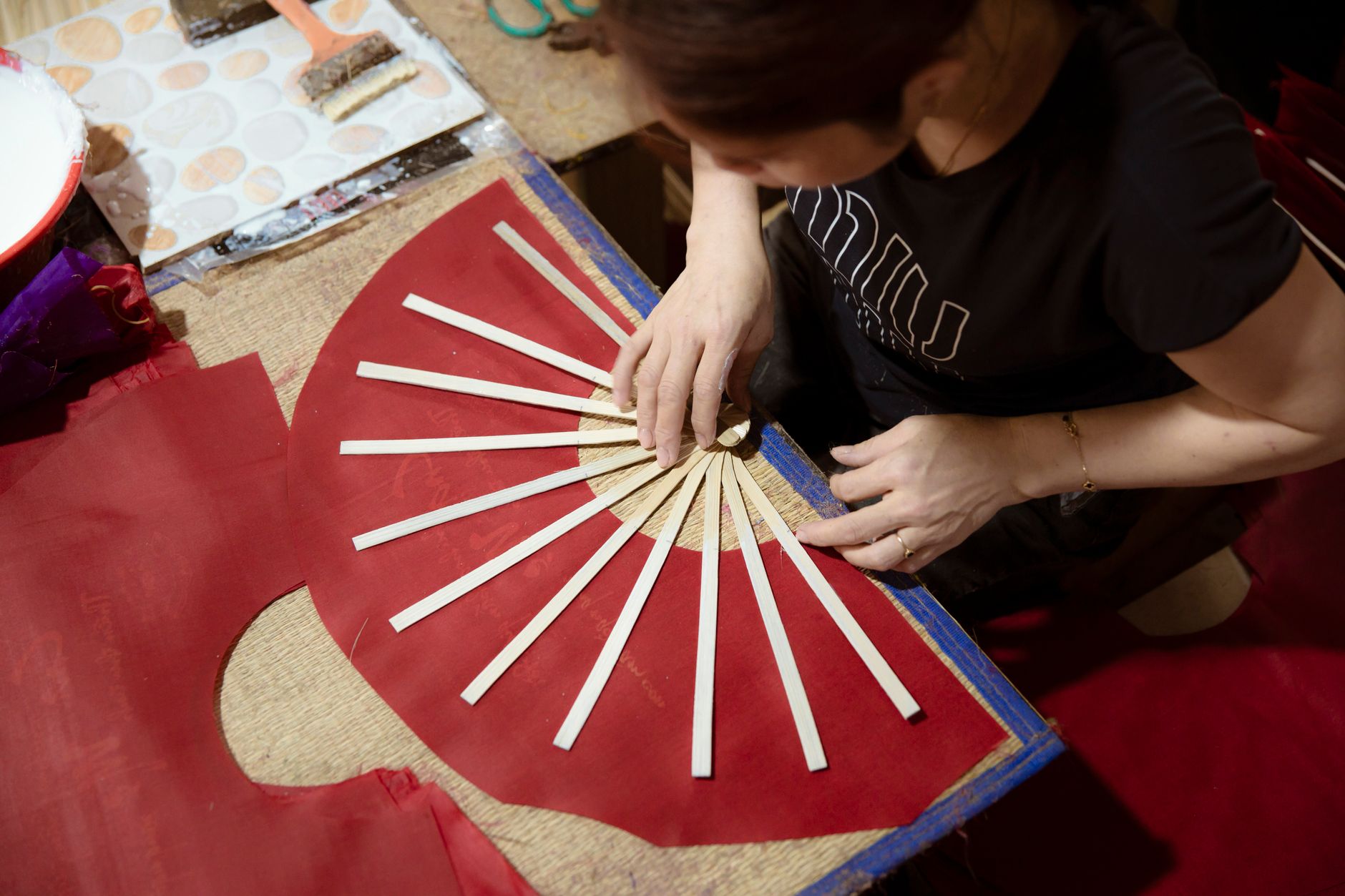
Workshop #37 is a small, fiercely cluttered space where an older woman named Mrs. Ko has been folding paper for more than fifty years. The room is too warm and smells sharply of acacia starch, which she uses to stiffen the paper for boxes. A visitor who stops to watch her hands finds it almost impossible to follow the sequence: a square of hanji is turned, creased, tucked, flipped — and what was a flat sheet twenty seconds ago is now a three-dimensional box with a fitted lid, no glue, no cutting, no visible seam. “The paper remembers,” Mrs. Ko says, barely looking up. “It was already a box. I’m just asking it to unfold into one.”
Two doors down, the atmosphere is entirely different. Workshop #40 belongs to a younger craftsman, Mr. Shin, who works with dyed hanji — sheets saturated with persimmon, indigo, or gardenia before they are dry. The result is paper that has a faint, specific scent: tannic, vaguely vegetal, nothing like the chemical smell of factory-dyed goods. Mr. Shin’s specialty is stacking these colored sheets into layered shapes — bowls, vases, even small stools — compressed under weights for days, then sanded smooth so the edges reveal each color as a thin stripe of the rainbow. “The dye has to soak into the living fiber,” he says, wiping his hands on a rag that is itself a magnificent shade of plum. “If the paper is already dry, the color sits on top like paint. It lies. This way, the color is honest.”
What is striking about the workshops is how un-retail they are. In a district that draws busloads of tourists on weekends, many of the hanji studios do not display price tags. Items sit on shelves not as merchandise but as examples of what can be done. The transaction, when it happens, is secondary to the conversation. A customer who lingers too long over a particular lamp or writing set is often told — not pushily but matter-of-factly — about the piece’s flaws: a slight asymmetry in the weave, a discoloration in the corner where the pulp was too thin. It is not modesty. It’s the ethos of a craft culture where the maker can still remember exactly which sheet of paper that object came from.
The most sought-after items are not the obvious souvenirs. The hanji-covered jewelry boxes and lacquered coasters sell steadily, but they are not what the regulars come for. Regulars come for the hanji itself — raw sheets, sold by weight, from stacks that sit on high shelves wrapped in muslin. A single sheet of properly made mulberry hanji can last centuries. It is stronger, when dry, than cotton cloth of the same thickness. Museums in Japan and China have restored fifteenth-century Buddhist scriptures on Korean hanji because the paper was the only thing that had not rotted. Buying a stack of it, taking it home, and putting it in a drawer feels like an investment not in decoration but in longevity.
Mrs. Ko’s workshop sells her own stash of raw sheets on the second Tuesday of every month, a fact that is not advertised and is known only to a small network of collectors and university professors. A visitor who arrives on the wrong day is gently turned away. But a visitor who arrives on the right day finds a scene that feels less like shopping and more like a private sale: sheets spread across a long wooden table, sorted by thickness, inspected by hand, prices written in pencil on scraps of the same paper. The cheapest run about 12,000 won per sheet — close to twelve dollars in Australian money — for a standard practice grade. The best, made from the inner bark harvested in a specific winter season, can cost ten times that. They sell first, and they sell to people who know exactly what they are looking at.
The Hanok Village is not a quiet place. Tour groups pass through with alarming frequency, their guides speaking into headsets. The main street in summer is a slow-moving river of parasols and cooling fans. But the paper workshops form a kind of parallel geography, tucked behind courtyard walls and up short, tiled staircases that are easy to miss. The trick is not to follow the signs. The signs point to the big studios with the English-language pamphlets and the credit card machines. The good workshops — the ones where the paper is made in the back and sold in the front — never have signs. They have a wooden door left ajar, a faint sound of water running, a stack of pulp drying on a rack visible through a window. Recognizing these cues is itself a kind of craft; not everyone develops it.
One afternoon in late spring, a workshop near the eastern edge of the village was locked and quiet, its paper screens drawn shut. A handwritten note in Korean was taped to the door. A passing resident translated it for a visitor standing there: “Gone to gather bark. Back in three days, or something like that.” No phone number, no email, no apology. The paper comes first. That is not rudeness. It is the logic of a material that is only as good as the raw ingredient, and an ingredient that only becomes available when the season allows.
The buying itself can feel anticlimactic. There is no wrapping paper, no wax seal, no elaborate bag. A sheet of hanji is folded, handed over, slipped into a cloth sleeve. The transaction takes seconds. The experience that led to it — choosing the right sheet, feeling its weight, understanding why one costs three times another — takes much longer. And in a way, that imbalance is the point. The object is incidental. The education is the thing.
By late afternoon, the light in the Hanok Village changes character. The tile roofs, which looked grey at noon, turn the color of dried persimmon. The shadows of wooden beams fall across the stone pathways. Paper that was being made in the morning is now set out on racks to catch the last of the sun, and the alleys between workshops become corridors of translucent color — pale yellow, soft green, the faintest pink. It is the best time to see hanji not as a product but as a material still in process, still alive.
Mrs. Ko closes her workshop at five, but she sometimes stays late if there is a customer who looks genuinely interested. She will light up a drawer and bring out pieces that are not for sale — prototypes, experiments, things that went wrong in interesting ways. One is a box that was folded from paper that had been dyed too wet, so the corners buckled. Instead of throwing it away, she cut the buckled section into a new shape, a flower, and sewed it onto the lid. The result is a box that looks like it grew the flower, not had it attached. She does not consider it a failure. “The paper showed me what to do,” she says. “I just followed.”
The visitor who buys hanji from Jeonju is buying something that will not look right for a long time. A sheet of the good stuff is too stiff to bend easily, too thick to fold into a card or a note. It needs to be worked, soaked, dried again, and worked some more. It is not a finished thing. It is a promise of something not yet made. The satisfaction is not in the purchase but in the potential — in knowing that a material that has survived centuries is now sitting in a drawer somewhere, waiting for the person who has an idea.
A photograph can show the color, the texture, the way light passes through a single ply. But it cannot show the sound it makes when it folds, the smell of the starch, the warmth of a sheet that was setting in the sun an hour ago. The workshops of Jeonju’s Hanok Village, with their unmarked doors and their handwritten notes and their patient makers, remain some of the best places on earth to find those things.

📷 Photos: HONG SON (Pexels), Clark Gu (Unsplash)