
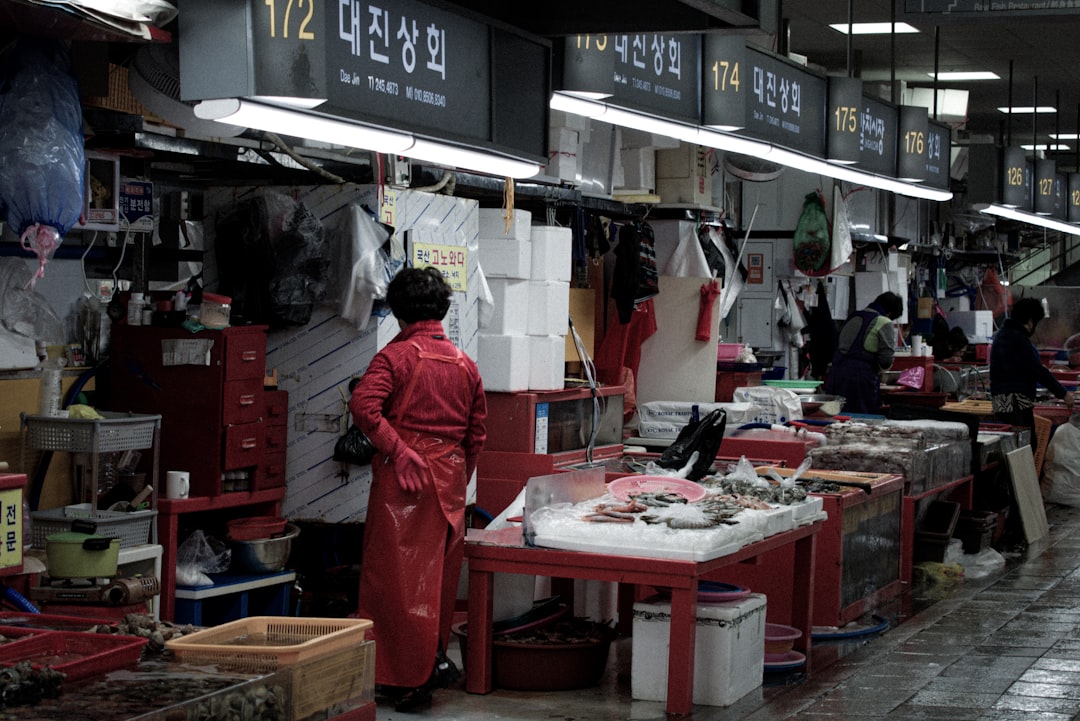
The woman at the stall gestures with a dried squid the approximate size of a car tire, then peels off a translucent strip and holds it up to the fluorescent light. “Chew this one,” she says, or maybe that’s what she says — her accent is thick, the market noise is relentless, and a halmoni pushing a cart stacked with Styrofoam boxes is trying to thread a path between a tourist from Osaka and a stack of metal basins containing things that were alive twenty minutes ago. The strip of squid comes away like a piece of cured leather. It tastes of the sea, but more precisely: it tastes of salt, smoke, and the particular mineral tang that accumulates when something has been hanging in coastal air for days.
This is Jagalchi Market, Busan’s great seafood bazaar, and most visitors arrive expecting the famous thing: the live tanks on the lower floors, the rows of octopus and eel and the kinds of crustaceans that don’t have English names, the ajummas in rubber boots filleting fish with speed that seems almost hostile. That part of Jagalchi is real and it’s worth seeing. But the question that brings most travelers here — where to find the best dried seafood and seaweed snacks to take home — is answered not in the wet market at all, but two floors up and one corridor over, where the air changes from wet to dry and the lighting shifts from aquarium-blue to the flat glare of a warehouse.
The dried seafood floor at Jagalchi is less photographed and more useful. It’s also where the real work of gift-shopping happens, though it takes a few laps to understand why.
Regulars know to come on a Tuesday or Thursday, when the morning catch has been processed and the drying racks have had two full days to work. The stalls on this level are arranged in long, narrow rows, each one stacked floor-to-ceiling with clear plastic bins and vacuum-sealed bags. The range of products is narrower than the wet market below — there are no live animals here, no dramatic dispatch — but the variety within that narrow range is bewildering. Dried anchovies in at least five sizes, from tiny silver things that could pass for fish-shaped glitter to finger-length specimens with visible bones. Sheets of laver in varying shades of green and black, some toasted, some raw, some speckled with sesame or perilla oil. Whole squid dried into pale, rigid boards. Cutlefish. Pollack. The dried frames of fish that have been gutted and flattened like botanical specimens.
The gift-seeker’s problem isn’t finding something. It’s finding the right something, and not paying three times what a local would.
One stall on the north side of the second floor, run by a woman named Mrs. Park who has been selling dried seafood here since 1992, keeps her best stock in a separate cooler near the back. She doesn’t offer it to first-time customers unless they ask the right question. The question, as it turns out, is not “What’s your best seaweed?” — that gets you the mid-tier product at the standard price — but rather “What do you eat at home?” This is the kind of thing seasoned visitors figure out through trial and error, or through a few rounds of paying too much for something that tastes merely fine.
Mrs. Park’s home stash, when she finally pulls it out, is a dark, almost black sheet of laver that has been toasted twice — once over charcoal, once over an electric burner — and then pressed with a faint layer of sesame oil and sea salt from the nearby tidal flats. It cracks cleanly when bent, not shattering into powder like the mass-market stuff, and it tastes not of “seaweed” as a category but of something closer to a grilled vegetable: savory, slightly smoky, with a finish that lingers without being fishy. She sells it in packs of ten sheets for about what a convenience store charges for a single bottle of water. “This one,” she says, tapping the package, “is for people who know.”
Descend the stairs from the dried-goods level and the temperature rises by close to five degrees, maybe a bit more. The air thickens with the smell of brine, crushed ice, and the faint metallic note of blood washing across tiled floors. The wet market operates on a different rhythm entirely — louder, faster, more transactional. Vendors call out prices in a rhythmic chant. Customers pick live seafood from tanks using long-handled nets. A woman in a floral apron guts a flatfish with three precise cuts and wraps it in newspaper before the customer has finished counting out won.
It’s tempting to spend all of one’s time down here, watching the theater of it. But the dried floor rewards patience in a different way. The pace is slower. The negotiations, if they happen at all, are conducted in low tones over digital scales. And the products themselves tell a story about how Korean cuisine thinks about preservation — not as a backup plan for when fish is out of season, but as a legitimate culinary category with its own techniques and standards.
Dried pollack, for example, appears in Korean cooking in ways that fresh pollack never could. It gets soaked and shredded into soups, grilled into banchan, pounded into powder for seasoning. The dried version has a texture that doesn’t exist in the fresh fish — chewy, almost fibrous, with a concentrated flavor that makes it a pantry staple rather than a perishable ingredient. At one stall near the far end of the dried floor, a stack of whole dried pollack sits next to a handwritten sign that reads simply “2 years” — the shelf life, not the age. Properly stored, the vendor explains through a mix of English and gesture, dried pollack doesn’t spoil so much as slowly change character, becoming more intense and more brittle over time.
Most tourists gravitate toward the pre-toasted laver sheets in brightly colored boxes, which are fine — but fine in the way that grocery-store cookies are fine. They do the job. What they lack is the specificity of the small-batch product: laver harvested from a particular cove on the south coast, dried on traditional bamboo mats rather than industrial rollers, toasted just long enough to turn the oil fragrant but not bitter. One stall near the middle of the row carries exactly this product, sourced from a single producer on Geoje Island, and marks it with a small yellow tag that regulars scan for before any other. The owner, a man in his sixties who goes by Mr. Kang, rotates his stock based on the harvest calendar, not on customer demand. When the Geoje laver is gone, he simply doesn’t restock until the next season. “Better laver later,” he says, in English that comes out as a single compressed phrase. “Bad laver never.”
It’s the kind of philosophy that makes no sense in a mass-market context and perfect sense in a market like Jagalchi, where reputation travels by word of mouth and the same customers have been coming to the same stalls for decades.
The gift-buying strategy that emerges after a few hours of walking the dried floor is simple but specific. Don’t buy the first thing you see. Circle the entire floor once, noting which stalls have the highest turnover — not the ones with the flashiest displays, but the ones where customers linger, where the vendor is handing out small samples to taste, where a conversation is happening rather than a transaction. Those stalls are the ones with returning customers. At one stall run by a woman named Ms. Yoon, on the south end of the second floor, the turnover is visible: a steady stream of older women, the kind who know their seafood, stop by for small quantities of specific items — a bag of dried shrimp, a packet of seasoned seaweed flakes, a single dried squid wrapped in paper. Nobody here is stocking up for a party. This is everyday cooking.
Ms. Yoon’s dried anchovy selection covers seven varieties, graded by size and by whether they have been gutted or left whole. The tiny ones, she explains, go into soup stock — you don’t gut them, you just toss them in and strain them out later. The larger ones get their heads and guts removed before being toasted and served as banchan. The difference in price between the two grades is somewhere around 30 percent, and each has a distinct use.
The seaweed snacks that end up in most gift bags tend to be the pre-seasoned, pre-packaged laver sheets that come in individual sleeves — convenient and shelf-stable for months. But the better play, the one that yields more impressed reactions back home, involves buying the unseasoned sheets in bulk and toasting them oneself. The process takes less than a minute per sheet: a quick pass over an open flame or a few seconds in a dry pan, then a light brush of sesame oil and a pinch of salt. A few vendors on the dried floor sell small portable butane burners specifically for this purpose, alongside the raw laver. They sell well.
What surprises visitors most about the dried seafood floor, consistently, is how little it resembles a tourist market. There are no English signs here except the ones scribbled on cardboard by vendors who deal with enough foreigners to have learned the word “gift.” There are no tasting stations set up for photo opportunities. The floor is not photographically dramatic — it’s too bright, too functional, too cluttered with practical objects. But that functional quality is itself the appeal. This is where Busan shops for its own pantry.
Mr. Kang, when asked why he doesn’t move his stall downstairs where the foot traffic is higher, shrugs. “Downstairs is for the fish that must be eaten today,” he says. “Upstairs is for the fish that will be eaten tomorrow. And next month. And next year.” He gestures at his stock, row after row of sealed packages and woven baskets. “This is the patient floor.”
The products are light, packable, and durable. A bag of mixed dried seaweed snacks takes up no more space than a paperback. A stack of laver sheets weighs almost nothing. A vacuum-sealed package of dried pollack fits flat in a suitcase’s lid pocket. And the gifts themselves travel better than anything from the wet market, which is to say they survive the journey home without smelling like a harbor by the time the bag hits customs.
One detail that catches most first-timers off guard: the seaweed snacks sold in Jagalchi’s upper floors, when stored properly, actually light up over the first few weeks after purchase. Something about the residual moisture in the dried product redistributing itself, the oils settling, the flavors melding. A package of laver bought on a Tuesday and opened on a Sunday three weeks later, back home, tastes different — rounder, more integrated — than the same package would have tasted the day it was bought.
The best approach, the one that yields the most satisfaction and the least buyer’s remorse, is to treat the dried floor not as a place to complete a task but as a place to let curiosity lead. Buy something you don’t recognize and figure out how to cook it later. Take the sample the vendor offers, even if it looks unappetizing. Ask the question about what they eat at home. The answers are rarely what the guidebooks predict, and the snacks that end up in the suitcase are rarely the ones on any list.

📷 Photos: Luke Ow (Unsplash), Luke Ow (Unsplash)