Draw of the Marble: A Campervan at Dawn in Taroko Gorge
The first thing that registers isn’t the marble—it’s the quality of the light. At 5:30 a.m., with the campervan still humming softly from the overnight generator charge, the canyon walls of Taroko don’t look like stone at all. They glow, a pale, ethereal jade shot through with veins of silver and quartz, as if the mountain itself is breathing. This is the moment the loop was made for: when the day-trippers are still asleep in Hualien City, when the tunnel traffic is just a single pair of headlights weaving through the marble, and the mobile home has already pulled off the road to watch the sunrise paint the cliffs.
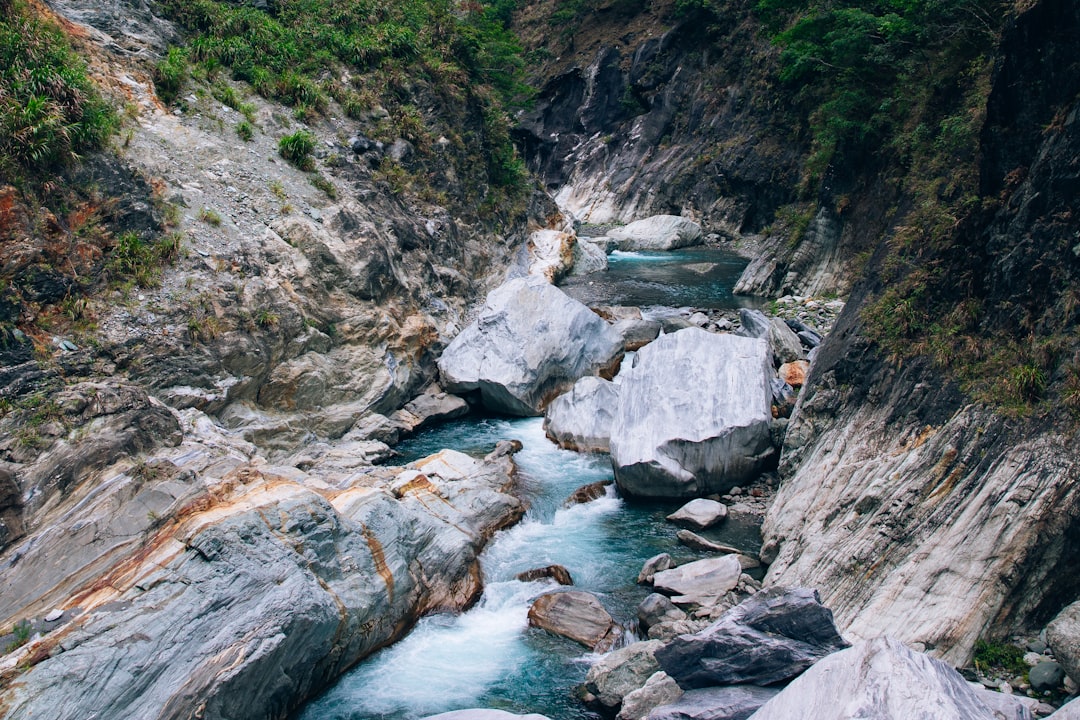
The entrance comes from the eastern gate, just north of Xincheng Township, where the campervan-friendly road widens for a moment before narrowing into the canyon’s embrace. The Liwu River runs alongside, a milky turquoise braid that owes its color to the powdered rock it’s cut through for millennia. Early in the morning, a van can park at one of the pull-offs near the Shakadang Bridge, and a walk to the river’s edge reveals water cold enough to ache the knuckles, with marble boulders—some as large as the campervan—polished smooth by the current. This is the first lesson in navigating the gorge: it rewards those who stop. The drive itself is only 19 kilometers from the entrance to Tianxiang, the loop’s heart, but stretching it over hours, maybe an entire morning, is the only way to let every curve reveal a new texture in the stone.
The campervan is a base camp, but it’s also the biggest limitation. The loop’s roads are narrow, winding, and occasionally shared with tour buses that take corners with alarming confidence. Experienced drivers know to treat the van’s width as a fixed constant—there’s no squeezing past a bus in a tunnel barely two lanes wide, so the move is to pull over at every passing bay, hazard lights blinking in the cool damp air. The reward for this patience is the ability to camp inside the gorge itself. There are only two official campervan spots inside Taroko National Park: one at the Heliu Campground, just past the Buluowan Terrace, and another at the Tianxiang Recreation Area, near the hot springs. These require booking at least three weeks in advance during peak season, but the payoff is extraordinary. At Heliu, sleeping with the back door open to the sound of the river rushing over marble shelves is a white noise machine no gadget can replicate.
The drive from the entrance to Tianxiang takes about forty minutes without stops, but a half-day affair is the smarter plan. The first major landmark is the Swallow Grotto Trail, a section of road where the cliff overhangs the campervan like a frozen wave of stone. In the early morning, the swallows that give the trail its name are just waking, swooping through the tunnel openings that riddle the cliff face. Parking at the grotto’s lot and walking the one-way trail on foot leaves the van put while the boardwalk clings to the cliffside. The Liwu River appears a hundred feet below, a thin ribbon of jade; the marble ceiling drips with stalactites, still growing, still shaping the canyon that took twenty million years to form.
The campervan offers a luxury no day-tripper has: the ability to wait. By late morning, the tour buses arrive in waves—Korean, Japanese, Taiwanese families with umbrellas and selfie sticks. They can be watched from the van’s window, a cup of locally-grown Taroko tea steaming in hand. The best photographs of the marble canyons happen not when the sun is high, but when it’s low and the stone catches the light at an angle. This is the wisdom of the campervan life: waiting out the crowds, eating a lunch of bento boxes from the Xincheng night market (the pork cutlet with pickled mustard greens is a favorite among regulars, though there’s also a decent braised tofu option if you’re tired of meat), and then, when the buses begin to thin around 2 p.m., resuming the drive.
Between the Swallow Grotto and Tianxiang, the route passes the Tunnel of Nine Turns, the stretch that gives the loop its reputation. It’s not really a tunnel in the conventional sense—a series of short, carved-out passages linked by open sections where the road clings to the cliff with no guardrail between the van and the river below. The marble here is the purest in the gorge, a ghostly white streaked with black manganese veins that look like calligraphy. Driving this section slowly is necessary not just for safety but for the view. At the third turn, a small pull-off allows parking and a walk to a viewing platform that juts out over the river. From here, the full sweep of the canyon appears—the layered marble, the emerald pools, the patches of moss that cling to the stone like velvet. This is the view that convinced the Taiwanese government to build the cross-island highway in the 1950s, a road that cost over four hundred lives to build.
Tianxiang is the loop’s logical halfway point and its most developed area. A visitor center, a small temple, and the hot springs that give the area its name are all there. The campervan’s parking spot at the Tianxiang Recreation Area includes access to a public bathhouse, though timing the visit carefully matters—the water is hottest at dawn, when the air is cold enough to make the steam visible. Soaking in the mineral-rich water after a morning of driving is a reward that makes the campervan life feel like a secret stumbled onto. The spring water contains sodium bicarbonate and sulfur, and locals claim it’s good for skin and joints after a long day behind the wheel.
The loop’s true magic, however, happens after dark. Once the last bus leaves Tianxiang around 5 p.m., the gorge empties. The road is alone. Driving back toward the entrance in the twilight, stopping at the Buluowan Terrace to watch the stars emerge over the canyon walls, reveals minimal light pollution. On a clear night, the Milky Way arches overhead like a second river. The campervan’s roof has a skylight, and if parked correctly—nose pointing east—lying in bed to watch the stars wheel by, with the sound of the Liwu River a constant companion, offers an experience no tour bus can provide: the canyon not as a destination but as a backdrop for a night of quiet solitude.
For those who want to extend the loop into a multi-day journey, a side road leads to the Hehuan Mountain Range. It’s a steep, winding climb from the gorge floor up to the high mountain passes, where the temperature drops ten degrees and the marble gives way to alpine meadows and pine forests. The campervan’s engine works hard on these grades, but the view from the Wuling Pass, at 3,275 meters, is worth the effort. Below, the marble canyons of Taroko stretch out like a map, and beyond them, the Pacific Ocean glitters in the distance. Camping overnight at the Hehuan Mountain parking lot is possible, but warm clothing is necessary—even in summer, the temperature can drop to near-freezing at this elevation.
The practicalities of the campervan loop are straightforward but worth reviewing before departure. A Taiwan-issued driver’s license or an International Driver’s Permit recognized locally is required. Most campervan rental companies in Hualien City offer vehicles equipped with diesel heaters, a full kitchenette, and a rooftop tent or a fold-down bed. Fueling up in Xincheng before entering the gorge is essential—there are no gas stations inside the park. Water and food are available at Tianxiang, but the selection is limited, so stocking the van’s pantry with noodles, canned goods, and snacks covers the full experience. And a good flashlight or headlamp is necessary: the tunnels are unlit, and at night, the only light comes from headlights and the stars.
One final piece of advice, offered by veteran travelers who have done this loop a dozen times: don’t rush the return. After two or three nights inside the gorge, the drive back to Hualien City feels like a different road entirely. The marble walls that seemed imposing on the first day become familiar. A last pull-over at the Shakadang Bridge, just to watch the river one more minute, is an impulse worth following. The campervan loop is not a drive crossed off a list—it changes the way you see stone, light, and the sound of water moving through a canyon that has been waiting for twenty million years.

📷 Photos: Anledry Cobos (Unsplash), Leo_Visions (Unsplash)