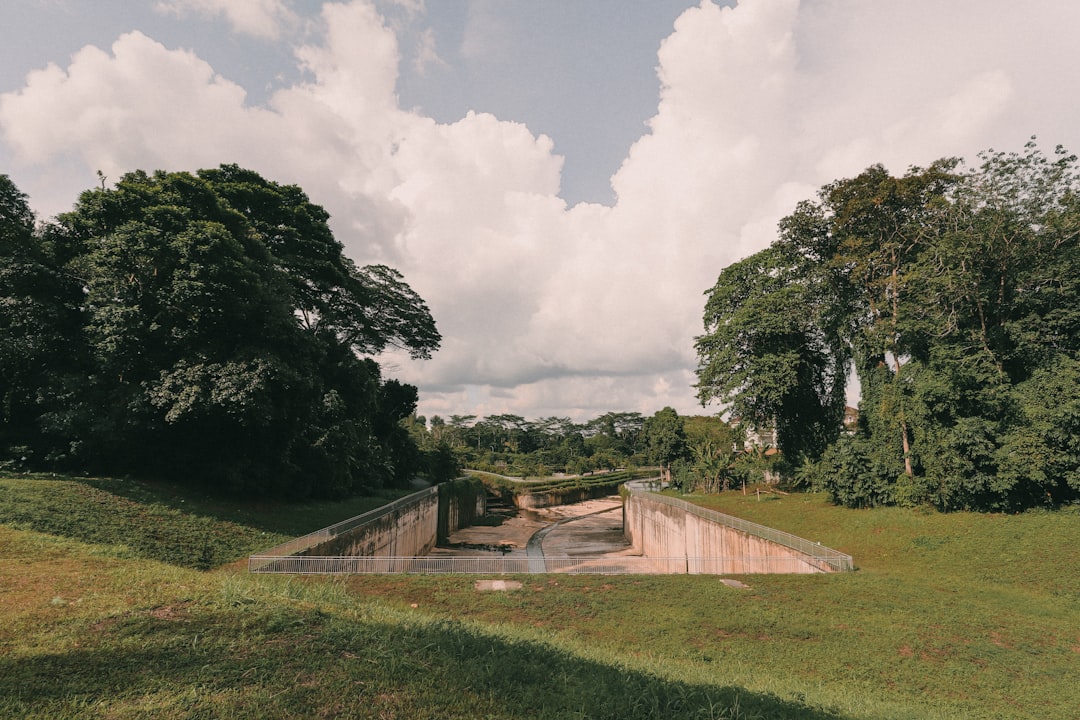
Driving Singapore’s Dark History: A Concrete Road Trip You Shouldn’t Skip
You’ve driven past them a hundred times without a second glance—those squat, moss-covered concrete structures half-hidden behind bougainvillea along the East Coast Parkway, or the squat blocks lurking at the edge of a Changi beach carpark. They blend in so thoroughly with the manicured tropical landscape that your brain registers them as drainage works or utility sheds. But pull over next time, really look, and you’ll find yourself staring at a piece of World War II history that sits right out in the open, ignored by almost everyone. Singapore’s abandoned coastal bunkers and pillboxes are the island’s most accessible yet least-visited historical sites, and mapping them on a road trip is one of the most unexpectedly absorbing things you can do with a rental car and a Saturday.
The first problem, of course, is finding them. Singapore’s wartime fortifications weren’t built for tourists, and nobody has put up helpful brown signposts pointing to “Machine Gun Emplacement, 1942.” Your phone’s GPS will be worse than useless—most of these structures sit on land managed by the Singapore Armed Forces, the National Parks Board, or private clubs, and they aren’t pinned on Google Maps as points of interest. Your first hour of the trip will likely be spent driving in slow circles around a roundabout in Pasir Ris, squinting at a crumpled printout of a 1942 British military map overlaid on a modern satellite image, trying to match a concrete cube in a field of lalang grass to the dot you’ve marked. This is the part that feels like a treasure hunt, and it’s also the part where you’ll make your first mistake: assuming you can just drive up to any bunker and park. You can’t.
The reality is that some of the best-preserved pillboxes sit inside active military training areas, behind chain-link fences topped with razor wire. You’ll find yourself at the end of a dirt track near Lim Chu Kang, staring at an immaculate machine-gun nest that looks like it was built yesterday, separated from you by a gate that says “RESTRICTED AREA. NO PHOTOGRAPHY.” This is when you learn the cardinal rule of bunker hunting in Singapore: do your location research at the National Archives, not on Instagram. The pillboxes you can actually access are the ones along the northeastern coast, from Pasir Ris down to Changi, and the clusters around Labrador Park and Sentosa’s southern shore. Everything else is a tease.
The northeastern run is where you should start, because it gives you the most bang for your petrol. Park near the Pasir Ris Town Park carpark and walk towards the mangrove boardwalk. You’ll spot the first one almost immediately—a squat, square pillbox with embrasures angled to fire across what was once an open beach, now thick with secondary forest. The concrete is pitted and stained with decades of tropical rain, and someone has painted a mural of a koi fish on one wall, which feels absurdly cheerful for a structure designed to kill people. You can walk right inside, but bring a torch; the interior is pitch black, and the floor is a mess of dead leaves, mosquito larvae in standing water, and the occasional discarded beer can. The ventilation shafts are still intact, and if you stand in the dim light filtering through the gun slit, you can see exactly how the defenders would have watched the sea approach. It’s a strange, sobering feeling.
From there, you’ll want to drive south along the coast towards Changi Beach Park. This stretch is where the pillboxes become almost comically frequent—you can spot one every few hundred metres, half-buried in the sand or tucked behind casuarina trees. The problem is that many of them are now inside the grounds of the Singapore Changi Airport runway extension, visible only from the public bus that runs along Airport Boulevard. You’ll find yourself pressing your face against the bus window like a child, trying to photograph a concrete dome through chain-link and security cameras. It’s frustrating, but it’s also oddly thrilling—these are genuinely war relics, not cleaned-up heritage displays, and they’re treated accordingly.
The real gem of the coastal drive is the Labrador Battery at Labrador Nature Reserve. This is one of the few sites that has been officially conserved, with interpretive signs and a boardwalk. You can see the massive gun emplacements that once defended the western approach to Keppel Harbour, their rusted traversing rails still embedded in the concrete. The tunnels connecting the gun pits are open to the public, and you can walk through them in a stoop, feeling the cool damp air and smelling the unmistakable mineral scent of old concrete. It’s well-lit and safe, which is a relief after scrambling through the dark, unmaintained pillboxes up the coast. But because it’s officially managed, it’s also the most crowded. You’ll share the space with families pushing strollers and couples taking selfies, and the solemnity of the place gets diluted by the ambient picnic atmosphere. If you want raw, unmediated history, you’re better off with the forgotten ones.
One of the most surprising discoveries you’ll make is how much of this history sits on Sentosa. You probably know the island for Universal Studios and beach clubs, but drive past the resort zone towards Siloso Beach and you’ll find a cluster of World War II coastal guns and bunkers that have been absorbed into the island’s leisure infrastructure. The guns at Fort Siloso are the most intact in Singapore, with wax figures and sound effects that walk you through the battle for the island. It’s a proper museum, which is great for context but terrible for atmosphere. The bunkers that aren’t part of the official tour—the ones hidden behind the luge track and under the cable car station—are far more compelling. You can find them by following the coastal path from Siloso Beach towards Palawan Beach, where the concrete blast walls and ammunition stores sit half-forgotten among the resort landscaping. It’s jarring to walk from a cocktail bar to a machine-gun nest in thirty seconds, but that’s Sentosa for you.
The biggest lesson you’ll take away from this trip is that Singapore’s bunkers are not a neat, curated experience. They are dirty, hot, sometimes inaccessible, and often disappointing. You will spend hours driving to coordinates that turn out to be inside a golf course. You will get bitten by mosquitoes in the dark interior of a pillbox that smells like bat guano. You will argue with your partner about whether the concrete block you’ve found is actually a wartime structure or just an old foundation for a water tank. But the moments that work—the ones where you’re standing in a gun emplacement at golden hour, watching a cargo ship slide past the very channel the guns were meant to protect—are worth all the wrong turns.
If you’re going to do this properly, here’s what you need to know: rent a small car, not an SUV, because the carparks near the coastal sites are tight and you’ll be doing a lot of three-point turns at dead ends. Bring insect repellent, a decent torch, closed-toe shoes you don’t mind getting muddy, and a bottle of water for every hour you plan to be out. Download the historical maps from the National Archives website before you leave home, because cell reception at some of the sites is patchy. And accept, right from the start, that you will not find every pillbox on your list. Some are gone, buried under reclamation land or demolished for development. Others are simply unreachable, sitting behind fences that you should not attempt to climb.
What you will find, though, is a version of Singapore that has nothing to do with its gleaming reputation. You’ll stand at the base of a gun emplacement that was built to defend against an invasion that came from the north, not the sea, because the British made a catastrophic miscalculation that the jungle was impassable. You’ll touch concrete that was poured by forced labour, pockmarked with shrapnel scars from the final bombardment. You’ll look out at the same horizon that young soldiers watched in February 1942, knowing that the ships on the water were enemy vessels. This hypermodern city-state was, not that long ago, a battlefield. And you drove there in air-conditioned comfort, listening to a podcast, and parked within walking distance.
That disconnect is the whole point. The bunkers are not comfortable or convenient or photogenic in the way that Marina Bay Sands is. They are stubborn, concrete reminders that history doesn’t clean up nicely for tourists. But if you’re willing to put in the driving, the map-reading, and the mosquito bites, you’ll find something rare in Singapore: a piece of the past that hasn’t been polished into irrelevance, sitting there, ignored, right where it’s been for around eighty years, waiting for someone to pull over and take a proper look.

📷 Photos: Joshua Tsu (Unsplash), leannk. (Unsplash)