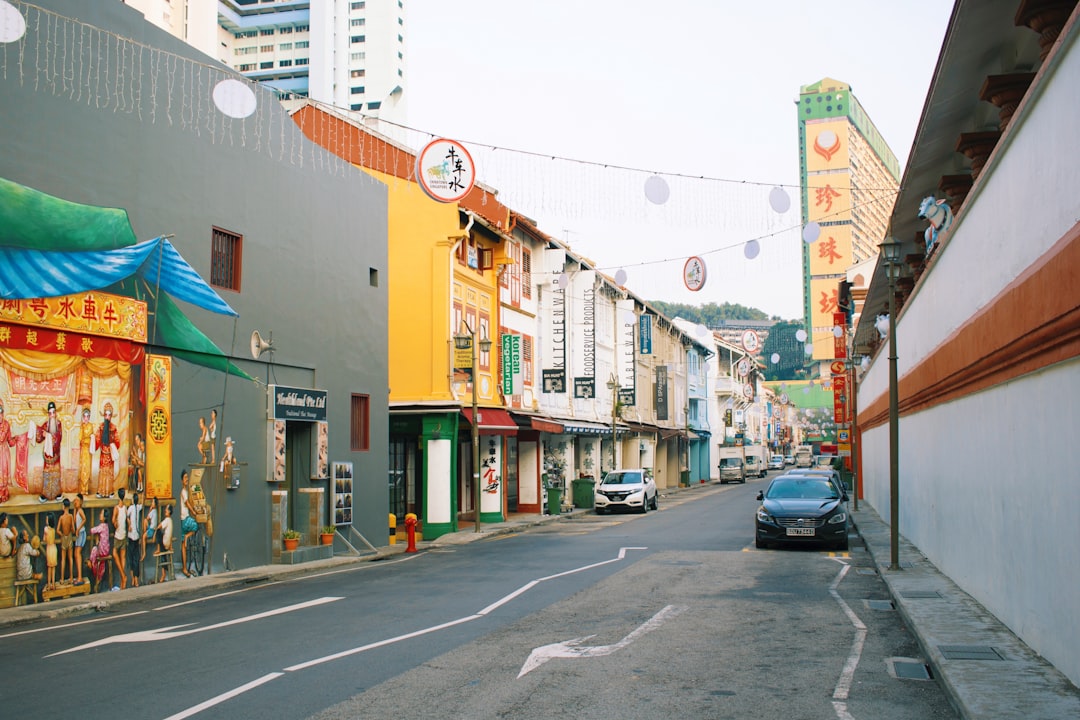
At the Junction of Joo Chiat and Koon Seng Road, Before the Sun Gets High
You might not think of Singapore as a road-trip destination. It’s small, yes—just 278 square miles of tropical island—but it’s dense, layered, and full of hidden corners that reward those willing to trade the MRT for a rental car and a willingness to get a little lost. And if you know where to look, you can spend three days tracing a vanishing craft: the hand-painted shop sign. These are not the glowing, mass-produced LEDs of Orchard Road. These are the works of aging sign painters—men in their seventies and eighties who still mix their own paints and wield brushes the size of your forearm—whose lettered masterpieces cling to the façades of old coffee shops, hardware stores, and Chinese medicine halls. On a three-day island loop, you can find them before they disappear.
Your first morning, pick up your car from a rental depot in the city’s east. You’ll want something compact enough to squeeze into narrow lanes but with enough character to feel like an adventure—a Suzuki Jimny or a small SUV works beautifully. Point yourself toward Joo Chiat Road, a long artery running through the Katong and Joo Chiat neighborhoods. This is where Singapore’s Peranakan heritage meets its modern café culture, and where you’ll spot your first signs before you’ve even stepped out. Look above the awnings of the old shophouses: a fading gold-on-green board for a traditional bakery, or a bold red script advertising a coffee shop that’s been here since the 1950s. The paint is cracked, the letters slightly shaky—this is not perfection, it’s history.
Park near the junction of Joo Chiat Road and Koon Seng Road and walk. The side streets, like Everitt Road and Tembeling Road, are where the real finds live. A hardware store with a sign that simply reads “Hock Lee” in a weathered sans-serif, the white paint yellowed by decades of tropical sun. A bicycle repair shop with a hand-painted panel showing a man riding an old Raleigh, the brushstrokes visible if you lean in close. These signs weren’t designed for Instagram; they were designed to be read from across the street by a customer on foot or on a bicycle. Their charm is in their utility, and their vulnerability is exactly what makes them worth finding now.
For lunch, you’ll find an old kopitiam—a traditional coffee shop—on Joo Chiat Road where the signage is itself a relic. Look for a place with a hand-painted menu board propped above the counter, the letters slightly uneven, the prices handwritten in white paint. Order a bowl of laksa and a cup of kopi-o, the strong black coffee that fuels every sign painter you’re about to discover. As you eat, watch the patrons: the older men in singlets, the aunties in floral blouses, the way they move through a space that hasn’t changed its signage in forty years. This is the living context for the signs you’re chasing.
Campbell Lane at Dusk, Where a Gold-Lettered Ghost Hangs Over the Pavement
Day two, drive north toward Little India. The roads here are narrower, the traffic more chaotic, and the signs more densely packed. Park in the Tekka Centre carpark and walk the streets around Serangoon Road and Campbell Lane. This is where you’ll find the most concentrated collection of hand-painted signs in Singapore, many of them for businesses that no longer exist but whose names remain, ghostly, on the walls above. A gold-lettered sign for a textile shop that closed in the 1990s. A beautifully rendered Hindi script for a jeweler who retired last year. The paint is fading, but the craftsmanship is undeniable.
It’s at this point in your trip that you might notice something: the signs are not evenly distributed. They cluster in the older, less-gentrified pockets of the island—the areas where rents are lower and the pressure to modernize is weaker. This is why a road trip works better than a walking tour of the city center. On a three-day drive, you can cover the whole island’s geography, from the old Malay enclaves of Geylang Serai to the Chinese clan associations in Telok Ayer, and you’ll see how the signs map onto Singapore’s social history. The Chinese medicine halls have the most elaborate signs, often with gold leaf and carved wooden frames. The Indian textile shops favor bold, upright scripts in vibrant colors. The Malay coffee shops tend toward simpler, more organic letterforms. Each neighborhood’s signs tell a different story.
On the afternoon of day two, head to Geylang Serai, the Malay heritage district near the eastern edge of the island. Park near the wet market and wander the lanes that radiate from it. Here, the signs are often bilingual, with Jawi script—the Arabic-derived writing system used for Malay—alongside Roman letters. A single shop might have three signs, each from a different decade, each painted by a different hand. The newest one might be from the 1980s, the oldest from the 1950s, and the colors have faded to pastels that look almost intentional. Photographers tend to recommend golden-hour light here, when the low sun catches the flaking paint and turns every sign into a study in texture and shadow.
South Bridge Road, a Block Away from the Tourists, Near the Hardware Shops
Your third and final day should be spent in the city’s oldest neighborhoods: Chinatown and Telok Ayer. But do not go to the tourist stretch of Pagoda Street. Instead, drive to the quieter end of South Bridge Road, near the wet markets and hardware shops. Park in the Maxwell Food Centre carpark and walk the streets that branch off it—Club Street, Ann Siang Road, and the tiny alleyways that connect them. This is where you’ll find the most refined hand-painted signs, many of them for clan associations and temples that have stood here for over a century. A sign for the Hokkien Huay Kuan, the Hokkien clan association, painted in deep red and gold, the characters so perfectly proportioned they look machine-made until you see the slight wobble in a single stroke. A sign for a traditional Chinese physician, the diagnosis rooms above a shophouse, the characters brushed in black ink on a white board, no frills, no pretense.
By the afternoon of day three, you’ll have developed an eye for it. You’ll notice the difference between a sign that was painted in the 1960s and one that was painted in the 1980s—the older ones have a looseness to the brushwork, a confidence that comes from practice. You’ll spot the ones that were touched up by a different hand, the repair evident in a slightly different shade of red or a letter that doesn’t quite match. And you’ll begin to understand why these signs matter. They are not just advertising. They are the last physical traces of a Singapore that existed before air conditioning, before skyscrapers, before the relentless march of economic development. They are the handwriting of a city.
Before you head back to the rental depot, make one final stop: the old Tiong Bahru estate, Singapore’s first public housing project, built in the 1930s. The signs here are some of the oldest on the island, many of them painted directly onto the concrete walls of the low-rise blocks. Look for the bakery signs, the butcher’s signs, the barbershop signs—each one a small, hand-painted rectangle that has survived war, independence, and redevelopment. The paint is almost gone on some of them, reduced to faint stains on the concrete. But they are still there, if you know where to look.
One Last Sign, Almost Faded to a Stain on the Concrete
There is no tidy lesson here, only the faintest outlines of a city’s handwriting on a wall. The signs survive because nobody has bothered to scrape them off, not because anybody made a plan to preserve them. A barber’s sign on Tiong Bahru Road, a wood panel yellowed to the color of old newsprint, its letters barely legible in the afternoon shade—this is what will remain when the last sign painter retires. The drive back to the depot passes through neighborhoods that look nothing like the ones you spent the morning in, and that is the whole point. You saw them while they were still there.

📷 Photos: Anh Tuan To (Unsplash), Roaming Pictures (Unsplash)