Frame by Frame with Jeepneys: Documenting Manila’s Mobile Art Gallery Before They’re Regulated
Frame by Frame with Jeepneys: Documenting Manila’s Mobile Art Gallery Before They’re Regulated
A chrome-plated jeepney idles at a stoplight on Taft Avenue, its hood painted with the Black Nazarene in lurid purple and gold. The driver’s arm hangs out the window, a rosary wrapped around the rearview mirror. For months, photographers have been chasing these rolling canvases through Manila’s gridlock, trying to document them before the government’s modernization program replaces them with mass-produced minibuses.
Photographing jeepneys isn’t just about pointing a camera at a colorful truck—it’s about reading the city’s rhythm, earning the trust of drivers who’ve seen too many tourists snap a quick shot and disappear, and accepting that most of the best frames come from failure.
5:47 a.m. on EDSA
Manila is not a friendly city for street photography. The heat hits like a wall the moment you step outside, the humidity fogging your lens within minutes. Pedestrians and tricycle drivers step directly into your frame without warning, and the traffic means you’ll spend half your time stuck in a jeepney yourself, watching your ideal shot disappear around a corner. The first few days feel like a masterclass in frustration, with all the wrong exposures at all the wrong moments.
What saves you is patience. You stake out a spot near a major intersection during the early morning lull, when the light is soft and drivers are still rinsing down their rigs. The real game-changer comes when you stop treating jeepneys as static subjects and start approaching them as personalities—each one bearing the driver’s family name, the face of a favorite saint, or a tribute to a Filipino celebrity.
The Hood, the Sides, the Seats
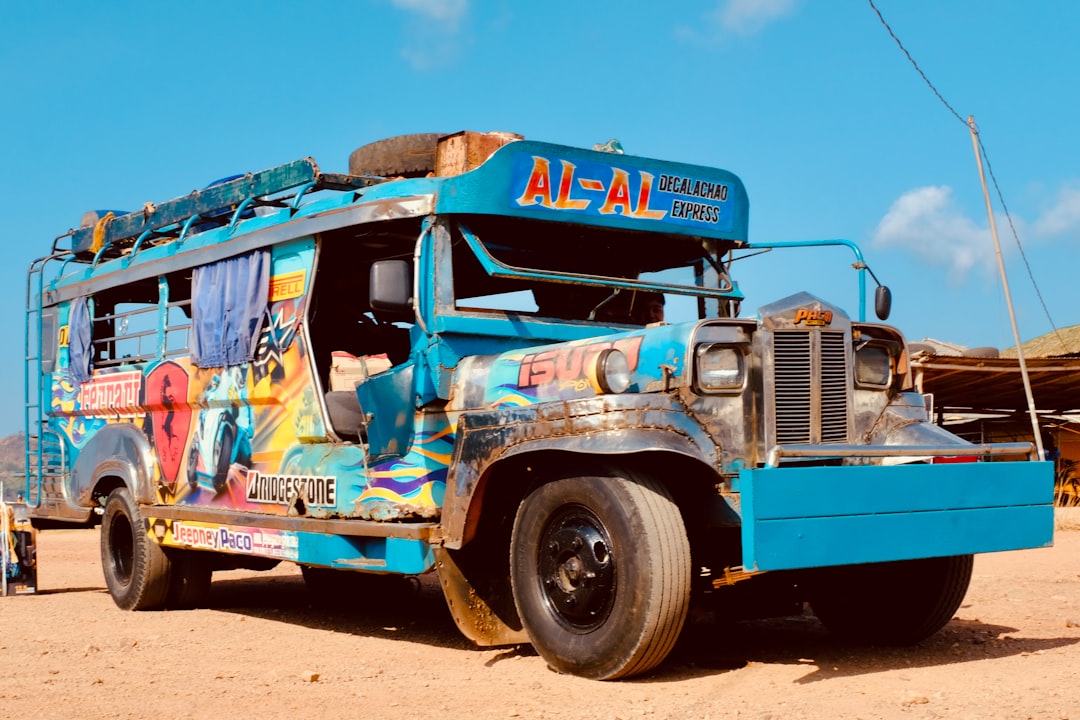
Every jeepney tells a layered story through its physical details. On the hood, you find the most elaborate artwork: hand-painted portraits of boxers like Manny Pacquiao, Catholic icons, or Filipino superheroes from local komiks. The chrome work is often custom, with hood ornaments shaped like galloping horses, eagles, or the Philippine flag.
Move to the side panels, where the real personality emerges. Each jeepney has a “body name” painted in bold, hand-drawn lettering—”Princess,” “God Is Love,” “Beyonce,” or “Pusong Bato” (Stone Heart) in lurid shades of pink, green, and gold. These names are chosen with care, often passed down through generations of drivers. The trick is capturing them in context: the name reflected in a puddle, framed by the driver’s arm hanging out the window, or backlit by the neon lights that come alive at dusk.
The interior is equally rich but often overlooked. Jeepney seats are lined with upholstery in patterns that would make a 1970s casino blush—floral prints, geometric dazzlers, or once-white fabric now stained by years of commuters. Overhead, plastic advertisements for laundry detergent or energy drinks hang from strings, casting shadows across passengers’ faces. A wide shot of the interior during rush hour, with bodies packed shoulder-to-shoulder, tells you more about Manila’s daily life than any posed portrait could.
Cubao at Noon, Quiapo at Dusk
Not all jeepneys are created equal. The route from Baclaran to Divisoria along Taft Avenue is a goldmine for chrome-heavy, elaborately painted jeepneys maintained for decades—the “luxury” versions, with multiple rows of seats, stereo systems blasting OPM ballads, and drivers who take genuine pride in their rigs.
For sheer density, head to the Cubao area in Quezon City. The Araneta Center bus terminal and the nearby jeepney stops are a photographer’s playground, with dozens of vehicles converging from different routes. You can spend an entire afternoon here, moving from one parked jeepney to another. The key is shooting from low angles—crouch down near the exhaust pipe so the jeepney towers above you, emphasizing its size and the complexity of its design.
In the narrow streets of Quiapo near the Black Nazarene Church, you’ll find jeepneys modified for religious devotion, with shrines built into the dashboard, rosaries dangling from the rearview mirror, and images of the Black Nazarene painted onto the roof. The drivers here are often more willing to talk, because their rigs are an extension of their faith. Ask permission, and you’ll gain access to details most photographers miss—the handwritten prayer taped to the steering wheel, the incense holder tucked beside the gearshift.
F/8 at 1/250th
Manila’s light is brutal. The midday sun is harsh and flat, washing out vivid colors and casting hard shadows across a jeepney’s surfaces. Your camera’s meter will fight you, underexposing the chrome while blowing out the sky. The solution: shoot in the golden hours or embrace the rain. Manila’s monsoon season brings dramatic, overcast skies that diffuse the light perfectly, saturating the paint jobs and adding moody reflections from wet pavement.
Movement is your other constant enemy. Jeepneys rarely sit still for long, and when they do, they’re usually surrounded by swarms of commuters and vendors. A fast shutter speed—at least 1/250th of a second—is essential for freezing the action. But don’t default to a shallow depth of field. The whole point of jeepney photography is context: you want the surrounding market stalls, the street signs, the other vehicles, and the pedestrians to be sharp. Stop down to f/8 or f/11 and let the scene speak for itself.
A polarizing filter is your best friend here. It cuts glare from the chrome, deepens the blue of the sky, and reduces reflections off the windshield so you can see the driver’s face. Without one, your images of chrome-laden jeepneys will look like they were shot through a smeary lens.
“Maganda Po ang Jeepney Ninyo”
Drivers are protective of their jeepneys, and rightly so. These vehicles are their livelihood, often costing hundreds of thousands of pesos and requiring constant maintenance. When you approach a driver to photograph his rig, you’re asking him to pause his income-generating activity. The respectful approach is to offer money—a standard “pamasahe” (fare) of 50 to 100 pesos is appreciated and opens doors. But never hand over cash before you’ve negotiated access, or you’ll find yourself in a situation where the driver demands more after a few shots.
You’ll encounter drivers who refuse outright, especially those running late for their route. Don’t push. Instead, learn to read body language. A driver who’s smiling, leaning back, or chatting with other drivers is open to conversation. One who’s gripping the steering wheel, checking his watch, or talking on his phone is not. The best interactions come when you show genuine interest in the vehicle. Ask about the name painted on the side, or compliment the chrome work.
Learn a few Tagalog phrases—”Maganda po ang jeepney ninyo” (Your jeepney is beautiful), “Puwede po bang kumuha ng litrato?” (May I take a photo?), “Salamat po” (Thank you)—and use them sincerely. Your effort will be repaid with patience, and often with stories about the jeepney’s history that you’d never get otherwise.
The Crowd as Compass
Manila’s streets are never empty, and that’s both a curse and a gift. A jeepney without commuters boarding it, or without a vendor selling cigarettes through the window, looks sterile and staged. Embrace the chaos.
Use the crowd as a compositional tool. Frame the jeepney so that passengers are exiting and entering, creating a natural flow of movement across your image. Position yourself so that a row of commuters waiting for the next jeepney becomes a leading line toward the main subject. Let the crowd blur at slower shutter speeds to emphasize the jeepney’s stillness, or freeze them to capture the energy of a busy intersection.
One trick that works: shoot from inside a jeepney looking out. The view through the window, with the driver’s arm visible and the streetlife rushing past, gives the viewer a sense of what it’s like to ride these vehicles. You’ll need a wide-angle lens, and you’ll have to work quickly before the jeepney departs.
Neon and Fluorescence
As evening descends, Manila transforms into a city of neon and fluorescence. The jeepneys, with their rows of colored lights along the ceiling and their illuminated nameplates, become something else entirely. This is when you switch to a fast prime lens—a 35mm f/1.8 or a 50mm f/1.4—and shoot wide open to capture the glow of the dashboard shrines and the reflection of streetlights in the chrome.
The low light means you’ll crank up your ISO, and the noise in the shadows can be distracting. But the trade-off is the atmosphere: a jeepney idling at a stoplight, its interior lit by the soft amber of a single bulb, the driver’s face half-hidden in shadow. These are the images that feel like late-night commutes, like the city’s pulse after dark. You’ll want a tripod for stationary shots, but handholding at 1/60th of a second is possible if you brace yourself against a wall.
Be aware that nighttime photography attracts more attention. Police officers and security guards may approach, assuming you’re documenting something sensitive. Carry a photocopy of your passport and a polite explanation of your project in Tagalog. The drivers themselves are often more relaxed at night, after a long day, and more willing to let you spend time with their vehicles.
Texture, Not Technicolor
Back at your editing setup, you’ll face the temptation to oversaturate your jeepney images. The colors are already loud, the chrome already blinding—more vibrancy will tip them into cartoon territory. Instead, focus on contrast and clarity. The jeepneys’ paint jobs are weathered, with layers of dust and grime that add texture. Emphasize that texture by pulling back the highlights and boosting the shadows, so the chrome retains detail and the painted surfaces show their brushstrokes and fading.
Your white balance will need adjustment. Manila’s streetlights are a mix of warm sodium orange and cool fluorescent blue, and your camera will struggle to find a neutral point. Correcting to a daylight balance often makes the evening shots look unnatural; embrace the mixed lighting instead, letting the warm hues dominate while the blue accents add depth.
One Route, Ten Rides
The modernization program is real, and it’s moving fast. Already, thousands of old jeepneys have been replaced by modern, air-conditioned units that lack the hand-painted art and chrome accents. In some parts of Metro Manila, routes that were once dominated by vintage jeepneys now run only the new models. If you’re serious about documenting these mobile galleries, the window is narrowing.
This pressure can make a photographer frantic, and a frantic photographer makes bad decisions. The counterintuitive solution is to slow down. Spend an entire day on one route, riding back and forth, getting to know the drivers and their schedules. The photographs you take on day two will be better than anything you shot in a frenzy on day one, because you’ll have learned the rhythm of that particular line—when the light hits the hoods, when the crowds thin, when the drivers are most willing to pose.
Target three or four routes—the Baclaran-Divisoria line, the Cubao-Crossing line, the Quiapo-Baclaran line—and commit to shooting each one over multiple visits. The documentation project isn’t a sprint; it’s a slow, careful archive. You’ll sweat through your shirt, miss shots to sudden rain, negotiate with drivers in broken Tagalog, and return with hundreds of frames that don’t work. But the ones that do—a jeepney’s chrome grille catching the morning sun, a driver’s weathered hand on the steering wheel, a family name painted in gold against a fading blue sky—become something more than photographs. They’re evidence of a Manila that’s disappearing, one junction at a time.
📷 Photos: John Mukiibi Elijah (Unsplash)