Dark Water, Darker Trail: One Night on the Phong Nha River
Dark Water, Darker Trail: One Night on the Phong Nha River
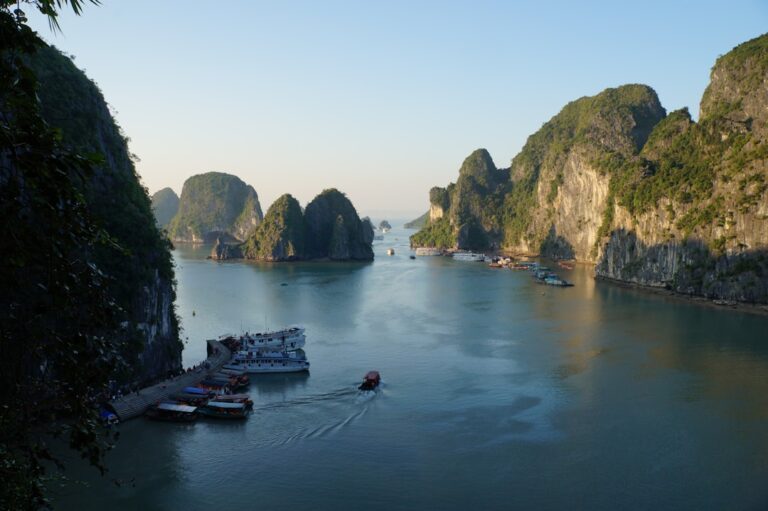
The boatman killed the engine a full kilometer before the landing. Not because they’d arrived, but because the water had narrowed to a channel where the propeller risked hitting the limestone shelf beneath. For a moment, the only sound was the hull scraping against rock, then nothing at all—just the drip of water off the oar he’d picked up without a word. It was 4:30 in the afternoon, and the sun had already vanished behind the karst ridge to the west, leaving the river in a flat, green twilight.
Phong Nha is not a place that announces itself. The national park, about an hour’s drive northwest of Đồng Hới, contains some of the largest cave systems on earth—Son Doong gets the magazine covers, Hang Én gets the trekkers—but the river valley itself is quieter than most visitors expect. Guesthouses cluster along the main road through Phong Nha town, but the trailheads are scattered and unmarked. The Dark River, a tributary that feeds into the Son River a few kilometers downstream of the main cave entrance, doesn’t appear on most tourist maps at all. Locals call it something simpler: the back way in.
The plan was to paddle upriver before dark, find the old trailhead used by the Vietnamese Army during the war, and camp somewhere high enough to hear the gibbons call at dawn. The full moon was supposed to rise around nine, which meant navigating the return trail by moonlight—no headlamps, no backup lights, just whatever the sky gave. The boatman, a man in his sixties named Mr. Lợi who’d been running these waters since before the park existed, didn’t seem to find this unusual. He asked once if the visitor had a hammock. Yes. A rain cover. Yes. Then he nodded and continued poling.
The River at Dusk
The Dark River gets its name from the tannin-stained water, the color of steeped tea, which absorbs light rather than reflecting it. From the boat, the bank looked like a wall of green—bamboo, rattan, strangler figs, the occasional exposed root system of a tree that had grown sideways out of the limestone. The channel twisted constantly, and Mr. Lợi navigated by reading the surface: a ripple here meant a submerged rock, a smooth patch meant deep water. He pointed once at a cave entrance half-hidden behind a curtain of liana, no bigger than a car door. “Bomb shelter,” he said. “Nineteen-seventies.” Then he said nothing for another twenty minutes.
By the time they reached the landing—a muddy bank where the forest floor met the water at a steep, slippery angle—the light had gone from green to gray. Mr. Lợi tied the boat to a sapling and gestured up the slope. “One hour,” he said. “Maybe more, if you take the wrong way.” He pointed to a faint cut in the vegetation. “Follow the white paint.” Then he pushed off, the boat sliding back into the current without a sound, and was gone.
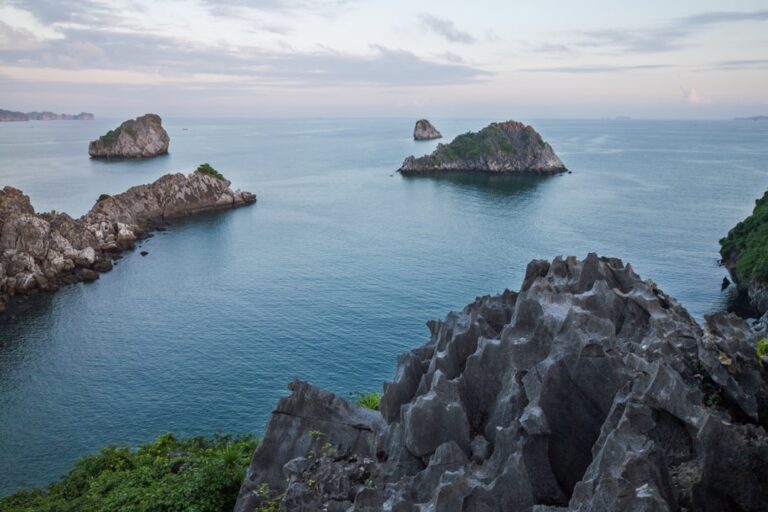
The trail went up immediately. Not switchbacks—just a straight, punishing climb over limestone karren, the sharp-edged rock that forms when millions of years of rain dissolve the surface into ridges and pockets. The white paint marks were small, about the size of a thumbprint, and appeared every twenty or thirty meters. Miss one and the forest closed in fast. The air was damp in a way that felt heavy, almost liquid, and the smell was less of soil than of wet stone and rotting leaves, with an occasional sharper note—something like cinnamon, but not—that came from a tree whose bark had been scraped by a passing animal.
A Clearing and a Question
Forty-five minutes in, the trail leveled out onto a small plateau maybe fifty meters across. The canopy opened just enough to see a patch of sky, still pale blue overhead. In the center of the clearing stood the remains of a concrete structure—walls about waist-high, the roof long gone, a rusted metal door frame with nothing attached. The floor was covered in leaf litter and bat guano. Someone had built a fire ring in one corner recently; the ash was still dry, not yet turned to mud by rain.
This was the place. The army had used this ridge as a staging point during the war, moving supplies along the trail network that connected the DMZ to the Ho Chi Minh Trail farther west. The concrete was probably a communications post. There was no plaque, no sign, nothing to explain it. Just the walls and the silence and the sound of something large moving through the underbrush about a hundred meters off—a deer, maybe, or a wild boar. The sound stopped when the visitor stopped moving, then started again, heading away.
Setting up the hammock took longer than expected. The trees at the edge of the clearing were mostly hardwood, their trunks smooth and straight, but finding two the right distance apart meant walking the perimeter twice. By the time the tarp was up and the mosquito net tied off, the sky had gone from blue to a deep, bruised purple. The full moon hadn’t risen yet, but the stars were coming out—not the washed-out version visible from town, but the full, dense field of them that only appears when there’s no artificial light within miles. The Milky Way was a distinct band, almost bright enough to cast a shadow.
Waiting for the Moon
Darkness in the Vietnamese karst forest is not the same as darkness anywhere else. It arrives all at once, as if someone turned a dimmer switch past its last click. One moment there was still enough light to see the outline of the concrete walls; the next, there was nothing but the soundscape: cicadas at a pitch that seemed to vibrate inside the skull, the occasional rustle of something small moving through dry leaves, and, once, a sound that could have been a bird or a frog or something else entirely—a low, resonant croak that lasted about three seconds and then stopped. No one nearby to clarify what made it.
The moon came up over the karst ridge at 9:12, give or take a few minutes. It was not the gentle, romantic moon of postcards. It was sharp and white, and it flooded the clearing with a light so strong that the shadows of individual leaves were visible on the ground. The forest, which had felt claustrophobic in the dark, suddenly opened up into a landscape of silver and black. The concrete walls, which had seemed merely abandoned, now looked deliberate, their angles catching the light in a way that felt intentional. A bat flew across the moon’s face, and for a second, the whole scene looked staged—like a diorama in a natural history museum, too perfect to be real.
Sleep didn’t come easily. The hammock was comfortable enough, but the sounds changed after midnight. The cicadas quieted, and something else took their place—a low, rhythmic hooting that came from the valley below, too steady to be a bird. It went on for about twenty minutes, then stopped. Then, closer, a rustling that sounded like an animal brushing against the hammock lines. The visitor sat up, heart pounding, and shone a headlamp into the darkness. Nothing there. The rustling continued for another few minutes, then faded. Probably a civet. Probably.
The Gibbons Wake
The gibbons started calling at 5:17 AM. Not gradually—they began at full volume, as if someone had pressed play on a recording. The sound was unlike anything a Western ear expects from a primate: not the hooting of a monkey or the shriek of a chimpanzee, but a long, ascending whoop that seemed to hang in the air for several seconds before sliding down into a series of shorter notes. It was musical in a way that felt deliberate, almost melodic, and it came from two directions at once—a duet between a male and a female, their voices interweaving in a pattern that repeated every fifteen or twenty seconds.
There are about 130 gibbons left in Phong Nha-Ke Bang National Park, according to a 2019 survey by the park’s conservation department. The population has been stable for about a decade, which counts as a success story in a country where most primate species are in decline. The gibbons here are the northern white-cheeked variety, and their calls carry for up to two kilometers through the forest. The duet serves multiple purposes: it marks territory, it strengthens pair bonds, and it tells other groups exactly where everyone is, reducing the chance of confrontation. But knowing that intellectually doesn’t prepare anyone for the experience of hearing it at dawn, alone, in a clearing where the only other human sound is one’s own breathing.
The calling lasted about forty minutes, then tapered off. By six, the forest had gone quiet again, and the first light was starting to filter through the canopy—a pale, watery gray that didn’t yet feel like morning. The visitor lay in the hammock for another ten minutes, not moving, listening to the silence settle back in. Then the birds started, and the cicadas, and the normal daytime sounds of the forest resumed, as if nothing unusual had happened.
Leaving the Clearing
The walk back to the river took longer than the walk up. Not because the trail was harder in daylight—it was actually easier, the white paint marks obvious now—but because the visitor kept stopping to look at things that had been invisible in the dark: the enormous buttress roots of a tree that must have been three hundred years old; a spider’s web strung across the trail, each strand beaded with dew; a pile of fresh elephant dung on the path, still steaming, which raised the question of whether elephants were supposed to be in this part of the park or not. (They weren’t, officially. Wild elephants in Vietnam number around a hundred, mostly in the Central Highlands. But someone had forgotten to tell this one.)
Mr. Lợi was waiting at the landing, exactly on time. He had brought a thermos of green tea and a bag of sticky rice wrapped in banana leaf, which he handed over without comment. The visitor ate sitting on the edge of the boat, feet dangling over the dark water, while Mr. Lợi poled them back downriver. The sun was fully up now, and the karst peaks were reflected in the river’s surface, which had turned from tea-brown to something closer to jade in the morning light. A kingfisher shot past, a blur of blue and orange, and disappeared around the next bend.
“Gibbons?” Mr. Lợi asked, after a long silence.
“Yes,” the visitor said.
He nodded. “Good sign.” Then he went back to poling, and they didn’t speak again until the boat reached the main river, where the tour boats were already lining up for the day’s first cave trips. The engine started, the propeller bit into the water, and the Dark River disappeared behind them, indistinguishable from any other channel in the limestone.