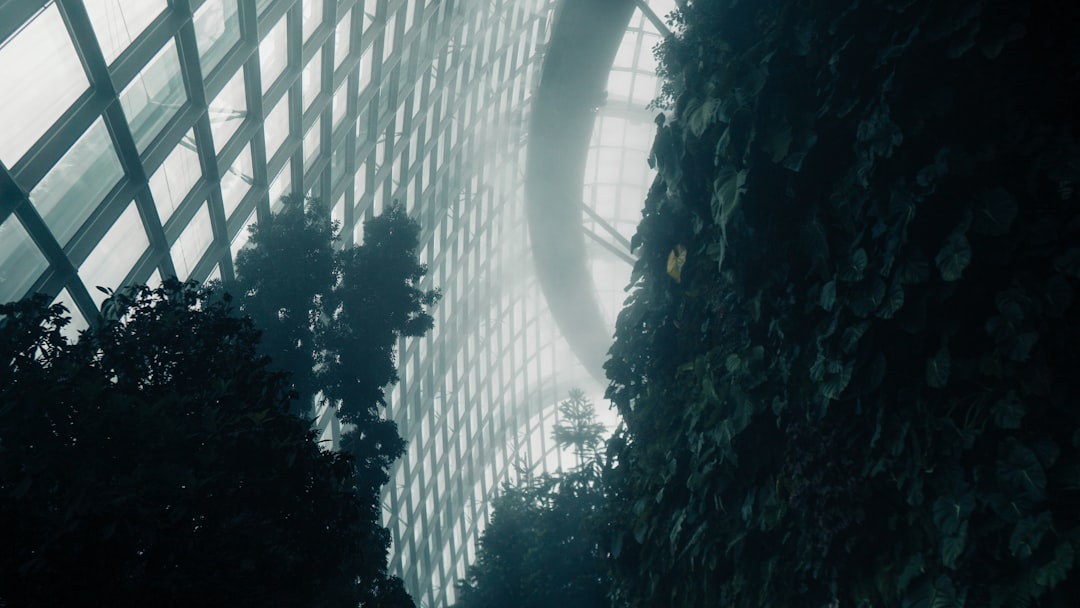
The runes only show for an hour. After that, it’s just trees.
The runes only show for an hour. After that, it’s just trees.
The Supertrees at Gardens by the Bay are not subtle. They rise at heights between 25 and 50 meters, clad in living flora, wired for light shows, visible from half of Marina Bay. Most visitors see them at night, when the Garden Rhapsody show turns them into a slow-motion fireworks display projected onto steel-and-concrete trunks. That version is polished, scheduled, and photographed by roughly 12,000 people on any given evening.
But the daytime version, between roughly 3:30 and 4:30 PM on a clear afternoon, does something the night show cannot. The low sun angles through the canopy and hits the structural steel at a specific slant, producing shadows on the ground that look less like engineering and more like something scratched into a cave wall by a hand that never expected anyone to find it. Not beautiful, exactly — the word that keeps coming up is illegible.
“I thought someone had drawn them,” said Marcus Yeo, who works at the Ticketing Services counter near the Supertree Grove and has watched visitors stop mid-stride during that window for the past two years. “Tourists would point at the ground and ask where the artwork was. They couldn’t believe it was just the sun.”
It is, in fact, just the sun. But just the sun, at the right hour, turns the OCBC Skyway’s suspension cables and the steel lattice of the tallest trees into patterns that do not resolve into anything recognizable — not a face, not a letter, not a shape the brain can file away as finished.
Four o’clock works. Noon does not.
The Supertree Grove contains twelve structures, but only the four tallest — those above 40 meters — produce the shadow effect reliably. The shorter ones cast shadows that are too stubby, too close to their own base, to read as anything other than a blob. The geometry requires a steep enough angle that the shadow stretches outward from the trunk, and a low enough sun that the steel framework casts not a single silhouette but a fractured, multi-layered one, where each horizontal beam prints a separate line on the pavement.
That window runs from approximately 3:30 PM to 4:30 PM during Singapore’s dry season (February through April, and July through August). In the wetter months, cloud cover often scatters the light before it reaches the ground, turning the rune effect into a faint suggestion at best. On overcast days, the patterns look like nothing at all.
Nur Sakinah, a landscape architect who consulted on the Supertree Grove’s planting scheme during construction, noted that the effect was not fully anticipated by the design team. “We knew the orientation would produce certain light conditions,” she said. “But the runic quality — that was not in the brief. The engineers were more concerned with how the structure would handle wind load and irrigation. The shadows were incidental.”
Incidental, but not random. The pattern changes day to day as the sun’s arc shifts by roughly a degree per week. A visitor arriving in early March will see a different arrangement than someone standing in the same spot in late April. The shadows stretch longer and thinner as the season progresses, eventually losing definition entirely when the angle becomes too oblique.
Where to stand
Not at the center of the grove, as most people do. The best viewing position is at the southern edge, where the shadows fall across a wide, flat area of concrete that was originally intended as overflow space for events. There are no benches there, no signage, no marked viewpoint — just a stretch of ground that happens to catch the light. The shadows stretch northeast from the trees, so a visitor standing with their back to Marina Barrage will see the patterns at their sharpest.
A small group of regulars has learned this. On a Tuesday afternoon in late March, six people were positioned along that edge, none of them talking, most of them holding phones flat against the ground to capture the pattern without distorting it. One of them, a retiree named Koh Boon Hwee who comes twice a week, said he first noticed the effect three years ago while waiting for a grandchild to finish at the nearby Children’s Garden. “Nobody told me about it,” he said. “I just saw my own shadow didn’t look right. Then I looked down and saw the whole thing.”
The practical friction
Getting to that spot at the right time costs more in inconvenience than in money. Entry to the Supertree Grove is free — the ticketed attractions are the OCBC Skyway (S$14 for adults) and the two cooled conservatories. The Singapore weather, however, is not free, and 3:30 PM in March sits at the tail end of the day’s heat, with temperatures still hovering around 32°C and humidity at 80 percent. The concrete radiates stored warmth. There is no shade in the viewing area. A 45-minute wait there means sweat, squinting, and the kind of discomfort that makes most visitors retreat to the air-conditioned Flower Dome after ten minutes.
That discomfort is the filter. It keeps the space uncluttered. A visitor who shows up at 4:15 PM, having wandered over after a cold drink at the nearby food court, will find the area largely empty and the shadows already softening. The real show happens between 3:30 and 4:00, when the heat is at its most punishing and the casual crowd has not yet returned from lunch breaks or hotel naps.
Sakinah pointed out another complication: maintenance schedules. The Supertrees are not static structures. They are irrigated, pruned, and occasionally scaffolded for repairs. On a visit in January, a work crew had cordoned off the southern edge entirely, forcing viewers to the central plaza where the shadows fell across turf and planting beds instead of bare concrete, absorbing the pattern into the greenery. The effect became invisible.
“There is no way to know when maintenance will happen,” she said. “The schedule is not published. You could come at the perfect time and find a truck parked on your pattern.”
That is the risk of incidental design: nobody has to protect it.
What to bring, what to skip
Phone cameras perform better here than most dedicated cameras, for a specific reason: the shadows require no zoom and no depth of field manipulation. The whole pattern sits flat on the ground, and the best shot is taken from directly above, with the phone parallel to the pavement. A wide-angle lens distorts the edges. A telephoto compresses the pattern into something that looks like ordinary gridwork. The phone’s standard lens, held at arm’s length, captures what the eye sees.
A hat matters. Sunscreen does not — it melts off within twenty minutes in the combination of heat and sweat, and any protection it offered is gone by the time the shadows reach their peak. A light-colored, long-sleeved shirt works better. A bottle of water, purchased at the convenience store near the Bayfront Plaza MRT exit, costs S$2.30. The same bottle inside the Gardens costs S$4.50.
Koh brings a folding stool that he carries in a small backpack. “I tried sitting on the ground,” he said. “First time, I couldn’t stand up. Second time, I didn’t try.” He also brings a notebook, not for the shadows but for the birds that arrive at the Supertrees around 5:00 PM to roost.
The question of the Skyway
The OCBC Skyway — the elevated walkway that connects two of the larger Supertrees at 22 meters up — is sometimes recommended as a viewing platform for the shadows below. It is not. From above, the shadows appear as themselves: structural projections, unremarkable and ordinary. The rune effect depends on being at ground level, where the pattern cannot be traced back to its source without looking up. The walkway gives the viewer too much information. It ruins the illusion.
The Skyway is worth the S$14 for the view of the Marina Bay skyline at sunset, but not for this. That distinction matters because many visitors try to combine the two experiences and end up disappointed, having spent money on a ticket that undercuts what they came to see.
What the runes actually look like
The word “rune” is a metaphor, and like most metaphors for unidentifiable things, it is imprecise. The shadows do not look like Norse or Germanic characters. They look like scratches. They look like a language that someone started to write and then abandoned halfway through. There are curves that do not close, straight lines that intersect at angles that feel deliberate but lead nowhere, and one recurring motif — a kind of spiral with a tail — that appears every afternoon in the same spot, as if the sun is trying to sign its name.
That spiral, Koh said, is the only part of the pattern that visitors consistently try to photograph. “Everyone wants that one. They see it and they say, ‘That’s the one. That’s the one that means something.’ But it’s just the light catching a specific weld joint on Tree Number Eight. I looked it up.”
He did look it up. Tree Number Eight is the second-tallest in the grove, at 46 meters, and its weld pattern happens to produce a spiraling shadow during a six-week window in early spring. After that, the joint stops catching the light, and the spiral disappears until the following year.
There is no way to know when the spiral will return. The designers did not track it. The maintenance crew does not account for it. The information exists, if at all, only in the observation of people like Koh, who have stood in the heat long enough to notice what changes and what does not.
The best time to see the runes is three-thirty in the afternoon, on a clear day, between February and April, on the southern edge of the Supertree Grove, in the heat, away from the shade, with a bottle of water from outside the park and a phone held flat to the concrete. The spiral may or may not be there. The maintenance crew may or may not have parked a truck on your spot. The sky may or may not cooperate.
But when it works, the pattern on the ground has no explanation that fits in a caption, and it does not need one.
📷 Photos: Makarios Tang (Unsplash), Daniel G (Unsplash)