One Woman’s Jalan Nagor and the Case of the Missing Banana Leaves
One Woman’s Jalan Nagor and the Case of the Missing Banana Leaves
The first one I found was on Jalan Nagor, and I almost walked right past it.
It was late afternoon, maybe four-thirty, and the sun was still fierce enough that the shadows were short and mean. I’d been wandering around George Town for three days, eating my way through the usual suspects — the char koay teow at Lorong Selamat, the cendol at Penang Road, the nasi kandar that everyone insisted was the best. Good stuff, all of it. But I was looking for something I’d read about in a blog post from 2014, something that felt like it belonged to an older version of this city: the banana leaf rice stalls that were supposed to be vanishing one by one.
The blog had mentioned a woman near the Chowrasta Market who’d been doing it for forty years. But Chowrasta is a warren of lanes and tempers, and after two hours of walking in widening circles, my shirt was stuck to my back and I’d gotten nothing but a headache and a polite but firm “sorry, no” from three different stallholders who looked at me like I was asking about a ghost.
I stopped at a Kedai Kopi on the corner of Jalan Nagor to drink two glasses of iced barley in a row. The place was mostly empty — a few old men reading Chinese newspapers, a fan that barely moved the air. I was staring at nothing, the condensation running down my glass, when I noticed the woman across the street.
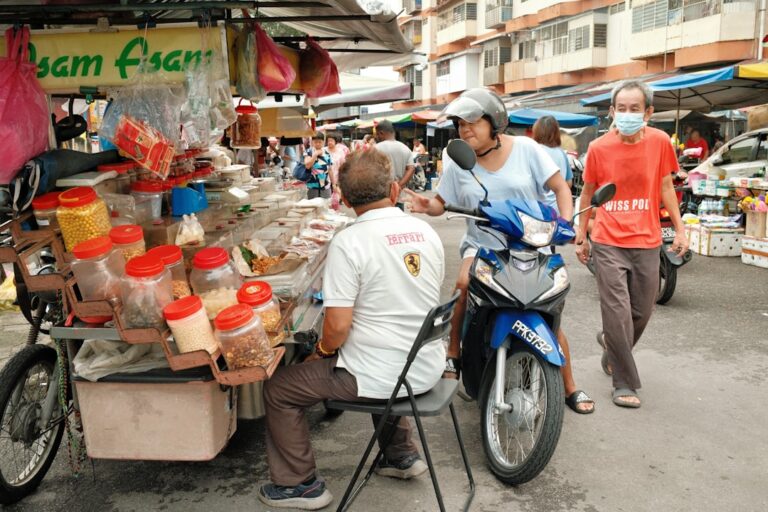
She was setting up. Not a stall, exactly — more like a portable kitchen that had been assembled so many times it knew its own shape. A large steel pot, a stack of banana leaves cut into neat rectangles, a smaller pot of what looked like curry. She moved with a kind of economy that comes from doing the same thing for decades. No wasted motion.
I crossed the street. She was maybe sixty, with grey-streaked hair pulled back tight and the kind of hands that don’t shake. I asked her — in my clumsy Malay that I’d been practicing on strangers — if she sold banana leaf rice.
She looked at me for a second, then said, in English, “You want?”
“Yes, please.”
“Come back seven o’clock.”
That was it. She went back to arranging her pots, and I went back to the coffee shop to wait.
The Seven O’Clock Queue
At seven sharp, there were already six people waiting. Not tourists — a construction worker in a dusty vest, a woman carrying a market bag with some greens sticking out, a man who looked like he’d just finished his shift at one of the hotels. I joined the back of the line.
The woman — I never did get her name, not properly — worked fast. Banana leaf on the plate, a ladle of white rice, then a smaller spoon of fish curry, a spoon of chicken curry, a dollop of sambal belacan that she warned me about with a finger pointed at my face. “Spicy,” she said. “You sure?” I nodded. She added it anyway, but with a smaller amount than she’d given the man before me.
The whole thing was 4 ringgit. That’s less than a dollar.
I took my plate and found a spot on a low wall across the street, balancing it on my knees. The rice was still steaming. The banana leaf gave it a faint, grassy smell that I hadn’t expected. The curries were different things — the fish curry was sour and sharp with tamarind, the chicken one was rich and thick, almost black with caramelized onions. The sambal hit about ten seconds later, a clean, precise burn that didn’t linger but left a heat in the back of my throat that made me reach for the barley I’d brought from the coffee shop.
I ate too fast. I always do when something is good and I’m worried it might be the last time.
She was already packing up by the time I brought the plate back. I asked her if she was here every day. “Not Sunday,” she said. “Sometimes Monday also not.” That was all she offered.
A Woman on Her Front Porch
Over the next few days, I started asking around properly. Not at the tourist information office — nobody there knew what I was talking about — but at the wet market, at the coffee shops, at a hardware store where a man sold me a bottle of water and ended up giving me directions to three different stalls.
The first one he sent me to was on Lebuh Kimberley. It was a proper kopitiam, fluorescent lights, Formica tables, a guy with a cigarette behind his ear. He served banana leaf rice but it was a side thing, not the main show. The leaf was there, sure, but the rice had been sitting in a warmer and the curry was thin. It was fine. It was lunch. It wasn’t what I was looking for.
The second one was in a housing estate off Jalan Perak — a woman named Kala who’d been selling from her front porch for fifteen years. I found her around 8 a.m., which turned out to be the only time she served. Her banana leaf rice was different from the first woman’s — more vegetables, a bright yellow dal that she ladled generously, and a lime pickle she made herself. She told me, unprompted, that she used to have a stall in town but the rent went up and she couldn’t justify it. “Better here,” she said. “My neighbors, they know me. They come.”
I asked her about the old ones. The ones that were gone.
“Ah,” she said, wiping her hands on a cloth. “You want those.” She named a few locations — Jalan Dato Keramat, a stall near the old bus station, one that used to be behind the Kapitan Keling Mosque. “All gone,” she said. “Some retired. One died. The children don’t want.”
She didn’t seem sad about it. Just factual. But she also told me that Ravi sometimes took over his uncle’s old spot on Jalan Dato Keramat, if I wanted to try my luck.
Two Afternoons on Jalan Dato Keramat
I went to Jalan Dato Keramat anyway. It’s a busy road, noisy, full of motorbikes and the smell of exhaust and frying things. The address Kala had given me was for a spot between a phone repair shop and a clinic. There was nothing there but a patch of oil-stained concrete and a faded sign that said “Banana Leaf Rice” in Malay, with the letters wearing away.
I sat on the curb for a while and watched a man across the street fix a scooter. I felt stupid for expecting anything else.
But two days later, I was walking past the same spot around 1 p.m., and there was a man there. He was unloading a cooler from the back of a beat-up Proton. I stopped. He saw me looking.
“You want?” he said.
He was maybe fifty, with a face that looked like it had been in the sun a lot. He told me his name was Ravi. He’d taken over the spot from his uncle, who’d retired three years ago. “Some weeks I come,” he said. “Some weeks, no. Depends.”
I asked him if business was good. He shrugged. “Enough.”
His banana leaf rice was different again — simpler, just rice, a single fish curry, and a pile of fried bitter gourd that he seemed particularly proud of. “You try,” he said, pushing it toward me. It was good — the bitterness cut through the richness of the curry in a way that made sense.
I sat on the same curb and ate. A dog came by and sniffed my shoe. A motorbike almost hit a chicken that had wandered into the road. Traffic roared past. It was not picturesque. But the rice was steaming hot, the banana leaf was fresh, and I had the feeling of being exactly where I was supposed to be, which is not the same as being comfortable.
Air Itam, Thursday Only
The last one I found was through a piece of bad luck. I’d been working from a list I’d compiled from three different sources — two blog comments from 2017 and a conversation with a taxi driver who’d said, “My wife’s aunt, she used to do that.” I’d tracked the aunt to a coffee shop in Air Itam, a forty-minute bus ride from George Town. I got there at eleven in the morning, ready for lunch, and found the coffee shop closed for renovations. A sign on the gate said it would reopen in three weeks.
I was annoyed. I’d wasted a morning, and the bus back was not for another hour. I stood around near the bus stop, trying to figure out what to do, and a woman selling kuih from a basket asked me what I was looking for. I told her. She thought for a moment, then pointed down a side street. “There,” she said. “But only Thursday.”
It was Thursday.
The stall was tucked behind a hardware store, barely visible from the road. A woman named Subha, who had to be in her seventies, was serving a small crowd from a setup that looked like it had been there since the 1980s. Plastic chairs, a faded umbrella, a pot of curry that had been simmering so long the spices had collapsed into something almost velvety.
Her banana leaf rice came with a piece of fried fish — a whole ikan kembung, head and all, crisp on the outside, the flesh flaking apart. She served it with a spoonful of sambal that was dark red, almost black, and a heap of cucumber slices. The leaf itself was huge — big enough that the rice barely covered half of it.
I ate slowly this time. The fish was good, but the curry was the main event — deep, a little sweet, with a heat that built gradually, not the kind that announced itself. I had two servings. Subha didn’t say much, but she smiled when I asked for more rice, and that felt like enough.
Back to Jalan Nagor
I went back to Jalan Nagor on my last evening in Penang. I wanted to see the first woman again, to thank her properly, maybe to get her name. But the spot was empty. Next to it, a guy was selling fried noodles from a cart, and he told me she hadn’t come that day. “Sometimes she doesn’t,” he said. “Family things.”
I stood there for a few minutes, watching the traffic. The sun was starting to drop, and the light was turning that particular Penang gold — thick and warm, the kind that makes everything look like it belongs in a photograph, even a patch of oil-stained concrete with a faded sign for banana leaf rice.
I’d found four stalls. Three of them were women working alone, from their homes or from spots they’d held for years. One was a man who showed up when he felt like it. None of them were on Google Maps. Two of them I found by accident, through someone who pointed down a street I wasn’t planning to walk down.
I don’t know if they’re the last ones. I don’t know if there’ll be fewer next year, or if new ones will appear somewhere else, in some other lane. But I know the food on Jalan Nagor was 4 ringgit, and the curry on a Thursday in Air Itam was the best I ate all week, and I still don’t know the first woman’s name.
If you’ve found one I missed, I’d love to hear about it — drop a comment below.