The Morning I Almost Didn’t Go Up
The Morning I Almost Didn’t Go Up
I’d been to Cradle Mountain maybe six times before that March morning, and I still made the same mistake. Left my rain jacket in the car. The forecast said “possible showers” which in Tasmania means you should assume you’ll be wet within an hour, but I was rushing because the shuttle bus timetable hadn’t changed since my last visit and I’d forgotten how quickly they fill up in spring. By the time I realised, I was already at the Dove Lake carpark with a light fleece and a sense of impending regret.
The walk to Marion’s Lookout starts deceptively flat. You’re threading through buttongrass and snow gums, thinking this is manageable, and then suddenly you’re on a wooden staircase that seems to have been designed by someone who hated knees. The track climbs about 600 metres in a bit over two hours, and it’s the kind of gradient where you stop pretending you’re fit after the first fifteen minutes. I passed a couple from Melbourne who were taking turns reading the Parks Tasmania signage out loud — the one about the pencil pines being relics from the last ice age, how some of them are over a thousand years old. They were trying to make it feel like a nature documentary, and I appreciated the effort, but the wind was starting to pick up and I could feel the temperature dropping faster than the forecast had suggested.
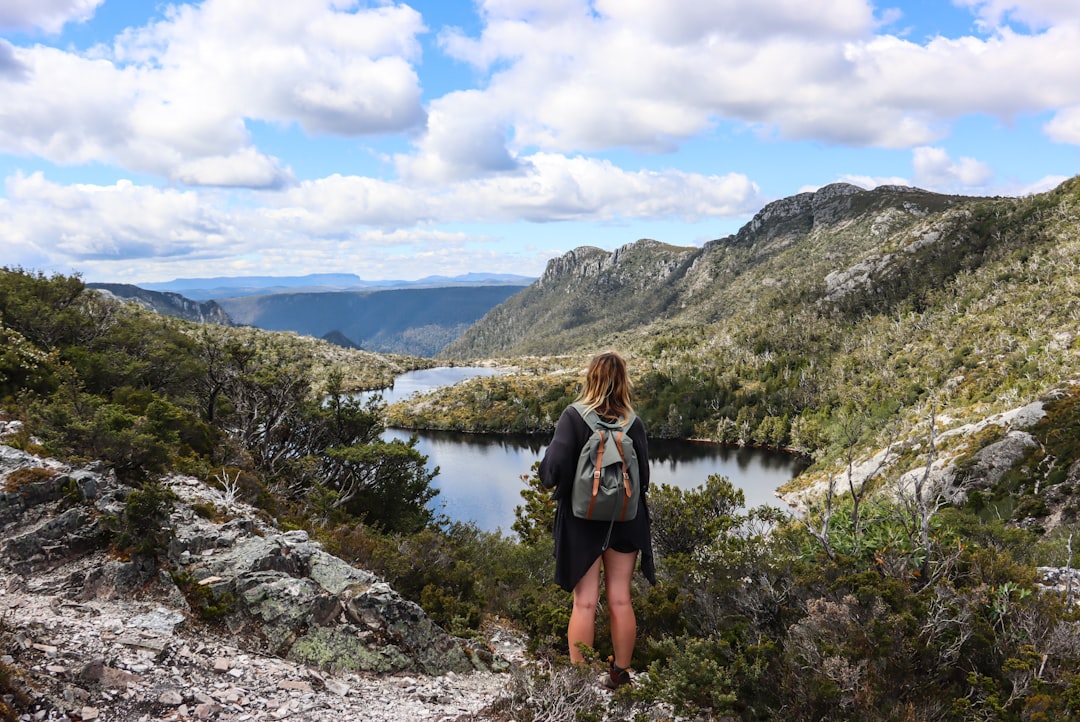
By the time I hit the alpine section, the view was doing that thing where it opens up and you forget to breathe for a second. Cradle Mountain itself, all dolerite columns and jagged edges, was catching the morning light in a way that made it look less like a mountain and more like something that had been carved deliberately. But here’s the thing no one tells you about the Marion’s Lookout track: the best view isn’t from the lookout itself. It’s about a hundred metres before, where the track curves around a small tarn that most people walk straight past because they’re focused on the summit. The tarn reflects the mountain perfectly on still days, and because it’s shallow, the water warms up enough in summer that you can sit on the rocks and dangle your feet in it. I did that for maybe twenty minutes, watching a cloud shadow move across the mountain face, before I heard the first shuttle bus groan up the hill and knew the crowds were about to arrive.
Four-Ten at Ronny Creek
Most people go to Cradle Mountain hoping to see a wombat, and most people leave disappointed. That’s because they’re looking in the wrong place at the wrong time. The wombats aren’t up on the alpine tracks — they’re down lower, around the Ronny Creek area, and they come out in the late afternoon when the day trippers have mostly gone back to their accommodation. I learned this from a ranger named Dave who was fixing a boardwalk near the visitor centre. He had the kind of sunburn that suggested he hadn’t taken his own advice about sunscreen, and he was muttering something about the gibber gun — apparently that’s what they call the tool they use to shoot gravel into the gaps between the boards. “Wombats are creatures of habit,” he said, not looking up from his work. “They’ve got their routes, their feeding times. You won’t find them at eleven in the morning.”
I took his advice, and at 4:10 pm I was sitting on a fallen log near the edge of the boardwalk, not moving, not even taking photos yet. A wombat emerged from the scrub maybe fifteen metres away. It was bigger than I expected — probably thirty kilos, with that solid, barrel-shaped body that makes them look like someone crossed a bear with a rock. It didn’t seem to notice me, or if it did, it didn’t care. It spent about twenty minutes grazing on the grass near the boardwalk, and I got maybe three decent photos before the light started to go. But the best part wasn’t the photos. It was watching how it moved — deliberate, unhurried, like it owned the place. Which, technically, it does.
One thing that surprised me: wombats leave cube-shaped scat. I knew this from reading about it, but seeing it in person is different. It’s not a perfect cube, more like a rough hexagon, but you can see the symmetry. Dave had mentioned this too, said something about the wombat’s intestines having ridges that shape the scat as it passes through, and apparently they use the cubes to mark territory because they don’t roll away. I’m still not sure I believe that explanation fully, but the scat was definitely there and definitely cube-adjacent, so something’s going on.
Barn Bluff, the Taller Neighbour
I’ve never done the full Overland Track — the six-day version, the one that requires booking months in advance and carrying a tent and a PLB and enough dehydrated food to last a week. What I have done is the section from Cradle Mountain to Barn Bluff, which you can do as a day walk if you’re fit and start early enough. Most people don’t do this. They do the Dove Lake circuit or the Marion’s Lookout track and call it done. But if you head north from the saddle near Marion’s, you can pick up a side trail that takes you across the alpine plateau towards Barn Bluff, and it’s a completely different landscape.
The trail is marked but faint — just a series of cairns across the rocky terrain, and in misty conditions you’d lose it in about thirty seconds. I made sure the weather was clear before I attempted it, because getting lost up there isn’t a minor inconvenience, it’s a genuine emergency. The walk crosses several creeks that aren’t bridged, so you have to be comfortable with wet feet. I’d brought a pair of sandals specifically for this, which made the crossings easier but also made me look ridiculous when I was scrambling over boulders with sandals strapped to my pack.
What you get for that effort: a view of the entire national park from a perspective that feels like you’re standing on the roof of Tasmania. Barn Bluff is less famous than Cradle, but it’s actually taller by about thirty metres, and because fewer people go there, you can stand at the summit alone. I sat there for maybe an hour, eating a sandwich I’d wrapped in foil that morning, watching the clouds roll in from the west. A hawk — or maybe an eagle; I’m not good with birds — circled overhead for a while, probably wondering if I was dead or just sitting very still. I wasn’t either, but I appreciated its concern.
The Bus That Left Without Me
The shuttle bus system at Cradle Mountain is efficient but maddening. It runs from the visitor centre to Dove Lake, with stops at various points along the way. In theory, you can hop on and off as you please. In practice, the buses fill up quickly, and if you’re not at the stop ten minutes before the scheduled time, you might end up waiting an hour for the next one. I missed a bus because I was taking photos of a fallen tree that had moss growing in a particularly interesting pattern — the moss was bright green against the dark bark, and the light was hitting it just right. By the time I’d taken the shot and walked the hundred metres to the stop, the bus had already left. That cost me forty minutes, and by the time the next bus came, the clouds had moved in and the light I’d been chasing was gone. I’m still annoyed about that, and it happened three years ago. The photo wasn’t even that good.
At 1,200 Metres, the Forecast Means Nothing
Tasmania’s weather is not a suggestion. It’s not a variable you plan around — it’s the central character of any trip to the central highlands. I’ve been up Cradle in summer when it was 28 degrees at the carpark and 8 degrees at the summit, with hail. I’ve been there in April when the autumn colour was vivid but the wind made it feel like November. The lesson, if there is one, is that you need to carry a puffy jacket no matter what the forecast says, and you need to be willing to turn around if the conditions change.
On this particular trip, I’d checked the forecast the night before and it said “mostly sunny, light winds, 15% chance of precipitation.” By 11 AM, I was in the middle of a cloud at about 1,200 metres, with visibility down to maybe twenty metres and the wind strong enough that I had to lean into it to stay upright. I wasn’t in danger — I was on a well-marked track and I had enough layers to stay warm — but it was a reminder that forecasts in Tasmania are more like rough suggestions than reliable predictions. The cloud stayed for about an hour, then lifted as suddenly as it had arrived, and I was back in full sun with a view that stretched all the way to the ocean. I could see Bass Strait in the distance, the water a flat grey-blue under the afternoon light, and for ten minutes I had the mountain to myself because everyone else had turned back when the cloud came in.
The Guestbook at Waldheim
There’s a reconstructed hut at Waldheim — original was built by Gustav Weindorfer in 1912, burned down in the 1970s, rebuilt later — that most people visit for about five minutes, take a photo of the stone fireplace, and then leave. But the hut has a guestbook, and if you sit there long enough, you’ll read entries from people who’ve been coming to Cradle for decades. One entry from 2019 said “same view, same wind, same feeling. Some things shouldn’t change.” Another from a woman who’d visited in 1975 and returned in 2022: “the pencil pines are still here. I’m not sure I am.”
I spent about an hour there, reading through the book, watching other tourists come and go. A family from Sydney sat at the table and ate their lunch — cheese and crackers and apples — and the mother asked me if I knew where the toilets were. I told her they were near the visitor centre, about a twenty-minute walk, and she sighed in a way that suggested she’d been holding that question for a while. Her son was about eight, and he asked me if I’d seen any wombats. I said yes, and his face lit up. I told him to go to Ronny Creek around four-thirty, sit still, and wait. I don’t know if he did, but I hope so.
📷 Photos: Where did she go this time?! (Unsplash), Laura Smetsers (Unsplash)