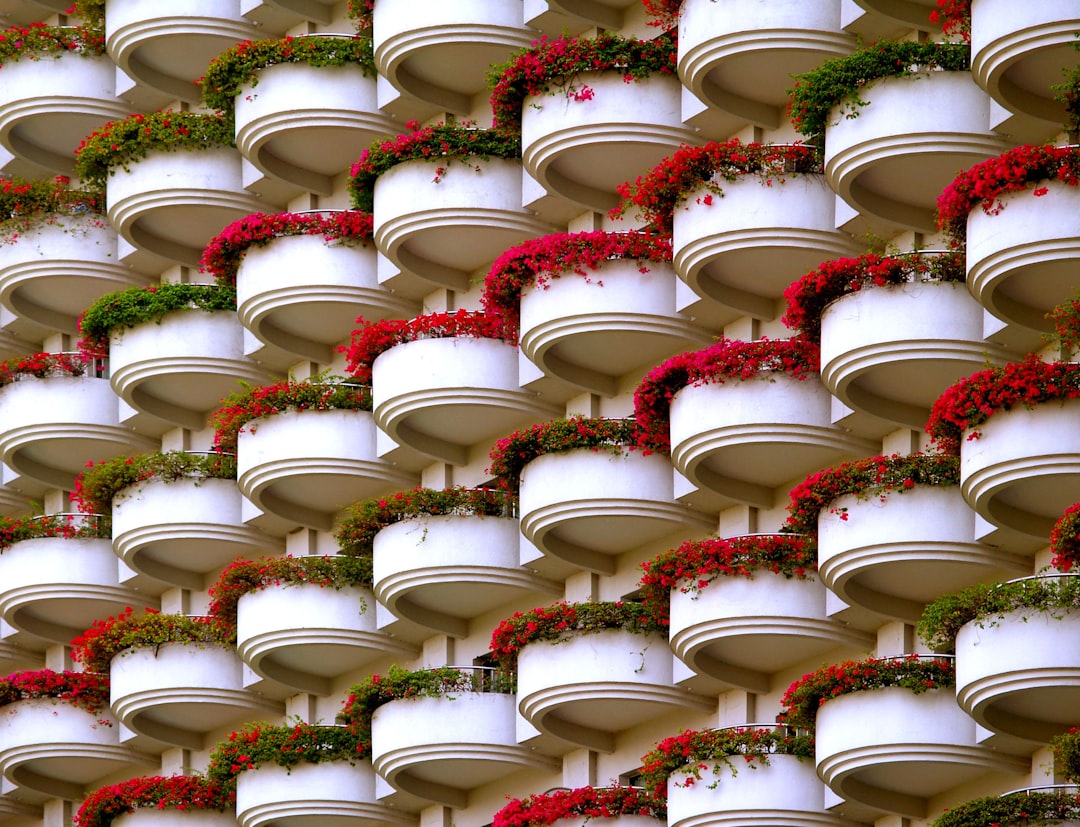
The balcony faced west, which meant by three in the afternoon the light came in at an angle that turned the whole thing into a greenhouse. We had been in Hong Kong for three days by then, long enough to have settled into the small rituals of the hotel room — the position of the slippers, the way the kettle clicked when it reached a boil — and long enough to have noticed that the balcony’s six potted plants were arranged in a way that made no sense. Three of them were crammed into the corner nearest the railing, blocking each other’s access to the light. Two were pushed so far back against the sliding door that they caught nothing but the room’s air conditioning. The sixth sat alone on a small side table, as if it had been placed there as an afterthought.
We rearranged them on the second afternoon, purely out of impatience. It was the kind of thing you do when you’re waiting for a call to go through or the afternoon heat has made it impossible to think straight. We moved the three out of the corner and spaced them along the railing. We slid the two away from the door and closer to the sun. We left the one on the side table where it was, mostly because we couldn’t decide where else to put it. It looked better, but it didn’t feel resolved — just less irritating.
That evening, heading down to the lobby to ask about a ferry schedule, we passed a man in a plain grey tunic who was locking up what we had assumed was a storage room off the ground-floor corridor. He had a small incense burner in one hand and a stack of folded papers in the other. He nodded. We nodded back. It wasn’t until we reached the front desk that the concierge, seeing the direction we had come from, mentioned that the man in the tunic was the temple keeper for the small shrine attached to the hotel — a detail that appeared nowhere on the website, not even in the fine print under “hotel amenities.”
The shrine turned out to be a modest room at the far end of the ground floor, tucked behind a bamboo screen and a set of doors that most guests would mistake for a service entrance. It was dedicated to Tin Hau, the sea goddess whose temples dot the coastlines of southern China and whose protection is still sought by fishermen and ferry operators across the territory. The keeper’s name was Lam. He told us this the next morning when we found him watering a row of small potted bushes arranged along the shrine’s outer wall. He had the careful, deliberate movements of someone who has performed the same task for decades and has no interest in speeding it up.
“You moved the plants on your balcony,” he said. Not a question. We looked at each other. We hadn’t told a soul.
Lam explained, in a mix of Cantonese and English that we pieced together over the course of several conversations that week, that he had been the one to arrange the hotel’s balcony plants in the first place. The hotel management had hired him years ago, after a guest complained that the rooms felt “unsettled” — that the air didn’t move properly, that the sleep quality was off. The management, pragmatic about such things in a city where feng shui consultants are routinely consulted on everything from office layouts to grave sites, brought in Lam to look at the rooms. He had walked every floor, noted the position of each balcony relative to the mountain and the harbour, and made adjustments. The odd placement of the plants, it turned out, was not random. It was remedial.
Feng shui, in its most stripped-down form, is the practice of arranging space to allow qi — life energy — to move through it without stagnating or rushing. Lam explained it using a glass of water on the table between us. If the water sits still for too long, it grows stagnant. If you tip the glass too quickly, it spills before you can drink any. The goal is a steady, moderate flow. Balconies, he said, are particularly tricky because they function as the lungs of a room — the place where the building’s internal energy meets the outside world. But a balcony is also exposed, meaning the energy can rush through too fast or get blocked entirely, depending on what’s around it. The plants, in Lam’s arrangement, were positioned to slow the qi down, to redirect it, to ensure it entered the room at the right pace and from the right direction.
By moving them, we had undone his calibration. The three we had spaced along the railing were originally clustered in that far corner for a reason: they formed a barrier that deflected the energy coming off the neighbouring building’s sharp corner, which Lam identified as a sha qi — a “killing breath” — the same category of influence that traditional practitioners associate with straight roads pointing directly at a front door. The two we had pulled away from the sliding door had been placed there to filter the energy before it entered the room. The one on the side table, the loner we had left untouched, was the only one that had been correctly positioned from the start. It was there to anchor the space, to give the energy something to circle around rather than running straight through.
We spent the next three mornings sitting on that balcony, watching how the light moved and how the air felt, trying to see what Lam saw. With the plants back in their original positions, the balcony felt less open but more contained — sheltered in a way that openness hadn’t achieved. The corner of the neighbouring building, which we hadn’t noticed before, now seemed to point directly at the spot where the plants had been. It was the kind of detail you can’t unsee once it’s been pointed out, like a misspelled word on a sign you’ve walked past a hundred times.
Lam let us watch him work on two other occasions. One was at the shrine itself, where he was rearranging the offerings before Tin Hau’s statue — a small bowl of oranges, a cup of tea, a handful of incense sticks. The offerings, he said, follow the same logic as the plants. They aren’t placed randomly. The oranges face the door because their round shape and gold colour attract positive energy. The tea is changed at the same time each morning because regular attention maintains the flow. The incense smoke, he explained, carries intention upward, but only if the air in the room is already moving correctly — which is why the incense burner sat on a small raised platform rather than directly on the altar. The elevation allowed the smoke to rise without obstruction before the ceiling fan caught it and dispersed it across the room.
The other occasion was a trip to a garden centre in Sham Shui Po, where Lam bought replacement plants for a few of the hotel’s balconies that had suffered through a particularly hot spell. He picked them by feel as much as by sight — running his fingers along the leaves, checking the soil’s moisture by weight rather than by looking. He explained that in feng shui practice, a plant’s health matters more than its type. A healthy plant in a slightly wrong position will outperform a sick plant in the perfect spot every time. The energy follows vitality, not geometry. This runs counter to the popular understanding of feng shui as a fixed system of rules — bed here, desk there, mirror over here — when in reality it’s more like gardening than geometry, a continuous process of observation and adjustment rather than a one-time setup.
We later tested this on our own, in a small way. There was a cactus on the windowsill of the hotel room’s bathroom, a detail we had noticed but not thought about. Cacti, in feng shui, are controversial. Some practitioners say their spines create negative energy. Others argue that the spines are no different from thorns on a rose bush — it depends on placement. Lam, when we asked, said the cactus was fine where it was because the bathroom’s energy needed to be contained and redirected rather than encouraged. The spines served a purpose. A cactus in the bedroom, he said, would be a different matter entirely. We left it where it was.
By the fifth day, we had stopped rearranging the balcony. Not because we were afraid of getting it wrong, but because we had started to see the logic in the existing arrangement — the way the light fell at different hours, the way the wind moved through the corridor outside the room, the specific angle of the neighbouring tower’s roofline. These were not abstract concerns. They were observable, measurable realities that Lam had read and responded to, and that we had blundered past on the second afternoon of our stay.
The hotel’s other guests, as far as we could tell, never noticed the plants at all. They walked past the shrine without seeing it, ate breakfast on the terrace without wondering why the tables were arranged the way they were, slept through nights that Lam’s adjustments had made quieter and more restful. This is not a criticism — it’s just the nature of well-applied feng shui. When it works, nobody notices. The room feels right. The sleep comes easily. The view from the balcony simply looks like itself.
On our last morning, we found Lam sweeping the shrine’s entrance with a soft-bristled broom. He was working from the corners inward, collecting dust and incense ash into a small heap before brushing it into a metal dustpan. The sweeping, he said, was not about cleanliness. It was about clearing the path for the day’s energy to enter. The broom moved the air as much as it moved the dust. He finished, straightened, and looked at us. “You’ll arrange the plants differently now,” he said. “In your own home, not just here.”
He was right. We did. The balcony at home faces southeast, not west, which means the morning light arrives first and the afternoon heat stays away. The plants there are a different species — a ficus, a peace lily, a small jade — and we have arranged them not according to any map or diagram but according to the specific behaviour of the light and the air in that particular corner of that particular building. We left the cactus where it was. The balcony feels different now. Quieter. More settled. The kind of change that is hard to measure and impossible to argue with, but that you know is real because the room itself seems to agree.

📷 Photos: Tim Broadbent (Unsplash), Jordan Opel (Unsplash)