
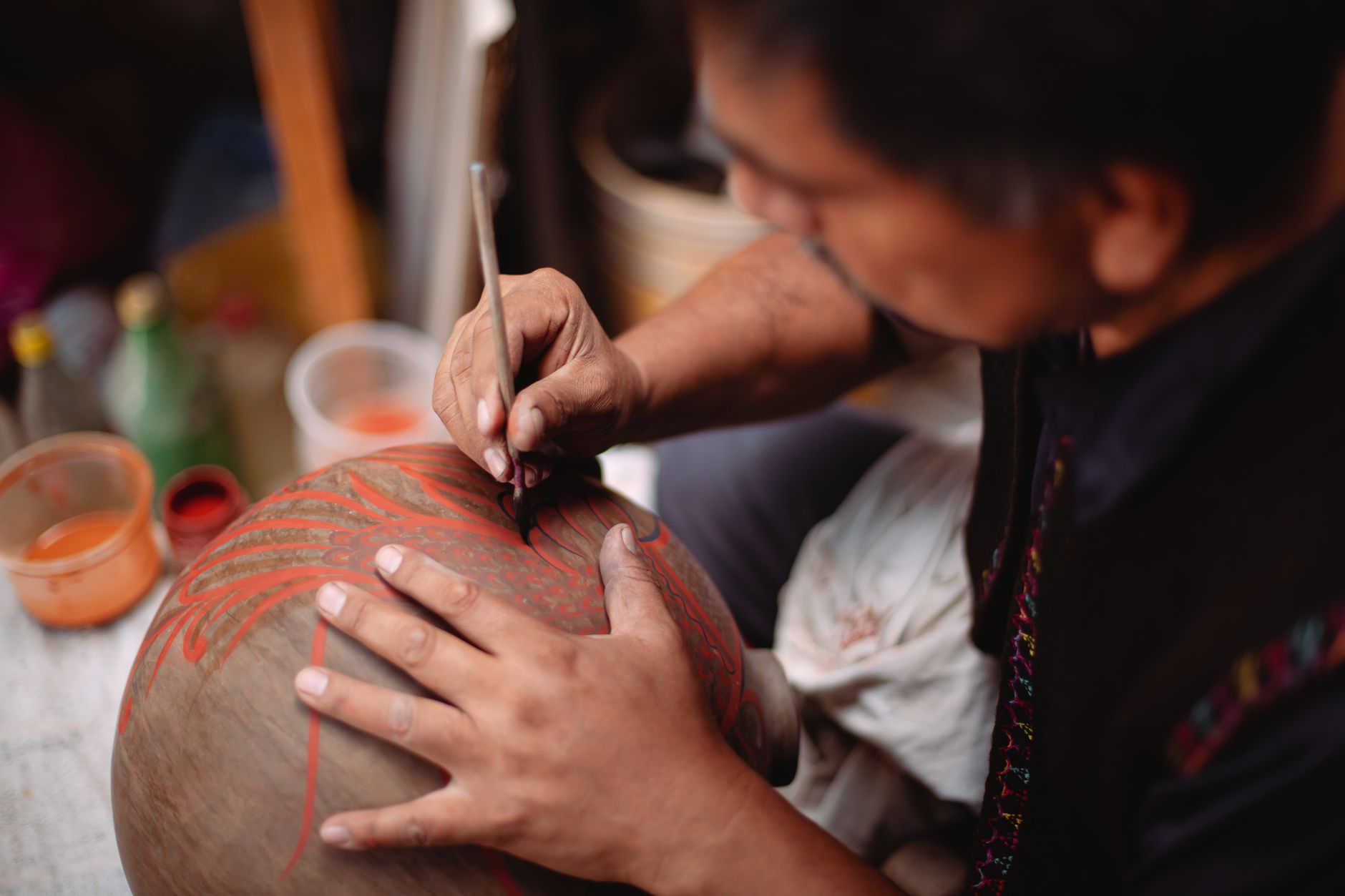
The first thing you notice about Icheon’s pottery district is how little of it is actually on the main road. Driving in from Seoul on a Tuesday afternoon in late spring, I passed three galleries with plate-glass windows and signage in English before I realized the real action was somewhere behind them, in a warren of concrete alleys where kilns vent directly into the air and the only signage is hand-painted on scraps of wood. I pulled over near a convenience store whose awning had been patched with what looked like packing tape, and a woman stacking clay flowerpots outside a garage-sized workspace nodded toward a gap between two buildings. “The good ones are back there,” she said in Korean, gesturing with her chin.
The gap led to a lane maybe two meters wide, lined with doorways that opened directly into working studios. There was no attempt at retail presentation — no display cases, no price tags, no lighting designed to make the pottery look better than it was. Each studio was essentially a workshop with a counter at the front, and the person throwing the pot was the same person who would eventually sell it to you. I counted twelve such spaces before the lane dead-ended at a larger kiln building, and in none of them was there a single object that looked like it had been made for export.
This is the part of Icheon that most coverage misses, because most coverage arrives with a preconception about what a moon jar should be. The classic dal hangari — a large, round, milky-white porcelain jar with a subtle blue tint, originally made for storing rice or grain during the Joseon dynasty — has become one of the most recognizable symbols of Korean ceramics. It’s also become something of a trap. The mass-produced versions sold in Insadong galleries in Seoul, priced at 50,000 won and stamped with a logo, bear roughly the same relationship to the real thing that a souvenir shot glass bears to a wine cellar. But the genuine article, made by a single potter over weeks, fired multiple times, and possessing that specific, unsteady roundness that comes from hand-throwing in sections, is a different object entirely.
The difference is visible within seconds of entering the right studio. I stepped into one called, as far as I could tell, nothing — there was no name on the door, just a faded slip of paper with a phone number. Inside, a man in his sixties named Park was trimming the foot of a jar that had already been bisque-fired. He didn’t look up when I entered, which I took as permission to stay. Along the wall behind him were about fifteen finished moon jars in various sizes, and the thing that struck me immediately was their irregularity. One was visibly lopsided. Another had a crack running from the rim about three centimeters down, which Park had filled with a gold lacquer — kintsugi as a practical choice, not an aesthetic statement. None of them matched. That was the point.
Most visitors, I’ve noticed, walk into a space like this and immediately reach for the most symmetrical jar on the shelf. It’s a reflex trained by decades of factory-made objects that treat uniformity as a sign of quality. Park’s work inverted that assumption entirely. The jar that eventually caught my attention was the least symmetrical one in the room — a medium-sized piece with a firing flaw that had created a faint blush of celadon along one curve, like a blush that had settled unevenly. When I picked it up, Park finally spoke. “That one,” he said, “took five tries.” He meant it literally. The previous four had cracked or slumped in the kiln. This one survived, flaw and all.
That jar became the first of three I’d buy that day. The negotiation process, such as it was, consisted of me pointing at it and Park saying a number — 220,000 won — and then looking away, which I learned later was his way of signaling that the price was firm but not offensive. I paid it without countering, which seemed to surprise him. He wrapped the jar in three layers of hanji paper and then a plastic bag, and handed it over with a grunt that might have meant anything. I carried it back to the car like it was a living thing. Which, in a sense, it was.
The second jar came from a younger potter named Aiko, a Korean-Japanese woman who had moved to Icheon three years earlier after studying in Kyoto. Her studio was at the opposite end of the alley, and her work was visibly different — thinner walls, a more deliberate asymmetry, a surface that she had carved with faint, almost invisible lines before glazing. “I’m not making moon jars the way Park makes them,” she said, wiping her hands on an apron that had more clay on it than fabric. “Mine are about the shape between the shapes.” She was referencing the traditional construction method, where a moon jar is thrown in two halves and joined at the middle, creating a seam that the best potters learn to hide. Her version made the seam visible — a deliberate, raised ridge around the equator of the jar — and used it as a design element. “Most people want the seam gone,” she said. “I want them to see where the two halves tried to become one.”
I bought a small jar from her, about the size of a cantaloupe, with the ridge left raw and unglazed. She asked 180,000 won and I said yes immediately, which made her laugh. “You’re too easy,” she said, but she was smiling. She also told me something that no guidebook mentions: the best time to visit Icheon’s pottery district isn’t the morning or the weekend, but a Tuesday or Wednesday afternoon between two and four. “That’s when the potters are done with the morning work,” she said. “They’re tired, their shoulders hurt, and they’re more likely to talk to you than if you come at ten when they’re trying to center the clay.”
The third jar I didn’t buy from a studio at all. On my way back toward the main road, I noticed a small jjimjilbang — a bathhouse — with a display case in the entryway. Inside, among the usual items you’d find in such a place (combs, soaps, packets of ramyeon), was a moon jar about thirty centimeters tall, clearly handmade, with a price sticker that read simply “50.” No unit. I asked the woman at the counter what it meant, and she said, “50,000 won. It was a gift from a customer who fired too many.” She didn’t know the potter’s name. The jar had no mark, no signature, no identifying feature except its own imperfect roundness. I bought it, and it sits now on a shelf in my apartment, the cheapest and in some ways the most mysterious object I own — a moon jar that came to the bathhouse by accident, passed from a potter’s surplus to a customer’s gratitude to a glass case in a place nobody would think to look.
There’s a reality here that most travel coverage of Icheon refuses to acknowledge, because it complicates the tidy narrative of “visit this specific place, buy this specific thing.” The best pottery in Icheon is not in the places that are easiest to find. It’s in the spaces that have no signage, no English, no website, no social media presence — the studios that exist because the potter needs to work, not because the potter needs customers. The economics of this are straightforward: a potter who sells ten jars a month at a fair price to people who find their way to the studio can make a living. A potter who tries to scale up, export, and market becomes a factory, and the quality drops predictably. The most honest work I saw that day was the work that was never intended as a tourist attraction.
This is also why the bargaining dynamic in Icheon is different from what you’d encounter at, say, a market in Itaewon or a street stall in Busan. The potters here aren’t playing the game. They aren’t pricing high expecting to be talked down. The price they name is usually the price they mean, and it’s based on a calculation of materials, time, and the probability that the next piece will crack. “If I sell you this one for 150,” Park told me at one point, “I have to make two more to cover the one that broke. So the price is the price.” A visitor who walks in expecting to haggle the way they would at a tourist market will be met with polite refusal or, more likely, a silence that ends the conversation. The correct approach is to ask the price, decide whether it’s worth it to you, and then either pay or walk away. No drama, no theater. The pottery itself is the only artifact worth bargaining over, and the bargain is simply whether you light up to its value.
Aiko mentioned something else before I left. She said that the most common question she gets from foreign visitors is whether the jars are “authentic” — meaning, I think, whether they are made in the traditional way using traditional materials. “They want to know if I dig my own clay from the Han River,” she said, laughing. “And I tell them, no, I order it from a supplier in Gangwon-do. But I dig my own understanding out of the ground every day. That’s the part nobody can verify.” She wasn’t being dismissive. She was pointing out that authenticity in ceramics is not a binary — it’s not about whether a jar was fired in a wood-burning kiln or an electric one, but about whether the person who made it was present in the making. A jar that was thrown with attention, glazed with attention, and fired with attention carries a quality that survives any test a visitor might administer.
By late afternoon, the alley had grown quieter. The potters were beginning to clean up, sweeping clay dust from their floors, covering half-finished pieces with damp cloths. The light had shifted from the harsh white of midday to a softer gold, and the jars that had looked clinical in the overhead fluorescents now seemed to hold a warmth that was separate from the light itself. I walked the length of the alley one more time, past Park’s studio (he was closing the door, carrying a newspaper and a glass of barley tea), past Aiko’s (she was still working, her hands moving in and out of my view through the small window), past the kiln building where a stack of freshly fired bowls cooled in the evening air.
I stopped at the end of the lane where it opened onto a small courtyard occupied by a jujube tree and a broken grinding stone. There was a wooden bench there, splintered and weathered, and I sat for a while with the three jars in their wrappings at my feet. Nobody came to ask what I was doing. Nobody tried to sell me anything. The courtyard had the feeling of a place where no transaction was expected to occur — a leftover space between the working studios, used for nothing in particular, which made it the most honest square meter in the entire district.
On the drive back to Seoul, with the jars secured in the passenger seat footwell by a bungee cord and my bag, I passed the three galleries on the main road. They were still open, their plate-glass windows still glowing with carefully lit displays of identical moon jars, each one perfect and each one interchangeable. I didn’t stop. The road curved east around the edge of a low hill, and the last light of the day caught the ridge of Aiko’s jar through the wrapper, a faint line of shadow where the two halves of the clay had met and refused to disappear.

📷 Photos: Los Muertos Crew (Pexels), Los Muertos Crew (Pexels)