The man running stall 47 in Hongdae Free Market doesn’t smile much. He sits on a low plastic stool, a cigarette burning down to the filter between his fingers, watching the foot traffic with the practiced disinterest of someone who has seen a thousand people pick up a pair of jeans, turn them over, and put them back. I picked up a pair of early-2000s Levi’s 501s from his table — not vintage enough for most collectors, too common — and asked him how long he’d been selling denim specifically. He shrugged and said, in Korean, that he used to sell electronics. “But denim doesn’t break,” he said, and then gestured at the stack of jeans beside him. “And it doesn’t need a charger.” That line has stuck with me ever since, not just because it’s funny, but because it gets at something about this market and the people who work it that most coverage of Seoul’s flea scene misses entirely.
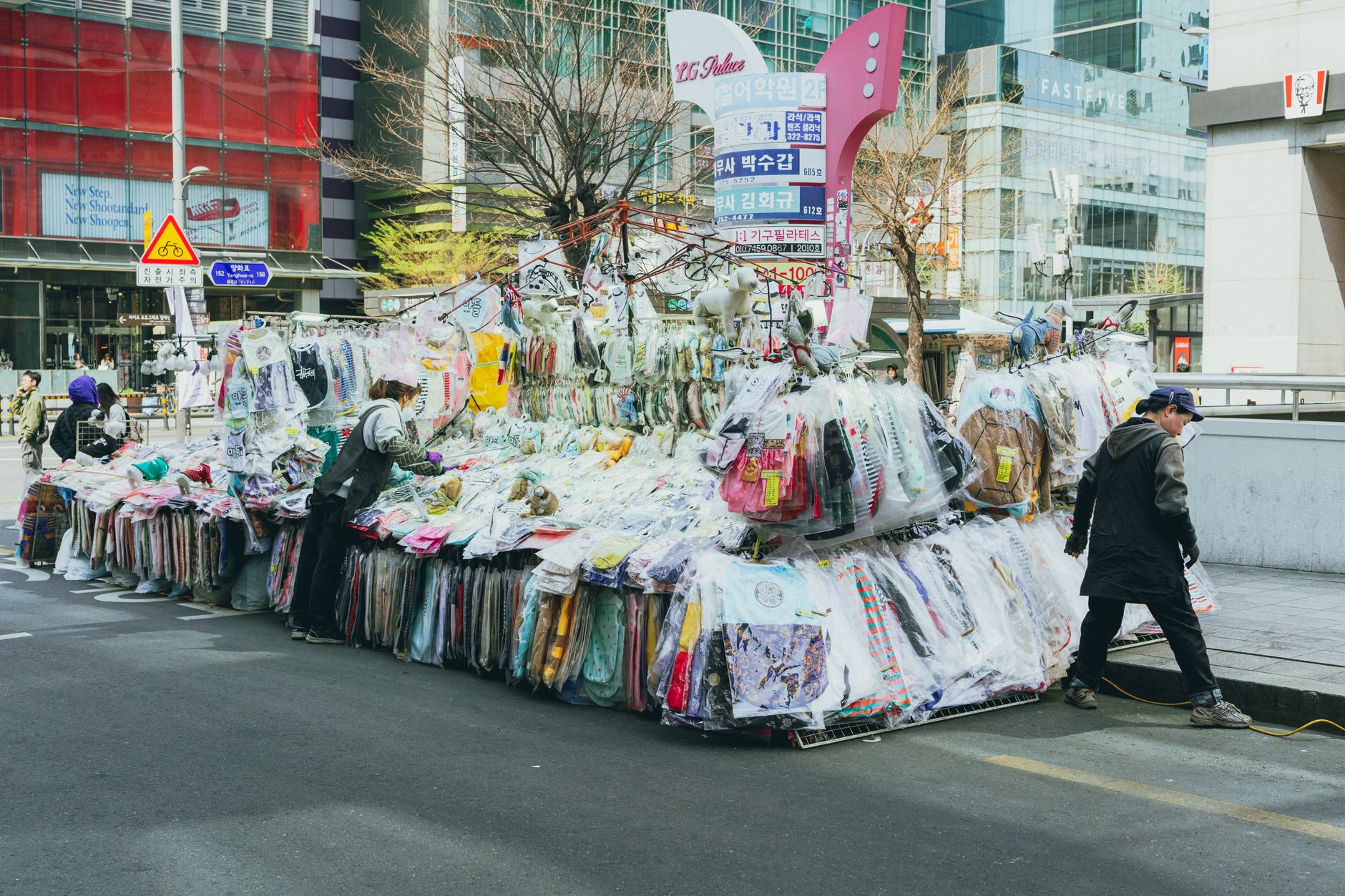
Hongdae after 1 PM on a Saturday is dense, disorganized, and overwhelming in a way that rewards patience. The main drag near Hongik University station is loud with buskers and pop-up food stalls, but the flea market itself — which runs along the walkway near the playground and stretches into the side streets — operates on a different rhythm. There’s no central organizing principle. Some stalls are proper tables with cash registers and laminated price signs. Others are just blankets on the ground with the goods laid out like a yard sale. The denim, when you find it, is rarely displayed as a specialty. It sits alongside old cameras, vinyl records, knockoff K-pop merchandise, and the occasional taxidermy specimen that nobody seems to know the origin of.
I spent the first two hours of that Saturday walking loops, trying to get a sense of where the denim was concentrated. The answer, I eventually learned, is that it isn’t. There’s no “vintage denim row” or designated section. The denim sellers are dispersed, and many of them don’t specialize in denim at all. The guy who sells you a pair of 1980s Wranglers might be the same guy who sells you a used electric fan an hour later. The best finds I saw that day came from stalls where I had to physically shift aside stacks of polyester jackets or lift a box of old comic books to reach the jeans underneath.
One specific pair I remember was a set of 1990s Edwin jeans, Japanese-made but distributed for the Korean market, in a wash that had faded to a pale, almost dusty blue. They were folded inside a cardboard box that also contained a broken rice cooker and a bundle of old postcards. The seller, a woman in her sixties with a small dog sleeping on her lap, told me she bought the box at an estate sale in Ilsan and hadn’t bothered sorting through it properly. I paid 15,000 won — about eleven dollars — and the jeans were in near-mint condition, with the original tags still attached to the back pocket.
The temperature that day was somewhere around 28 degrees Celsius, humid enough that the air felt thick, and the asphalt underfoot radiated heat well into the evening. You’re bending, squatting, lifting, sweating, and occasionally fighting the urge to give up and buy something from a proper air-conditioned boutique instead.
By late afternoon, the crowd had thinned slightly and the light had shifted to a gold that made everything look a little more desirable. I found a stall run by two brothers in their late twenties who had clearly done their research. Their prices were higher — 50,000 to 80,000 won for most pairs — but the selection was curated. They had a rack of 1970s Big Mac jeans, a South Korean brand that American collectors tend to overlook, alongside a handful of Sugar Cane and Studio D’Artisan pieces that had clearly been sourced from Japanese secondhand dealers. The older brother, who spoke English with a slight Australian accent from a year he spent working in Melbourne, told me that most of their stock came from bulk purchases at Japanese thrift auctions. “People in Seoul think vintage is all American,” he said. “But Japanese denim from the 1990s is often better made and priced lower here because nobody’s looking for it.” He pulled out a pair of 1997 Pure Blue Japan jeans, unworn, with the original paper tag, and offered it to me for 120,000 won. I didn’t buy them — the fit was wrong for my frame — but I thought about them for the rest of the trip.
There is a specific smell to Hongdae’s flea circuit that I haven’t encountered anywhere else. It’s a mix of mildew from old fabric, the faint chemical tang of plastic toys that have been sitting in storage for decades, fried chicken from the nearby stalls, and the particular mustiness of cardboard boxes that have been rained on and dried out multiple times. That smell announces the market before you see it.
I talked to a few other buyers that afternoon, mostly Korean teenagers and university students looking for cheap band tees and vintage sportswear. One of them, a design student named Seo-yeon, told me she comes every Saturday because the denim here is more interesting than what she finds in Myeongdong or Gangnam. “It’s not about the brand,” she said, picking at a loose thread on a pair of early-2000s Levi’s silver tabs. “It’s about the wear. Someone else wore these for years, or something. That changes the fabric in a way you can’t fake.” She held the jeans up to the light and pointed to where the denim had thinned at the knees. “You can’t buy this in a store.”
The afternoon wore on and the market began to wind down around 7 PM. The sellers started packing up, folding tables and loading blankets into the backs of small trucks and vans. I bought one more pair of jeans — a pair of 1990s Guess jeans with a slightly flared leg, for 8,000 won from a seller who was clearly eager to get rid of stock before loading up. They aren’t my usual style, but they fit perfectly, and the price was less than a single drink at a Hongdae bar. I walked back toward the station with the bag slung over my shoulder, the denim warm against my leg, and the smell of the market still clinging to my hair and clothes.
The best pair of jeans I found that day was a pair of early-1990s Lee Riders, made in Thailand for the Korean market, with a patch that had been repaired badly with a sewing machine at some point. The stitching was uneven and the thread didn’t match. I bought them for 5,000 won and wore them for the rest of my trip. The fabric had settled into its shape.
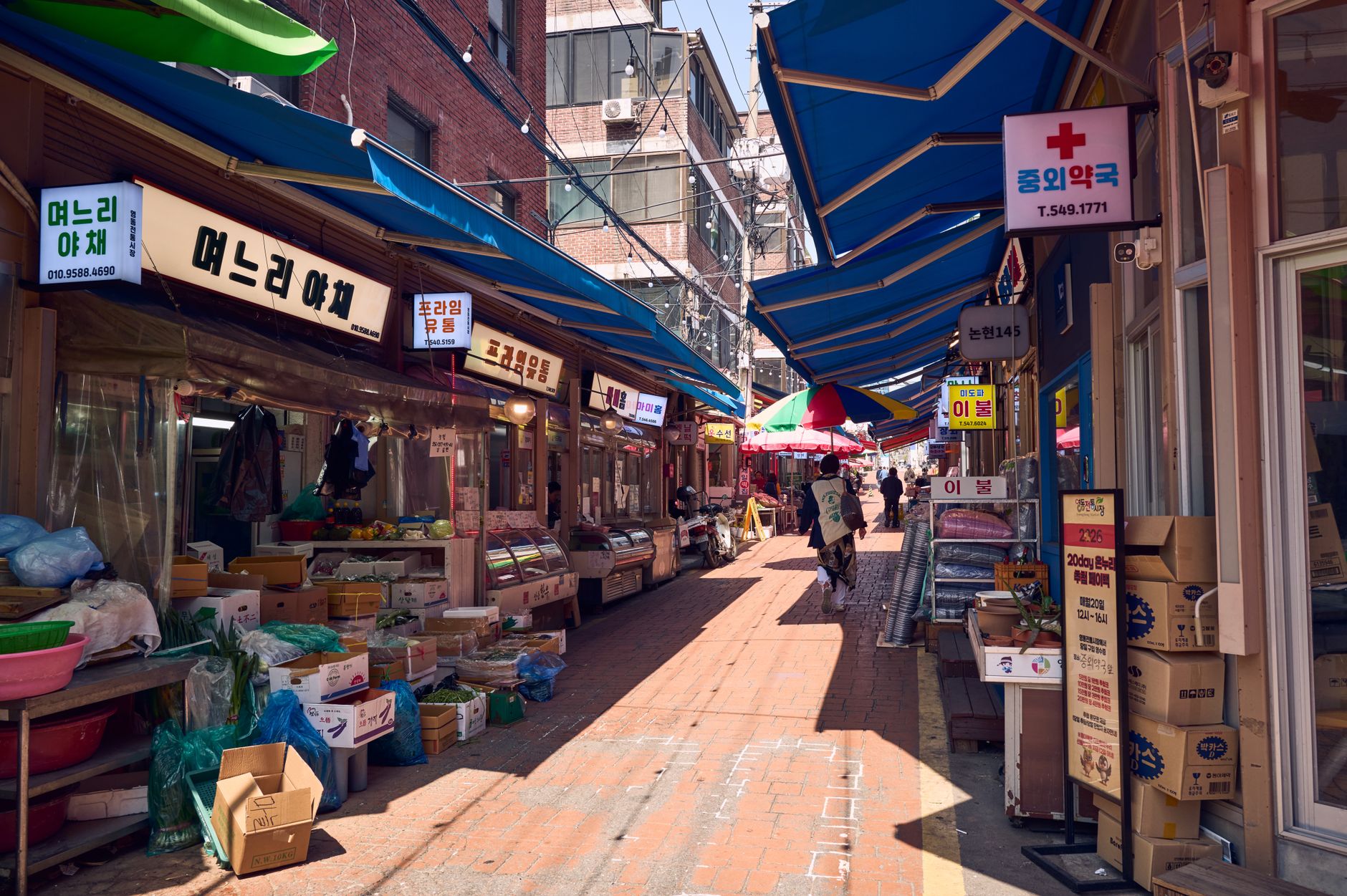
📷 Photos: Theodore Nguyen (Pexels), CK Seng (Pexels)