The trailhead wasn’t where the guesthouse owner said it would be. I stood at the end of a dirt track that dead-ended into someone’s chicken coop, phone showing no signal, the paper map I’d been given dissolving in the humidity against my palm. A rooster watched me from a pile of scrap lumber, making the kind of sound that felt like mockery.
The guesthouse owner had drawn the route on a napkin the night before, using a ballpoint pen that kept skipping. He’d marked a turn at a “big yellow house” and a second turn at a “tree that looks like a hand.” I found the tree. It looked like a hand. Then nothing else matched. The road kept going, turned to gravel, then to dirt, then to a track of compacted earth where motorbikes had carved two deep ruts into the clay. The yellow house, when I finally spotted it through the bamboo, was actually more of a pale ochre, and someone had started painting it green halfway up the wall.
I’d come to Pai because of the ridge. Not the usual one — the one that runs behind Wat Phra That Mae Yen, where everyone goes for sunset photos of the valley and the curves of the river below. That view is real but it’s also crowded, and I’d seen enough travel blogs with the same drone shot of the same bend in the same golden light to know I wanted something different. The ridge I was after didn’t have a name in English. It showed up on some topographic maps as a faint dotted line, not a marked trail, and the guesthouse owner had described it as “where Hmong hunters go when they’re not taking tourists.”
He’d drawn a small circle on the napkin above his sketch of the ridge. “Secret valley,” he said. “Not many.” He used his hands to show me how the valley was hidden — cupping them together, fingers tightening.
It took three more wrong turns and a conversation with an old woman washing dishes outside a concrete house to find the actual start of the path. She didn’t speak any English. I showed her the napkin, then pointed vaguely uphill, and she laughed. Not unkindly — the way someone laughs when they see you about to make a mistake they’ve watched a hundred other people make. She wiped her hands on her sarong, walked to the edge of her property, and pointed to a gap in the undergrowth I’d walked past twice. A faded strip of blue plastic tied to a branch marked the entrance.
The first fifteen minutes were fine. The trail was steep but clear, switchbacking through secondary forest where the light came through in shafts and the ground was damp underfoot. The air smelled of wet earth and something floral I couldn’t identify — not the cloying sweetness of frangipani but something sharper, more astringent, like a plant trying to defend itself. I passed a bamboo shelter with a corrugated roof, its floor scattered with cigarette butts and empty bottles of Singha. Someone had been sleeping there recently — a thin blanket lay folded in one corner, and the ashes in the fire pit were still grey, not white.
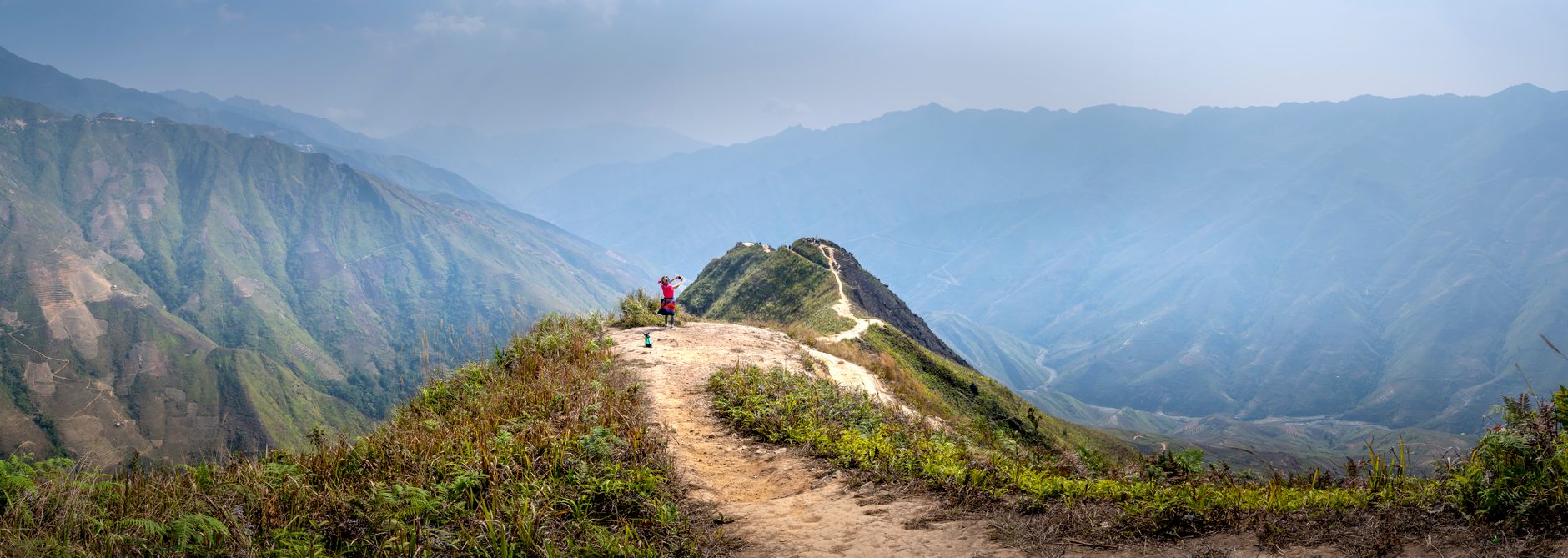
Around forty minutes in, the path narrowed to a single boot-width track that ran along the contour of the hillside, and the bamboo closed in overhead until I was walking through a tunnel of green. The humidity was ferocious. My shirt was soaked through by the time I reached a clearing where the ridge opened up for the first time, and I sat down on a rock that was still warm from the morning sun and drank half my water in one long swallow.
That’s where I saw the first marker. A small bamboo post, maybe knee-high, with a piece of faded red cloth tied around it. I found a second one about fifty metres further on, then a third. They weren’t regular. Sometimes I’d go ten minutes without seeing one, then two would appear within a few steps of each other, pointing in slightly different directions. The track started to split and rejoin, split and rejoin, like the hill itself couldn’t decide which way it wanted to go.
I chose wrong at a fork where one path went up steeply over a rock face and another skirted around the base of it, and I took the lower route because it looked easier. The marker I’d been following had been tied to a branch that had since fallen. The low route went about two hundred metres before it petered out into a tangle of vines and fallen timber, and I had to backtrack uphill, breathing hard, the sweat running into my eyes and stinging.
The rock face wasn’t as bad as it had looked from below. Handholds had been cut into the stone — not professionally, but by someone with time and a chisel, making a route that worked. I climbed it slowly, testing each hold before I committed my weight, and at the top I found a Hmong guidepost. It was a single piece of carved wood, about waist height, planted in a cairn of stones. The carving was weathered almost smooth — I could make out what looked like a directional arrow and maybe a symbol, but the details had been erased by years of rain and sun.
The post had fallen. It was leaning at a forty-five-degree angle, its base rotted through, held up only by the stones that had once supported it. Someone had tried to prop it back up — there was a fresh-looking stick wedged under one side — but the ground was too loose, and the whole structure shifted when I touched it. I spent ten minutes rebuilding the cairn, finding flat stones and pressing them into a stable base, then setting the post upright and packing earth around its base. It held.
Beyond the post, the ridge opened into a high basin — a depression in the curve of the mountain where the forest thinned and the ground became grassland, dotted with stands of pine that grew tall and straight. The grass was waist-high in places, brown at the tips and green underneath, and it moved in waves when the wind came through. I could see the main valley of Pai below, the river catching the light in a long silver curve, the rooftops of the town clustered together like a child’s toy set. But the basin itself was sheltered, hidden, invisible from any road or viewpoint I’d passed on the way up.
A Hmong woman was sitting on a rock at the far edge of the basin, facing away from me. She had a plastic basket beside her, half-filled with green leaves I didn’t recognise, and she was eating something — a piece of sticky rice wrapped in banana leaf, tearing off small pieces with her fingers. I stopped where I was, not wanting to startle her, but she must have heard me coming because she turned and looked directly at me without any surprise. She was old — maybe seventy, maybe older — with the kind of face that’s been shaped by weather and hard work into something that doesn’t give away much.
I raised my hand in greeting. She nodded and went back to her rice. I sat down on the grass maybe thirty metres away, not wanting to intrude, and drank the rest of my water while I looked at the view. The basin was quiet in a way that felt deliberate — not the quiet of absence but the quiet of someone who’s decided not to speak. There were no birds calling, no wind in the trees, just the distant hum of the town below and the rustle of grass moving against itself.
After a while, the woman stood up, picked up her basket, and walked towards me. She stopped a few metres away and said something in Hmong. I shook my head and said I didn’t understand. She considered this, then pointed at the ridge behind me, then at the sky, and made a motion with her hand — flat, then curving down. I mimed back: is the path that way? She shook her head and repeated the motion, more emphatically this time. Flat, then curving down. It took me a minute to understand: the weather was about to change. The flat hand meant the ridge now. The curve meant the valley later. She was telling me to go back before the rain came.
I checked the sky. There were clouds building over the western ridge — not the dramatic dark ones that announce a storm, but a slow thickening of grey that could mean anything from a light shower to an afternoon monsoon. I thanked her, or tried to, and she nodded once and walked past me down the slope, disappearing into the tree line without looking back.
The walk back was faster but harder. The rain started when I was halfway down the ridge, a light drizzle at first, then a steady downpour that turned the trail into a slick of mud and loose stones. I slipped twice — once landing hard on my right hip, once catching myself on a branch that snapped and left me holding a piece of wet wood while my feet skidded downhill. I was soaked through by the time I reached the woman’s house, and I stopped under her awning to wring out my shirt. She was there again, this time sitting on a plastic chair under the overhang, watching the rain sheet off the roof. She didn’t say anything. She just looked at me, then at the sky, then back at me, and shook her head slowly.
I made it back to the guesthouse at four in the afternoon, muddy and exhausted, my map a pulped mess in my pocket. The owner was sweeping the front step. He looked at me, looked at the state of my clothes, and said, without any surprise, “You found it?”
I told him about the woman and the basket of leaves and the rain. He nodded. “She lives up there. She knows the ridge better than anyone. She watches.”
He didn’t charge me for the room that night, although I hadn’t asked him not to. He just waved me off when I tried to pay, and pointed at the kitchen, where a pot of something was simmering on the stove. I ate alone, sitting at a plastic table in the darkening evening, listening to the rain slow to a patter and then stop. The valley below was coming back into focus — lights flicking on in the town, the river catching the last of the grey light, the ridges on the far side starting to clear. The basin was somewhere up there, hidden again, invisible from where I sat.

📷 Photos: Quang Nguyen Vinh (Pexels), Quang Nguyen Vinh (Pexels)