I was on my third prawn before I realized I hadn’t looked at the water once. The floating market at Amphawa is supposed to be about the canal, about the wooden boats nosing through the brown-green water, about the vendors in conical hats paddling past with coconut ice cream and grilled bananas. But I was sitting at a long table under a corrugated roof, staring at a plate of grilled river prawns, and the canal might as well have been a highway for all I cared about it.
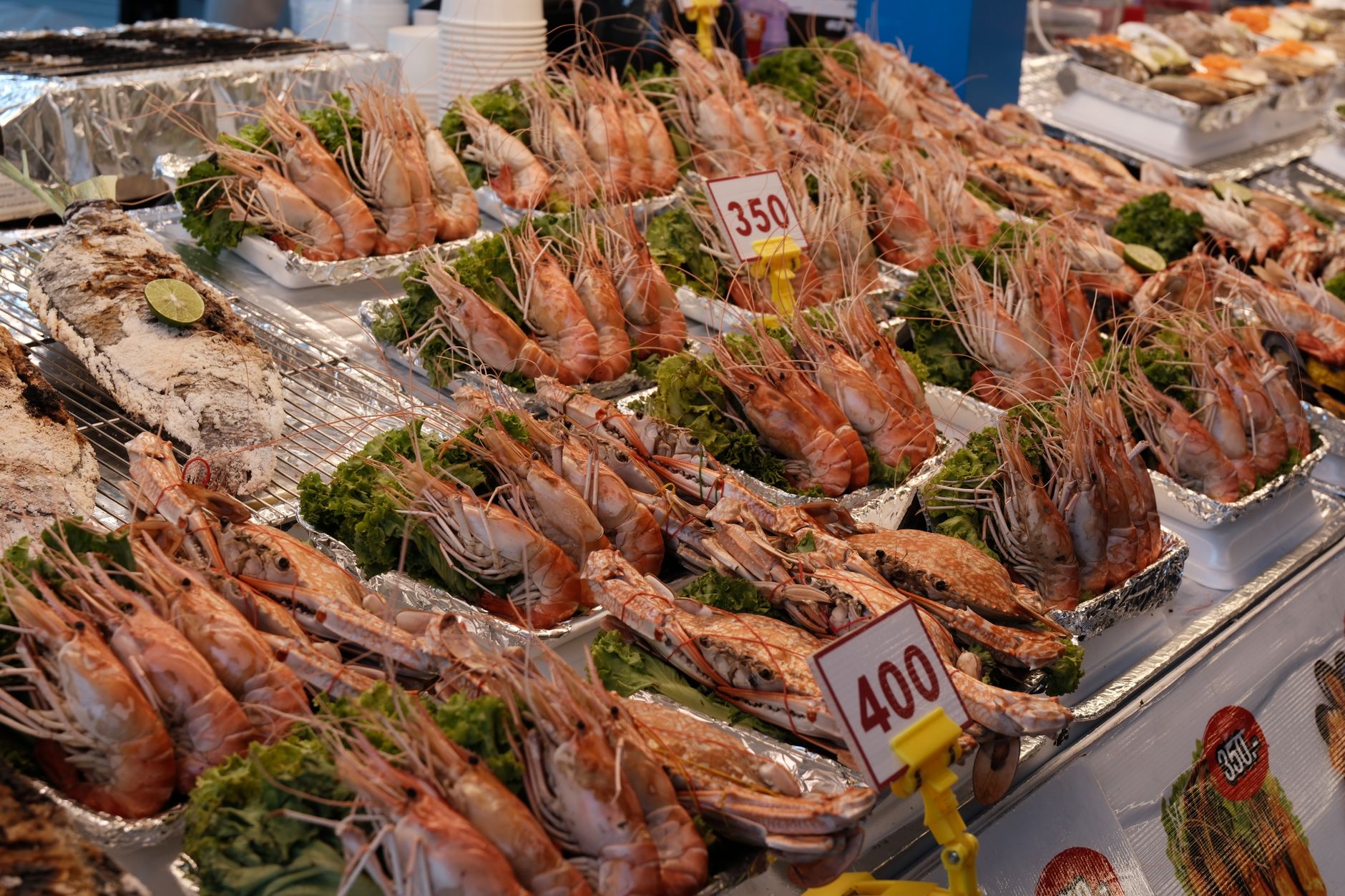
The prawns — kung mae nam, the menu called them, though menu feels like too formal a word for a laminated sheet with Thai script and handwritten prices — arrived on a metal tray lined with banana leaf. They were enormous, each one maybe the length of my hand from wrist to fingertip, their shells charred in irregular patches where the charcoal had bitten hardest. A small bowl of green sauce sat beside them, the colour of unripe papaya, flecked with what looked like bird’s eye chili and garlic.
I had come to Amphawa because every travel piece I’d read about Thailand mentioned the floating markets — Damnoen Saduak, mostly, the one clogged with tourists in orange life vests being paddled through narrow canals. I had been to Damnoen Saduak the previous day. It was what I expected: crowded, commercial, the boat noodles tasting of fish sauce and regret. The woman who sold me a plate of grilled prawns there had handed them to me in a styrofoam container, already peeled, the flesh cold and rubbery. I ate three and threw the rest in a bin near the car park.
Amphawa was different. I had read that it was more local, less touristed, but that description undersells the gap. Damnoen Saduak is a performance of a market. Amphawa is a market that happens to float.
I arrived around four in the afternoon, late enough that the heat had begun to break. The air was heavy with the smell of charcoal smoke, fried garlic, and the particular sweetness of coconut milk boiling down. A Thai friend in Bangkok had told me, before I left, to go to Amphawa instead. “But not for the boats,” she had said. “Go for the prawns. Go to the stall at the end of the pier, the one with the blue sign. The owner’s name is Pa Noi. You’ll know it because she yells at everyone.”
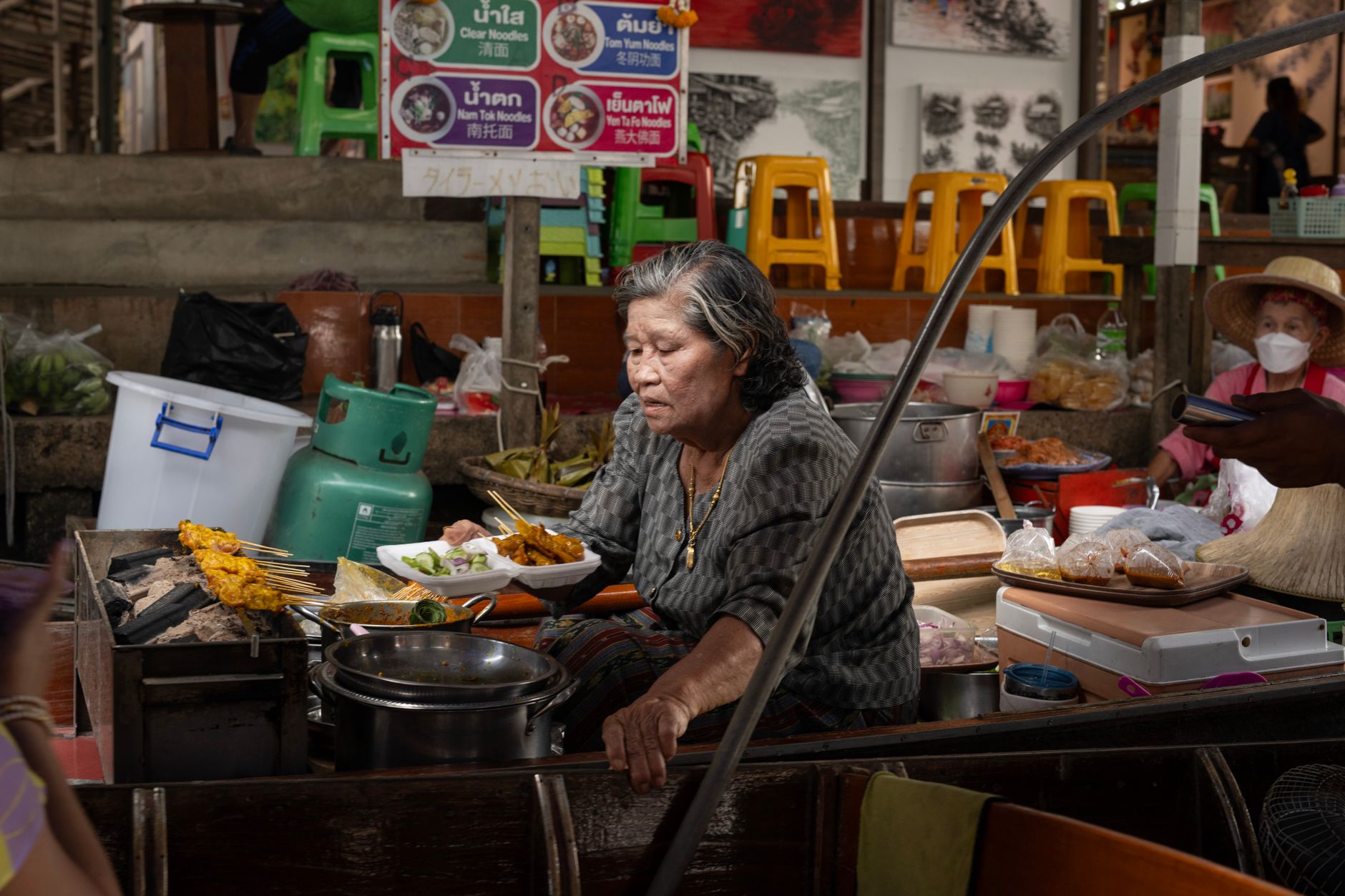
I found the stall easily enough. The blue sign was hand-painted, the letters uneven. Pa Noi was behind a griddle the size of a small car, her face half-hidden by smoke, a pair of long metal tongs in her hand. She was indeed yelling — at a young Thai man who had, from what I could gather, asked for his prawns without the heads. She said something sharp and fast in Thai, and the young man shrugged and walked away. I considered ordering without the heads and decided against it.
The prawns cost 350 baht. That’s about ten US dollars, which felt expensive for a floating market snack until the tray arrived. There were six prawns, each one the size of a small lobster, their antennae still intact, their black eyes staring up at me from the banana leaf. I had no idea how to eat them.
Pa Noi saw my hesitation. She came around from behind the griddle, wiping her hands on a rag that had once been white. She pointed at the prawn, then at my hands, then made a twisting motion. “Like this,” she said in English, her voice gravel and authority. She picked up one of the prawns from a tray waiting for another customer, twisted the head off, and sucked the orange fat from the cavity with a sound that was not polite. “Good,” she said. “The head is the best part.”
I followed her instructions. The head came off with a clean snap. Inside, the tomalley — or whatever the Thai equivalent is called — was a deep, sunset orange, rich and almost sweet, with a salinity that hit the back of my throat. It tasted of the river, but not in the muddy way I had expected. It tasted clean, briny, like the sea after it has passed through a filter of grass and reeds.
The body was something else entirely. The meat was firm, almost dense, with a texture that resisted the teeth before giving way. It was not the flaky, delicate flesh of a saltwater prawn. It was muscular, substantial, the meat of something that had spent its life swimming against a current. The char on the shell had transferred a faint bitterness to the surface of the meat, and the green sauce — a nam jim of garlic, chili, lime, and something unidentifiable that might have been fermented fish — cut through the richness with a clean, acidic heat.
I ate four prawns in silence. The fifth I ate more slowly, trying to understand what I was tasting. There was a sweetness to the meat that I had not noticed in the first four, a subtle sugar that built on the tongue after the initial salt and smoke faded. I asked Pa Noi, between customers, where she got the prawns.
“From the river,” she said, pointing vaguely at the canal behind her. “Downstream. Maybe twenty minutes, or something like that.”
I pressed her. What made them different from the prawns at Damnoen Saduak? She looked at me as if I had asked what made water different from sand. “Different river,” she said. “Different water. Different food for the prawns. Here, the water is sweet. Down there, near the city, it is salty and dirty.” She made a face. “Those prawns taste like the city. These taste like home.”
I didn’t quite believe her until the next day, when I made the mistake of ordering grilled prawns at a restaurant in Bangkok’s Chinatown. The price was higher — 550 baht for a plate of four — and the prawns were larger, more impressive, their shells painted with a thin layer of oil to make them gleam. But the meat was bland, almost neutral, as if the prawn had been a vessel for nothing but water. The head was empty, the tomalley watery and faint. I paid the bill and walked out feeling cheated.
The difference, I later learned, is not just about geography. At the big operations that supply Bangkok’s restaurants, the prawns are purged — held in clean, circulating water for a day or two before being sold. This removes any murkiness from the meat and any strong flavour from the digestive tract. But it also removes something else: the specific taste of the river they came from. The prawns become neutral, interchangeable, a blank protein waiting for sauce to give it meaning.
At Pa Noi’s stall, the prawns go from the river to the griddle in a matter of hours. They are not purged. They are not cleaned. They arrive in a bucket, still moving, their antennae waving, carrying with them the full, unedited flavour of the Amphawa tributary. The sweetness I had detected in the fifth prawn was not sugar. It was the river itself — the phytoplankton, the submerged grasses, the particular mineral composition of the water that flows through this stretch of Samut Songkhram province.
I spent the next three days going back to Amphawa. I told myself I was exploring the market, seeing the temples, photographing the canals. But I was really just waiting for four o’clock, when Pa Noi’s stall would open and I could order another tray of prawns. I tried the ones from the stall next door — a younger woman, friendly, who smiled and asked where I was from — and they were good, but they were not the same. The freshwater shrimp at a restaurant on the main road were decent but unremarkable. The grilled river fish at a vendor near the bridge was fine, but it tasted like grilled river fish everywhere.
On my last evening, I arrived at Pa Noi’s stall just as she was lighting the charcoal. The market was quiet, the day’s crowd having thinned. She remembered me. “Same again?” she asked, and I nodded. She picked six prawns from the bucket, each one moving, and laid them on the griddle. The shells cracked and hissed as they hit the heat.
I watched her work. She did not use a thermometer, did not time anything. She turned the prawns with her tongs, pressed down on the shells to check for doneness, pulled them off the heat when the colour looked right. It was a skill so practiced it looked like instinct, the kind of cooking that cannot be taught in a school or written down in a recipe.
The prawns that evening were the best I had. The tomalley was deeper, almost caramelized from the longer, slower grilling. The meat was sweeter, the char more pronounced. I ate all six, then asked for the bill.
“Three hundred,” she said.
“It was 350 before.”
“You are a regular now,” she said, and she smiled for the first time.
I paid and walked back along the pier, the smell of charcoal smoke in my clothes, the taste of the river still on my tongue. I had come to Thailand looking for something specific — the perfect pad Thai, the definitive green curry, a bowl of boat noodles that would ruin all other boat noodles for me. I had found none of those things. What I had found, instead, was a woman who yelled at her customers and grilled prawns caught somewhere around five hundred yards upstream, and the difference was so specific, so local, that it could not be reproduced anywhere else in the country.
📷 Photos: Miguel Cuenca (Pexels), King Ho (Pexels)