The Cable Car Was Just the Beginning
The Cable Car Was Just the Beginning
The man at the ticket booth didn’t speak English, and my Mandarin was limited to ordering noodles and apologizing when I choked on Sichuan peppercorns. We sorted it out with gestures and the calculator on his phone. 118 yuan for the cable car, one-way up the mountain. I paid, took the ticket, and walked toward the boarding area with my tripod slung over my shoulder like a weapon I wasn’t sure how to use.
It was early April, cold enough that I could see my breath, but the sun was already cutting through the mist over the quartzite peaks. The cable car holds eight people. I got one with a family of six from Shanghai — the grandmother was clutching a plastic bag full of steamed buns, the two kids were already arguing over whose turn it was to hold the phone for photos. I slid in beside them, backpack between my knees, and the doors closed with a soft thud.
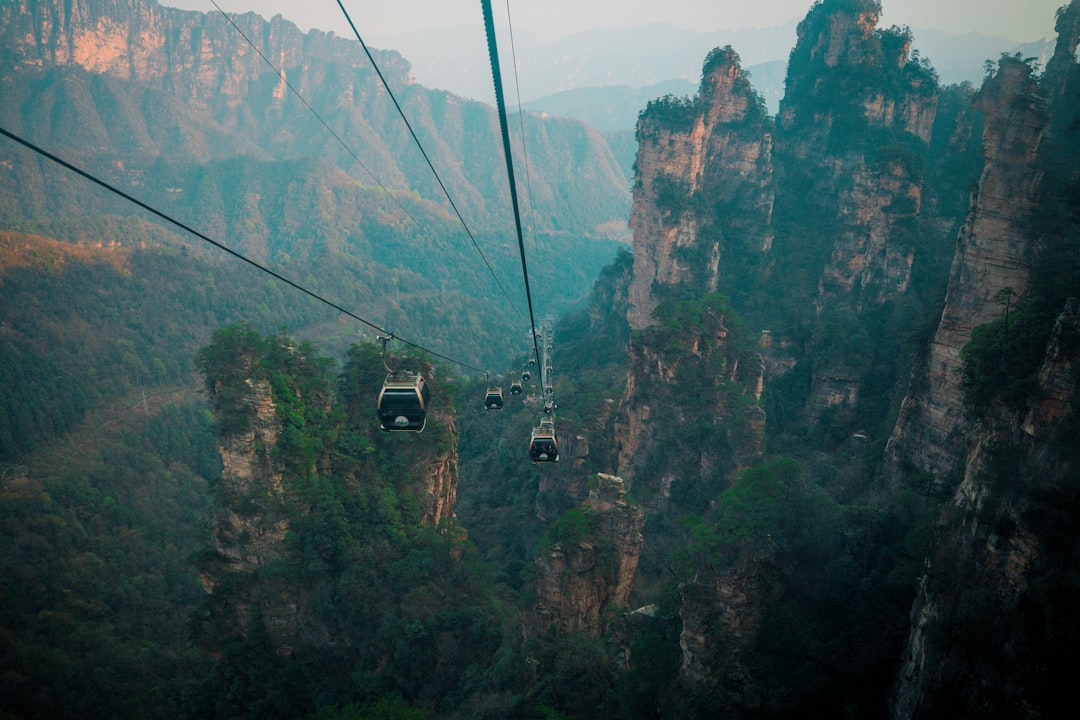
Zhangjiajie does not ease you into its scale. The car lifts off, the ground drops, and suddenly you’re looking at the same sandstone pillars that were photoshopped into Pandora for the Avatar movie. Except nobody’s blue and there’s no floating mountains here — just vertical rock, covered in pine and mist and the occasional streak of moss that looks almost green enough to be fake. The family’s grandmother made a small sound — not quite a gasp, not quite a laugh — and pressed her face to the glass.
Ten minutes later we were at the top, stepping out onto a platform that was already crowded with people in matching tour-group hats. Yellow. Blue. Red. The hats moved in clusters, like migrating ships. I stood still for a moment, adjusting to the altitude — about 1,200 meters up — and the silence that comes after the cable car’s mechanical hum cuts off. Then the hats started shouting at each other and the silence was gone.
The Southern Sky Pillars at 7:30 A.M.
The next morning, I didn’t take the cable car. I came back to the park entrance at 6:15 a.m., before the ticket booths were supposed to open, and found that they were already open. Someone in an orange safety vest waved me through with a grunt. I’d bought a three-day pass the day before — 225 yuan, about $35 — and the laminated card was already smudged from being shoved in and out of my jacket pocket.
I walked up the hiking trail that leads to the Southern Sky Pillars. The sign at the bottom said 3.8 kilometers, 2,800 steps. That was optimistic. The steps were uneven, cut into the rock at angles that seemed designed to destroy your knees. By step 900, I was already sweating through my thermal shirt. By step 1,800, I’d stopped counting and just focused on putting one foot in front of the other while a group of elderly Chinese hikers passed me going uphill without breaking a sweat. One of them, a woman who looked about seventy, was carrying a thermos and a bag of oranges. She smiled at me and said something that I think meant “slow down.”
The trail runs through a forest of bamboo and Chinese fir, over streams that run thin and clear over red sandstone. There’s a rest stop about halfway — a concrete platform with a wooden bench and a vending machine selling drinks at three times the normal price. I bought a bottle of water for 8 yuan, sat down, and listened to the forest. The sounds were different from what I expected. Not birdsong — more like insects scraping against bark, the rustle of wind through leaves that sounded like paper being crumpled. No cars, no announcements, no tour guides.
I reached the top at 7:30 and found myself alone on a viewing platform that faced a line of pillars stretching south. The mist was still low, maybe 200 feet above the valley floor, so the tops of the pillars floated on a sea of white. The sun was behind them, brightening the mist from grey to silver. I set up my tripod, fumbled with the camera settings for longer than I want to admit, and took the first frame.
Nobody else came for twenty minutes. That’s the window. That’s the entire reason to hike instead of taking the cable car — not the exercise, not the virtue of suffering, but that slice of time when the place belongs to you and the mist and the cold.
What the Cable Car Gets You
The cable car is fine. It’s efficient. It gets you to the top in less than ten minutes, and the view during the ascent is genuinely good — you can see the pillars from an angle the hiking trails never show you, rising up from below like fingers pushing through the earth. If you’re short on time, or you’re traveling with someone who can’t handle the 2,800 steps, or you just want to see the main sights without the preamble, take the cable car. I’m not here to tell you it’s wrong.
But by 9 a.m., the cable car drops off a fresh group every three minutes. The viewing platforms fill up. The paths between them become a shuffle of people stopping for selfies. The grandmother from yesterday’s cable car would be content here — the steamed buns, the family photos, the pleasant noise of a popular tourist attraction doing its job. But if you want to stand still and wait for the light to change, for the mist to part or thicken, for the feeling of standing on a rock that’s been here for 300 million years to sink in — you need to be there before the cable car starts running.
Heaven’s Gate
Heaven’s Gate is a natural arch cut into a cliff face, 130 meters tall, accessible by a cable car that’s even longer than the one to the pillars — 7.5 kilometers, the sign said, the longest in the world. You can also reach it by walking up a road with 99 curves, which sounds romantic until you try it. I didn’t try it. I took the cable car, paid the 118 yuan again, and emerged at the top to find a crowd already forming.
The gate itself is impressive — a hole in the mountain so large that the sky looks altered through it. There’s a staircase of 999 steps leading up to the gate, and people were sitting on every single one of them, catching their breath, eating snacks, scrolling through their phones. I climbed the steps slowly, stepping around the seated bodies like a game of Frogger, and reached the top feeling my calves burning.
The photograph I wanted was a particular one I’d seen online — looking through the arch from the inside, with the mountains visible beyond it. I waited. A group of Korean tourists stood in the frame for a solid five minutes, taking turns posing with the same peace sign. Then a Chinese couple walked right into the middle of it and started a photoshoot with a drone. The drone made a high-pitched whine that echoed off the rock. I put my camera down and watched it hover, annoyed, until the battery ran out and they packed up.
Twenty minutes later, I got my shot. The light was flat, the sky was white, and the mountains in the distance looked like grey lumps in a pot of soup. It wasn’t the shot I’d imagined. But it was the shot I got, and I took it anyway. Later, looking at it on my laptop, I realized the flat light made the mountains look ancient and patient, like they weren’t trying to impress anyone. I liked it better than the dramatic shots with the mist and the golden hour glow.
The Hiking Trail That Almost Broke Me
On my third day, I decided to take the path from Yuanjiajie to Yangjiajie, a route that’s not in most guidebooks but was strongly recommended by a British guy I met at the hostel in Wulingyuan. “No tour groups,” he said, “just forest and stairs.” He didn’t mention how many stairs. He also didn’t mention the section where the path disappears into a narrow crevice between two cliffs, barely wide enough for my backpack, and you have to squeeze through sideways while looking at the sky through a slot in the rock.
That section took twenty minutes to traverse. I scraped my tripod against the stone, leaving a scratch that I’d notice later and not care about. I dropped my water bottle into a crack and had to fish it out with a stick. When I emerged on the other side, I was standing on a ridgeline that looked out over a valley so deep the river at the bottom was just a silver thread. The wind was strong enough that I had to brace myself.
There was nobody else there. Not one person. The British guy had been right. I sat down on a rock, ate the packaged muffin I’d bought at the hostel for 3 yuan, and watched the clouds move through the valley. They moved fast — faster than I expected — rolling over the tree line, breaking apart, reforming. I took maybe ten photos, then just sat there and watched. The camera felt like an interruption.
The walk back took four hours. My knees hurt. I ran out of water with two kilometers to go. On the path down, I passed a family with a child who was crying, a group of college students who were passing around a flask of something that smelled like cheap baijiu, and a man in a suit — a suit, on a hiking trail — who was talking loudly on his phone. I wondered what his story was. I never found out.
One Thing About the Light
The light in Zhangjiajie is not cooperative. It shifts without warning. One minute you’re in full sun, the next you’re in a grey fog so thick you can barely see fifty feet. I learned to stop planning around the light and just shoot whatever was in front of me. The fog shots ended up being my favorite — the pillars reduced to shadows, the pine trees appearing and disappearing, the sense of a landscape that’s not quite solid.
For landscape photography, I used a tripod, a wide-angle lens at 16mm, and a polarizing filter that helped cut through the haze. I shot most things at f/8 to f/11, aperture priority, ISO 100. Nothing fancy. The real work was getting there early enough to have space to set up, and having the patience to wait for the right moment — which often wasn’t a moment at all, just a stretch of minutes when the light settled and the crowd was between waves.
I missed the sunrise because I was too slow one morning. I missed the sunset because I took the wrong bus back from Yangjiajie and ended up in a village I couldn’t find on any map. A woman in a blue coat pointed me toward a bus stop and I got back to the hostel at 9 p.m., hungry and tired and happy.
Before the Tour Groups Arrive
My last morning in the park, I took the cable car. I know — after all that talk about hiking, I took the easy way up. But my legs were sore and I wanted one more look from above before I left. The cable car was nearly empty at 6:45 a.m. I had the car to myself, hanging silent over the forest, the pillars rising and falling in the grey dawn.
At the top, the platforms were empty. The mist was thick, almost white, and I couldn’t see the pillars at all from the first viewpoint. I walked to the second, then the third. Nothing. Just fog. I sat on a bench and waited. Around 8 a.m., the first tour group arrived — yellow hats — and the fog started to lift, revealing the pillars one by one, like someone pulling cloth off a sculpture.
I got a series of photos of the pillars emerging from the mist. They’re not the best technically — the contrast is low, the focus is soft, the composition is simple. But they’re the ones I keep going back to. There’s something in them that the clear-weather shots don’t have: the sense that the mountain is revealing itself slowly, on its own terms, and you have to be patient enough to let it.
I took one more cable car down, bought a bottle of water and a packet of biscuits for 15 yuan from a vendor near the exit, and caught the bus back to the city. The British guy from the hostel was on the same bus. He said he’d spent the day hiking to a spot called the Natural Great Wall and had seen exactly three other people. He showed me a photo of a monkey that had stolen his sandwich.
📷 Photos: Sergio Kian (Unsplash), Sergio Kian (Unsplash)