I Got There at 11am and Regretted Everything
I Got There at 11am and Regretted Everything
The first time I walked down Hosier Lane I was full of confidence. I’d seen the photos online — you know the ones. The famous Hone Russell stencil, the Banksy that’s still there under its perspex shield, the whole corridor of colour. I’d told myself I’d tick it off quickly and move on to one of the laneways further north, maybe AC/DC Lane, somewhere quieter.
I got there at 11am on a Saturday in October. The spring sun was already warm and the lane was packed. Tour groups clustered around every decent stretch of wall, phones held above heads like offerings. A guy with a tripod was trying to get a clean shot of a huge paste-up of a woman’s face and kept having to wait for people to move. After three minutes he gave up and packed his gear away. I watched him leave and thought, well that’s going to be me in about five minutes.
It was. I spent maybe forty minutes there, got maybe three usable shots. Everything else had someone’s elbow in the corner or a backpack blocking half the frame. I left frustrated and walked up to AC/DC Lane where it was quieter but the art felt thinner, less dense. I didn’t take a single photo there. Ended up getting a shitty $9 flat white from a cafe near Federation Square and sitting on a bench questioning my whole plan.
7:15 on a Monday Morning
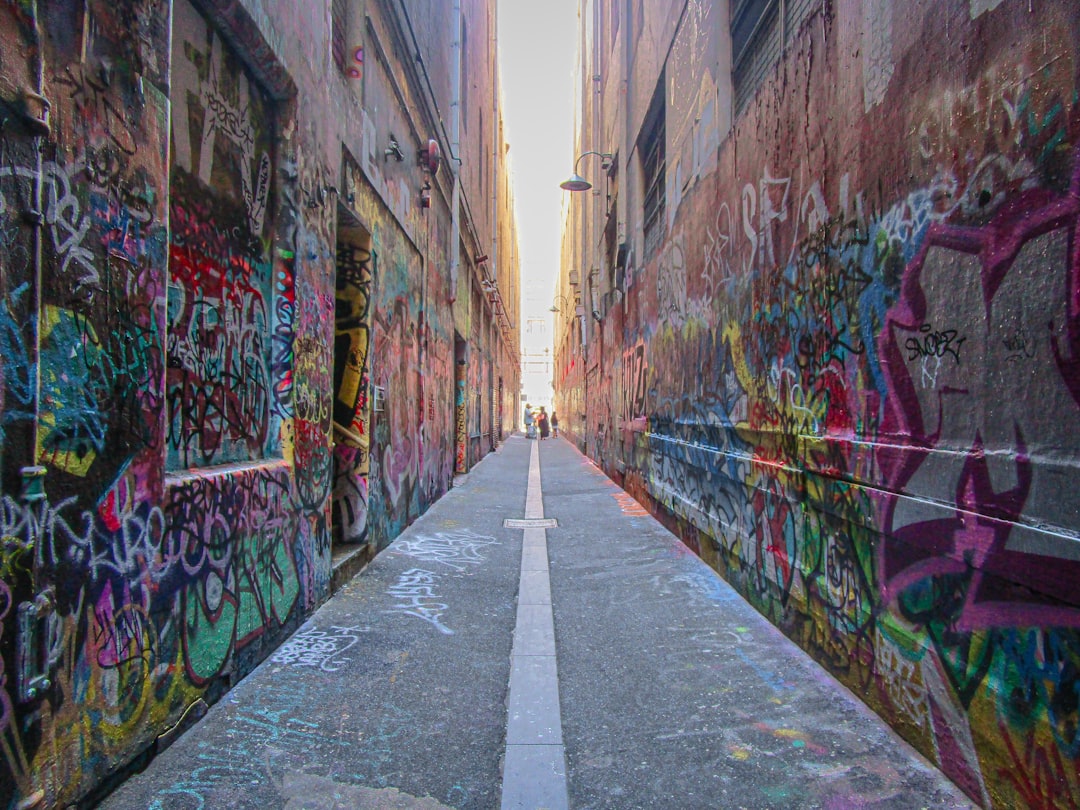
Hosier Lane isn’t a straight corridor. It bends slightly near the middle, which means the light changes as you walk through it. The southern end near Flinders Street gets direct morning sun and the colours pop hard — reds, blues, yellows, the big phoenix mural that everyone photographs. But by 10am the shadows from the buildings start cutting across the walls and you get these weird bands of light and dark that make everything look striped.
I went back two days later on a Monday morning. Got there at 7:15. The street was basically empty — one guy in hi-vis cleaning a doorway, a woman with a small dog walking through without looking at anything. The light was soft and the walls were dry. That makes a difference, by the way. The lane can stay damp from the previous night’s cleaning and the colours go dull, almost muddy, until the sun hits them properly.
I walked the full length slowly, about 150 metres from end to end. Took my time. The stencil work near the middle — the piece with the koala wearing a crown and holding a takeaway coffee cup — was catching the light perfectly. I got shots that looked nothing like the midday versions I’d taken two days earlier. The green in the foliage around the edges was brighter, more saturated. The paint on the concrete looked fresh, not worn.
By 8:30 there were maybe ten other people. By 9:00 the first tour group arrived — a Japanese group with matching jackets and a guide holding a yellow flag. They moved fast, maybe fifteen minutes total, but they filled the lane completely while they were in it. I was already done and heading up to get breakfast.
The Cat in the Spacesuit
Everyone talks about the big stuff. The massive phoenix at the Flinders Street end, the Hone Russell woman with the calm expression, the whole stretch that shows up on Instagram feeds. Those are worth seeing, sure. But the good stuff — the stuff that made me stop and actually look — was in the middle section, the part where the lane narrows.
There’s a small alcove on the left wall near the midpoint. It’s easy to miss because it’s set back slightly, maybe two metres deep. Inside it there’s a paste-up of a man in a suit with his face replaced by a television screen showing static. I don’t know who made it. There’s no signature. But the paint around it was layered — an old piece underneath showing through in patches, newer work layered over the top. You could see the history of the wall in that one small space. The static on the TV was made from tiny dots of white and grey, not a solid colour. Up close the texture was incredible.
The other spot I kept coming back to was near the southern end, on the right wall about chest height. A small stencil of a cat wearing a spacesuit, maybe thirty centimetres across. It was partially covered by a newer paste-up of a woman’s face, like it was being slowly erased. I photographed it on three separate visits and each time a little more of the cat was gone. By the third visit only the helmet and one ear were still visible. I thought about trying to find the original artist but that felt weird, like tracking down someone whose work was being painted over. That’s the life of street art though. Nothing stays.
Cup of Truth, $6.50
After the third visit I walked up to Degraves Street for coffee. There’s a place called Cup of Truth on an alley off Degraves that does a decent flat white for $6.50. Not cheap, but better than the $9 one I’d suffered through near Federation Square. I sat at one of the tiny outdoor tables and watched people move through the area.
A guy with a camera — proper Nikon with a big lens — stopped near the entrance to the alley and started photographing a small piece of graffiti I’d walked past without noticing. Just some lettering, maybe a tag, in silver and blue on a grey wall. He spent a good five minutes on it. I watched him because I was curious what he saw that I didn’t. When he finished I asked him about it. He said, “The light catches it differently from this angle. In an hour it’ll be dead flat.”
He told me he’d been shooting street art in Melbourne for twelve years. Said the best time was between 6:30 and 8:00 in the morning, not just for the crowds but because the angle of the sun changes the way the paint reads. A piece that looks washed out at noon can look completely different at 7:30 when the light comes in low from the east. He said he’d photographed the same wall over a hundred times over the years and it never looked the same twice because the paint changes, the light changes, the layers build up or get painted over.
I didn’t get his name. He drank his coffee and left.
Union Lane and Duckboard Place
Hosier Lane gets the attention but it’s not the only game in town. Union Lane runs parallel to Hosier, one block east. It’s narrower, darker, and the walls are covered in paste-ups and tags rather than the big commissioned murals. There’s almost never anyone there. I walked through it at 10am on a Tuesday and saw exactly two people, both of them just walking through to get somewhere else.
The art there is rougher. Less polished. Some of it is clearly done quickly, late at night, with whatever materials were on hand. A piece near the Bourke Street end — a black stencil of a crow holding a cigarette — had drips running down from where the paint had been applied too thick. It looked deliberate but probably wasn’t. I liked it more than half the polished stuff on Hosier.
Duckboard Place, which connects to AC/DC Lane, was another surprise. It’s essentially a service alley — bins, delivery trucks, a smell of grease from the restaurants. But the walls there have some of the best layering I saw in Melbourne. Old pieces half-buried under new ones, sometimes five or six layers visible in the same square metre. There’s a spot near the middle where a faded stencil of a woman’s face sits underneath a bright orange geometric pattern, and underneath that you can see the outline of what might have been an animal — a dog or a fox, hard to tell. The layers tell a story if you take the time to read them.
I spent an hour in Duckboard Place on my last morning. Nobody bothered me. A delivery driver in a white van gave me a look as he squeezed past, but that was it. The light was poor — it’s a north-south alley in shadow most of the day — but that didn’t matter for the close-up shots of the paint layers.
What I’d Tell Someone Going Tomorrow
If you’re going to Hosier Lane specifically for photos, don’t go between 10am and 3pm. The light is flat, the shadows are harsh, and the number of people makes it impossible to get a clean shot unless you’re willing to stand there for twenty minutes waiting for a gap. Go at 7am on a weekday. Or go just before sunset in summer when the light comes in from the west and hits the walls at an angle that brings out the texture of the paint.
Bring a lens that can do close-up work. The wide shots of the whole lane are fine but the real interest is in the details — the small stencils, the paste-ups, the way the paint cracks and peels at the edges. A 50mm or a macro will serve you better than a zoom.
Don’t skip the side alleys. Union Lane and Duckboard Place are within a block of Hosier and they’re almost always empty. The art is less polished but more interesting for it, more alive to the fact that it’s temporary.
And bring cash for coffee. Cup of Truth, the place on the alley off Degraves, takes cards now but the machine was down when I went. The $6.50 flat white was worth it anyway.
I’ve been home for three weeks and I’m still wondering if that cat in the spacesuit is fully gone by now. Probably. I’m glad I got there early enough to see it.
📷 Photos: Miranda F (Unsplash), XY YEW (Unsplash)