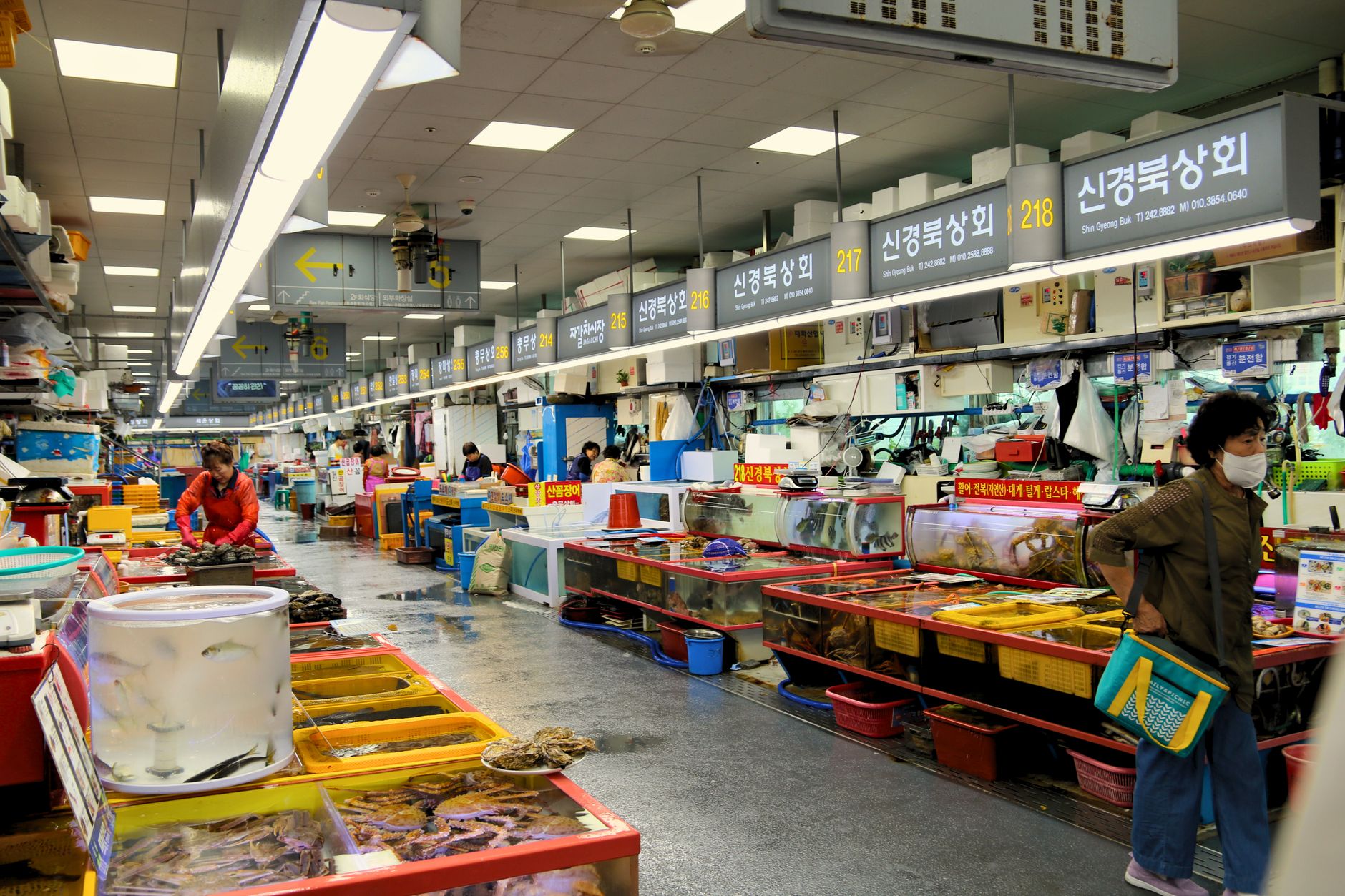
The woman at the eel stall didn’t smile when I sat down. She was in her sixties, maybe older, with the kind of hands that have been handling seafood so long the skin itself looks scaled. She gestured at the plastic stool, pointed at the tank of eels writhing against each other in cloudy water, then held up three fingers. Three portions. That’s the minimum at this particular stall — stall number 47 in Jagalchi Market’s main hall, though nobody calls it by a number. Regulars know it as “the eel ajumma’s place” and that’s enough. I’d heard about this stall from a fisherman I met the previous day at the pier near Gukje Market, a man in his fifties who was mending a net and didn’t look up when he talked. “Don’t go to the big places upstairs,” he said. “Go downstairs, find the eel lady. She has one thing and she does it well.” He was right. She has exactly one thing: jang-eo-gui, grilled eel, brushed with a sauce so simple it barely qualifies as a recipe — soy sauce, garlic, sesame oil, a touch of gochugaru. The eel arrives at the table still sizzling on a small wire grate, the skin blistering in dark patches, the flesh translucent white where the heat hasn’t fully caught up. There’s no banchan spread, no soup, no rice unless you ask. Just the eel and a shallow dish of salt and sesame seeds for dipping. I ate the first portion in about four minutes. The second portion I tried to slow down, but the salt and the char and the faint sweetness of the eel’s own fat kept my hands moving. By the third portion, I was full in a way that felt almost uncomfortable, but I finished it anyway because the ajumma was watching and she’d cooked it in front of me and it felt rude not to.
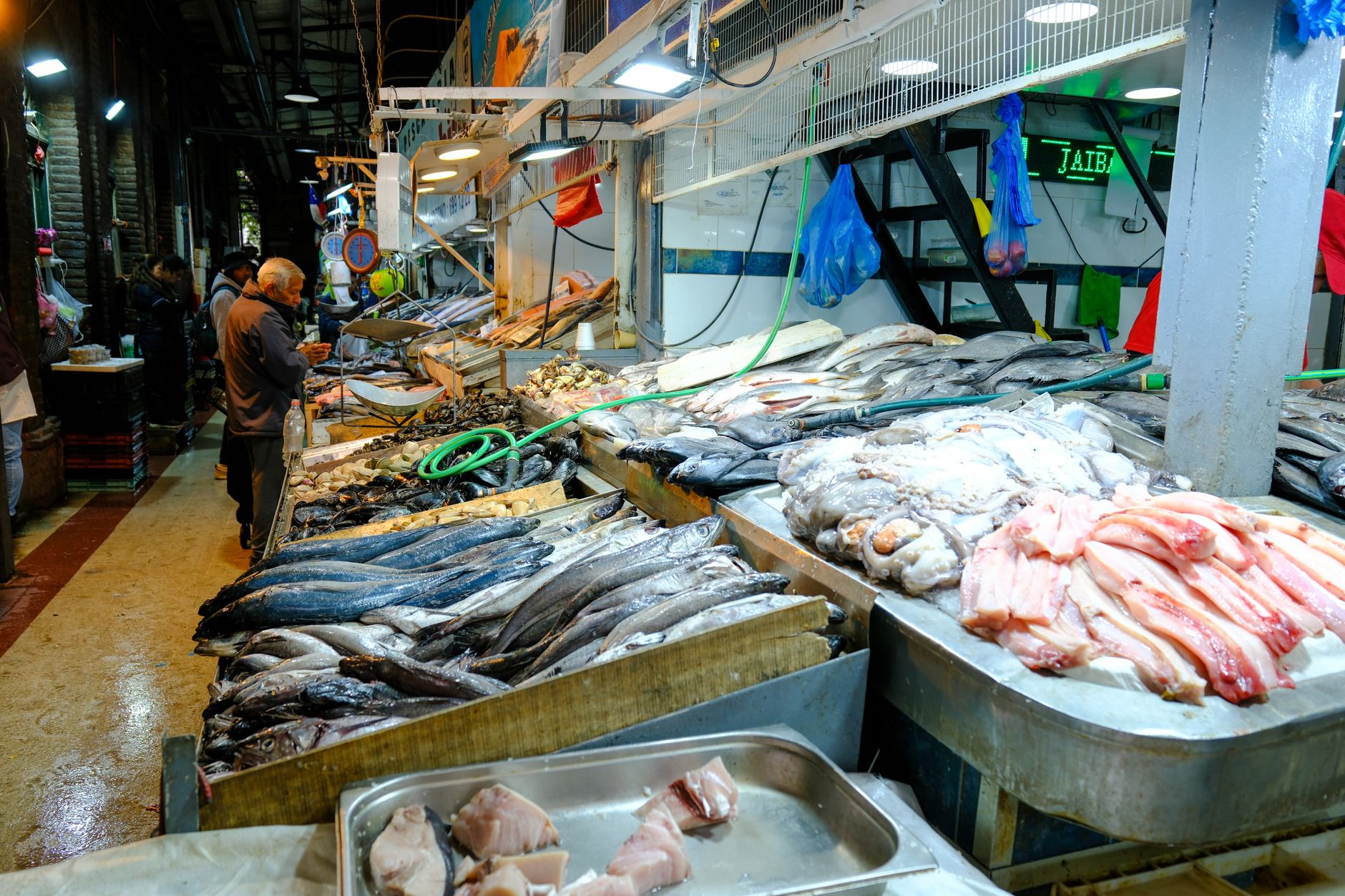
Jagalchi Market is usually described in guidebooks as Korea’s largest seafood market, and that’s technically correct, but the phrase doesn’t capture the actual experience. What it captures is the ammonia smell that hits you about twenty meters from the main entrance — a mix of brine, fish blood, and wet concrete that no photograph has ever managed to convey. The building itself is a concrete block from the 1960s, four stories, with a modern annex that was added in the early 2000s and still looks out of place. Most visitors head straight for the second-floor restaurants, where the tables have laminated menus with English translations and the staff will bring you a platter of sliced raw fish without asking how fresh it is. I spent the first hour on the ground floor instead, watching the women — and they are almost all women, the haenyeo, the sea women, who dive for abalone and sea urchin and octopus along the southern coast — gut and clean their morning catch. They sit on low plastic stools behind tables piled with ice, wearing rubber aprons and rubber boots and sometimes a headlamp even in the middle of the day. The light in the market is fluorescent and harsh, the kind that makes everyone look vaguely ill, but the fish look perfect under it: mackerel still flexing, sea squirts pulsing gently, eels twisting in shallow tubs. I watched one woman decapitate a large flatfish with a single diagonal cut, then flip the body over and fillet both sides in what felt like three seconds. She noticed me watching and held up the head, still moving, as if to ask whether I wanted it. I shook my head. She shrugged and tossed it into a bucket.
The raw fish — hoe — that most people eat at Jagalchi comes from these same women. You buy the fish downstairs, then carry it up to one of the restaurants on the second floor, where they’ll slice it for you and serve it with the usual accompaniments: gochujang, ssamjang, raw garlic, perilla leaves, a bowl of the peppery soup made from the bones. This is the standard procedure, and it works fine, but the quality varies enormously depending on which stall you bought from and whether the fish has been sitting on ice for three hours or three days. A restaurateur who runs a tiny sashimi place in the alley behind the market — not in the building itself, but in the concrete alley with the runoff drains — told me that most visitors don’t understand that the fish they see on ice downstairs isn’t necessarily what they’ll eat upstairs. “They buy a pretty fish because it looks fresh,” he said, wiping his hands on a rag that had once been white. “But the ajumma knows which ones are yesterday’s catch. She’ll sell you the pretty dead one and keep the ugly live one for her regulars.” He wasn’t being cruel about it. He was stating a fact about how the system works, like a mechanic explaining why you shouldn’t buy a used car that’s been detailed.
I took his advice and bought my fish from a stall near the back corner of the ground floor, where an older woman with a single gold tooth was selling domi — sea bream — from a tank of circulating seawater. She pulled one out with her bare hand, slapped it onto a cutting board, and looked at me. I nodded. She killed it with a knife to the brain, scaled it in three rapid strokes, and handed me the whole fish in a plastic bag, still twitching. Upstairs, at what I’ll call Mom’s Table — not its real name, but close enough — the ahjumma who ran the place took the fish without asking any questions, weighed it on a rusted scale, and told me it would be 5,000 won for the slicing. I paid. She disappeared into the kitchen. Fifteen minutes later, a plate arrived with the fish sliced into pieces thin enough to see the grain of the board through, arranged in a spiral pattern that looked almost architectural. The flesh was firm, almost crunchy, with a sweetness that hit the back of my tongue before the wasabi did. This is the difference between fresh hoe and the kind you get at a chain restaurant in Seoul: the texture still has resistance, a slight chew that tells you the fish was alive an hour ago. The rice was warm, the perilla leaves were whole, and the soup that came with it — made from the head and bones of the same fish — had a clarity that made me feel like I was drinking the ocean through a filter. I ate slowly, deliberately, trying to memorize the taste. I knew I wouldn’t find it again on this trip.
Sannakji is the thing everyone asks about. It’s the live octopus dish, the one where the tentacles are still moving when they hit the table, and it’s become the symbol of Korean seafood for thrill-seeking tourists. I’d eaten it before — once in a restaurant in Myeongdong, once at a stall in Gwangjang Market — and both times it had felt more like performance than food: the tentacles suctioning to the inside of my cheek, the table of Japanese tourists filming on their phones, the sense that I was participating in a spectacle rather than a meal. At Jagalchi, I found it different. There’s a specific stall on the ground floor, near the exit closest to the Yeongdo Bridge, where a woman in her seventies sells nothing but small octopus — nakji, the species that’s about the size of your hand, not the giant ones you see in tourist videos. She keeps them in a shallow basin of seawater, and when someone orders, she reaches in, pulls one out, and cuts it into pieces right there on the counter. No presentation, no garnish, no sesame seeds or sesame oil. Just the octopus, a bowl of salt, and a pair of scissors. I ordered a portion — 10,000 won — and watched her work. She cut the head off first, then the tentacles into segments about the length of my thumb, all while the octopus was still alive and its nervous system was firing random signals. The pieces writhed on the cutting board. She pushed them toward me with the flat of the blade. I picked one up with my chopsticks, dipped it in salt, and ate it. The suction cups grabbed at my tongue and the roof of my mouth, a sensation that’s not painful exactly but deeply strange, like having a tiny hand trying to grip you from the inside. The texture was mostly salt and seawater and a faint iodine taste, with almost no fish flavor at all. I ate the whole portion in about two minutes, and when I was done, the woman was already cleaning her scissors with a rag, uninterested in whether I’d enjoyed it or not. It wasn’t better or worse than the other times I’d tried it. It was simply more honest — less dressed up, less about the photo, more about the fact that sometimes you eat something that’s still moving and that’s just how it is.
A mistake I made on my second day at the market was trusting the English-language menu at a second-floor restaurant called — and I’m translating loosely — “Fresh Fish House.” The menu had pictures, English names, and prices that were about a third higher than the Korean-only menus I saw other tables using. I ordered the hoe platter for two people, thinking it would be a sampler of various fish, and received a plate of what was clearly yesterday’s catch: the slices were thicker, the edges slightly dried, the color a duller pink than the sea bream I’d eaten the day before. It wasn’t bad exactly. It was just ordinary, and I’d paid premium prices for ordinary. The ajumma who served me noticed I wasn’t eating much and asked — in Korean — if something was wrong. I told her, in my imperfect Korean, that the fish tasted old. She looked at the plate, looked at me, and said nothing. She took the plate away, returned five minutes later with a fresh portion — smaller, but visibly better, the slices thin and translucent — and set it down without explanation. She didn’t apologize. She didn’t acknowledge that the first plate had been substandard. She just corrected it and moved on, the way someone who’s been in this business for decades knows exactly what’s going on and chooses not to make a scene about it. I ate the second plate and paid my bill.
40 Minutes of Walking for An ATM That Didn’t Work
The logistical annoyance that shaped most of my time at Jagalchi was that I’d arrived without cash. The market’s ATM, a lone machine near the main entrance, was out of service. The woman at the eel stall wouldn’t take a card. The octopus lady wouldn’t take a card. The fish stall with the gold-toothed ajumma had a QR code for a payment app I didn’t have installed. I spent forty minutes walking between convenience stores and subway stations, trying to find a working ATM that would accept my foreign card, and by the time I returned to the market, the afternoon light was already shifting and the ground-floor stalls were starting to pack up. I missed the chance to try the kkotgetang — a spicy crab stew that several people had recommended — because the stall that served it had already washed its pots by the time I got back. I stood in the emptying market hall, holding a stack of won notes that I could now use, and felt a specific kind of frustration that comes from having solved a problem too late. I ended up eating dinner that night at a convenience store across the street: a triangle kimbap and a can of beer, sitting on a curb, watching the last of the market’s customers trickle out with their bags of ice and fish. It wasn’t a bad dinner. It was just the wrong dinner for the occasion, and the whole situation was my own fault for not bringing cash in the first place. The eel ajumma had told me — not in words, but in the way she’d pointed at a handwritten sign taped to her counter — that she only takes cash. I’d understood the sign and then ignored it, the way travelers sometimes do, assuming that there will always be a workaround. There wasn’t.
On my last morning in Busan, I went back to stall 47 one more time. The eel ajumma was there, same apron, same expression, same tank of eels. This time I held up four fingers. She nodded, pulled out four eels from the tank, and began to gut them on a board that was worn to a concave shape from decades of use. The eels twisted on the board, and she pinned each one with her palm, slicing from the head down to the tail in a single smooth motion, then scraping out the innards with the side of the blade. She worked without looking at me, without any of the performance that comes with the tourist-oriented stalls. When the eels were done, she laid them on the wire grate and brushed them with her sauce — the same sauce, I realized, that she’d been making for however many years she’d been here. The eels hissed when the sauce hit the hot metal. The smell was sesame and smoke and the faint bitterness of charred skin. I ate all four portions slowly, deliberately, the same way I’d eaten the sea bream on my first real day at the market, and when I finished, she picked up the empty plates and gestured for me to leave. A younger woman at the next table, who was eating alone and seemed to be a regular, leaned over and said in English, “She doesn’t like people who take pictures, or something like that.” I hadn’t taken any pictures. I’d just sat and eaten, and I realized that this was probably the right way to be at her stall — to be present without documentation, to treat the eel as food rather than content, to leave nothing behind but a clean plate and payment in cash.
I’d bring more cash next time, and I’d skip the second-floor restaurants entirely in favor of the ground-floor stalls and the alley behind the market where the sashimi place is. I’d miss the crab stew again, probably, because the timing never works out, and I’d sit at the eel ajumma’s stall and eat her eel and not take pictures and leave when she tells me to. That’s the thing about Jagalchi that most coverage misses: it’s not a place where you curate an experience. It’s a place where you sit, eat what’s in front of you, and get out of the way so the next person can sit down. The market doesn’t care whether you enjoyed your meal. It will still be there tomorrow, selling fish to people who know exactly what they want, and if you don’t come back, someone else will take your stool.
📷 Photos: Bruna Santos (Pexels), Mick Latter (Pexels)