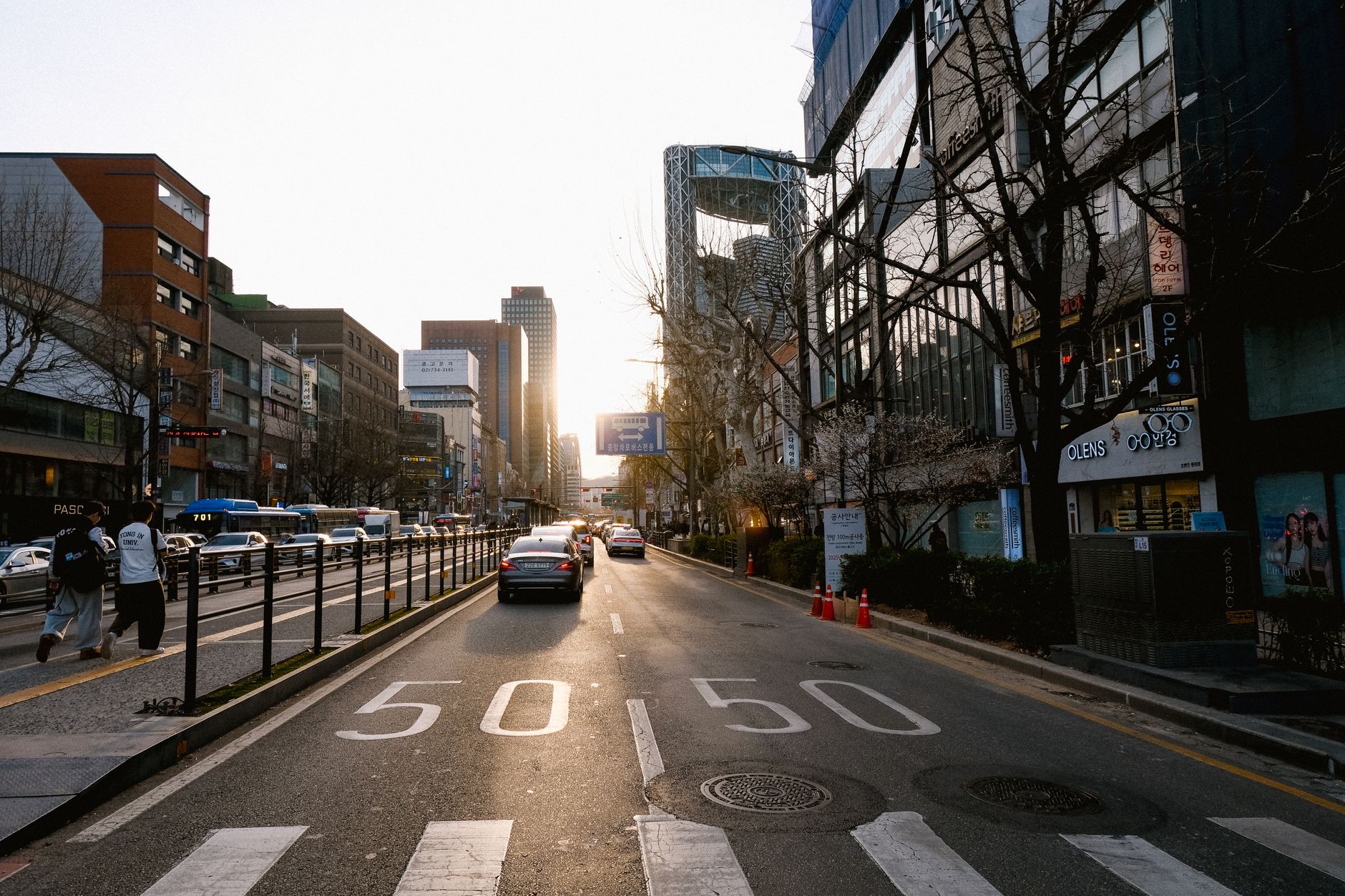
Late October, a Tuesday afternoon. I’d taken the wrong exit from Jongno 3-ga station and ended up in a tangle of alleys I couldn’t find on any map. The air smelled of fermenting soy and diesel exhaust and the particular damp that lives in Seoul’s older neighborhoods. A woman was squatting outside a doorway, washing a pile of large radishes in a plastic basin, the water running grey into the gutter. That’s when I noticed the stove.
It was visible through a half-open door that had once been painted blue but was now mostly chipboard and peeling lacquer. A single gas burner, a dented stainless steel pot that looked older than I was, and a woman—probably in her seventies—stirring the pot with a long-handled spoon. She saw me looking and said something I didn’t catch. I pointed at the pot. She shrugged, and gestured for me to come in.
The place had no name that I could find. No sign in Korean or English. Just a faded awning that might once have advertised something in Chinese characters, now too worn to read. Inside, four tables. Two were folded against the wall. One was occupied by an older man in a work jacket, eating silently, his bowl held close to his face. The woman brought me a bowl without asking what I wanted. It was kimchi jjigae—the classic Korean stew of aged kimchi, pork belly, tofu, and gochugaru—but nothing about it looked familiar.
The broth was darker than any I’d seen before: a deep reddish-brown, almost mahogany, with a surface gloss of oil that caught the fluorescent light. The kimchi was not the bright, orange-flecked version served in most restaurants. It was brown, translucent at the edges, the cabbage leaves collapsed into themselves. The pork belly was cut thick—thumb-sized chunks, not the usual thin slices—and the tofu had been fried on one side before being added to the pot. I asked her, in my halting Korean, how long the kimchi had been aged. She looked at me like I’d asked something irrelevant. “As long as it takes,” she said, and walked back to the stove.
The kimchi in that bowl had not been aged in a temperature-controlled kimchi refrigerator. It had been sitting in an earthenware jar on the roof, through summer heat and autumn chill, exposed to whatever wild yeasts happened to be in the air of that particular alley. The woman’s stew was not a recipe so much as a record of that specific jar, that specific year, that specific block of Jongno.
I’ve heard people say kimchi jjigae is a dish that forgives mistakes. But watching this woman work, I realized the opposite might be closer to the truth: the dish forgives nothing except patience. The kimchi must be old enough that its lactic acid has fully developed, young enough that the cabbage hasn’t turned to mush. The pork must be fatty enough to render into the broth but not so fatty that the surface becomes a slick of grease. The water must be added at the right moment—too early, and the flavors dilute; too late, and the stew scorches. She made it look effortless, which meant it wasn’t.
I finished the bowl in silence. The man in the work jacket had left without my noticing. The woman sat down at the table next to me and lit a cigarette, looking out at the alley. I asked her how long she’d been making kimchi jjigae in that spot. She thought about it. “Maybe forty years? My mother-in-law started this place before I married her son.” She tapped ash into an empty soju bottle. “I didn’t like her at first. But I learned to cook like her.” She didn’t say anything more, and I didn’t press.
Later that week, I went looking for context. A professor I met who studies late Joseon-era food records told me—off the record—that the earliest written reference to something like kimchi jjigae appears in a 19th-century cookbook compiled by a woman whose name is unknown. “But the dish as you know it,” he said, “is really a product of the 1960s and 1970s. When refrigeration became common, people started making kimchi in bulk. The old kimchi that wouldn’t keep through summer—that’s what became jjigae.” He paused. “The irony is that now, people buy special ‘jjigae kimchi’ that’s aged just for this purpose. I don’t know, it kind of defeats the whole point.”
The point, as I understood it sitting in that nameless restaurant, was that kimchi jjigae was never meant to be a destination dish. It was a way to use up what was already there. The scraps, the edges, the kimchi that had passed its prime for eating fresh. The dish is a record of thrift, not indulgence—which makes it strange that it’s become a staple of Korean restaurant menus worldwide, served as a main course with a side of polished nostalgia.
I went back to the Blue Door—that’s what I started calling it, because the door was the only distinguishing feature I could name—three more times over the following week. Each time, the stew was different. Once, it contained a handful of enoki mushrooms that hadn’t been there before. Once, the kimchi was more sour, almost sharp, and the woman added a spoonful of gochujang to compensate. Another time, the pork had been replaced by canned tuna—a common variation, but one I hadn’t seen her serve before. She didn’t explain the changes. She simply put the bowl in front of me and walked away.
On my fourth visit, a younger woman was at the stove. The older woman’s daughter-in-law, I learned—a woman in her late forties who had taken over most of the cooking. I asked if she used the same recipe. She laughed. “My mother-in-law never wrote anything down. I just watch and try to remember.” She pointed at the jar of kimchi on the counter. “The kimchi is different every batch. So the stew is different. You just have to taste and adjust.”
Most restaurants that serve kimchi jjigae today operate on a fixed formula: a standard base broth, a consistent source of aged kimchi, standardized portions of pork and tofu. The result is reliable, but it has no memory. The stew at the Blue Door was not reliable in that sense. It was inconsistent, variable, alive to the conditions of the day. The woman’s adjustments were not corrections but conversations—between the kimchi, the weather, the pork, and the moment.
One afternoon, a delivery truck blocked the alley and the woman disappeared for twenty minutes. The stew sat on the stove, simmering. I watched it. When she came back, she stirred it once, tasted it, and added a pinch of salt. That was the only intervention. The stew had continued cooking in her absence, reducing, concentrating. She didn’t try to undo that. She worked with it.
Most visitors to Seoul seeking kimchi jjigae end up at one of the well-known chains near Myeongdong that cater to tourists. Those places are fine. They serve a consistent version of the dish. But they cannot tell you what happens when a jar of kimchi is left on a rooftop through a Seoul summer, exposed to temperature swings of fifteen degrees in a single day. They cannot tell you what a forty-year habit of looking at a pot and knowing, without tasting, what it needs.
I never learned the woman’s name. On my last day in Seoul, I went back to the alley. The Blue Door was open, but the stove was off, and the tables were stacked. The daughter-in-law was sweeping. She told me her mother-in-law had gone to the market and wouldn’t be back until late. I said I was leaving. She nodded, and then, without my asking, she went to the kitchen and came back with a small plastic container. “For the road,” she said. Inside was a portion of kimchi jjigae, cooled but still fragrant, the broth having settled into a dense, gelatinous state around the pork and tofu. I ate it that evening, sitting on a bench outside Seoul Station, watching the commuters stream past. The stew had travelled badly—the tofu had broken apart, the broth had congealed—but it was still good. It tasted like the alley had tasted on that first afternoon: specific, unrepeatable, exactly what it was supposed to be. You carry it with you.
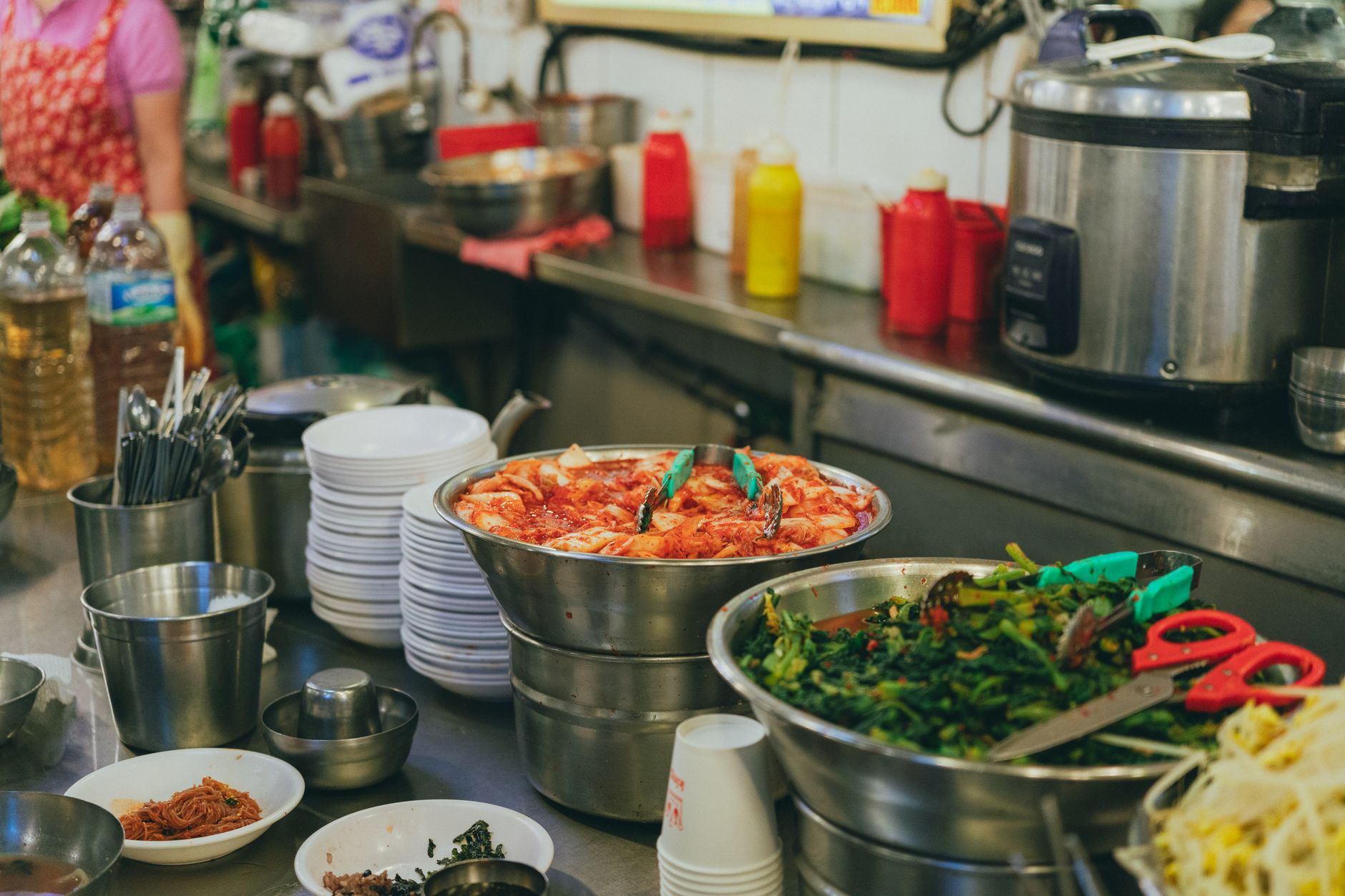
📷 Photos: Ayyeee Ayyeee (Pexels), Theodore Nguyen (Pexels)