The diesel fumes hit first, before any view of the water. That’s the smell of a real ferry terminal, not the air-conditioned version marketed to tourists. I was standing on the pier in Pak Bara, a small port in Satun Province that most travelers pass through on their way to Koh Lipe, if they come this far south at all. A local ferry to Koh Muk leaves at 11am, costs 300 baht, and takes roughly an hour. The ticket agent, a woman named Aye who’d worked the counter for fourteen years, told me most foreigners ask for speedboats. “They don’t know the ferries go anyway. They pay double and get there ten minutes faster.” I bought the ferry ticket.
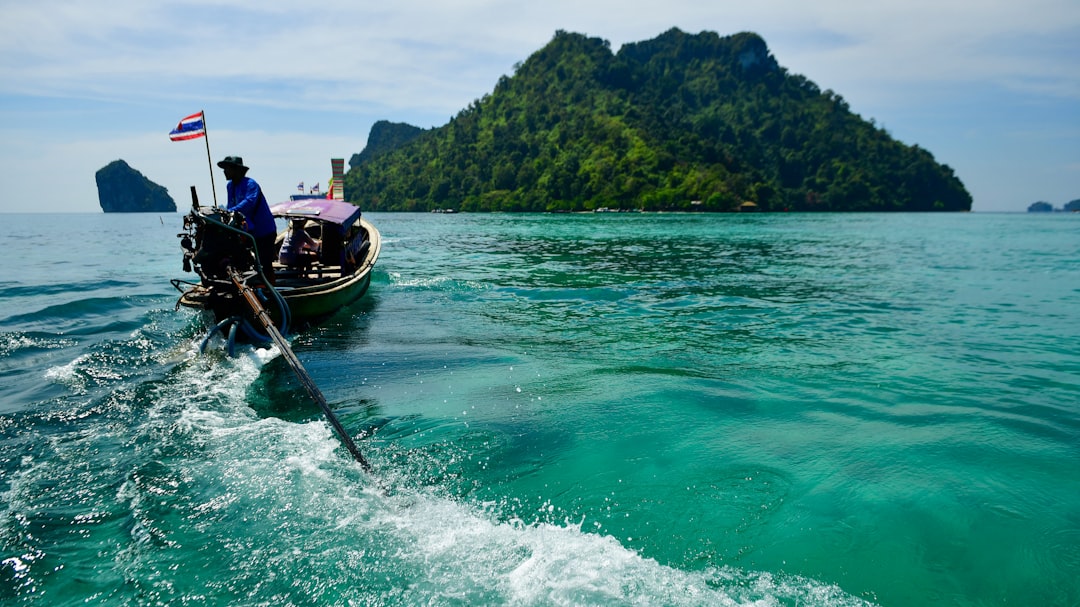
The boat was a rust-streaked thing with wooden benches and a roof that leaked near the left corner. A Thai family occupied the front half—three generations, a cooler of fried chicken, a baby who cried for most of the crossing. Two German backpackers sat near the back, looking uncertain. Nobody spoke much. The engine noise made conversation optional, which I’ve come to prefer on these trips. It forces you to look at what’s passing rather than talk about what’s coming. The limestone karsts off the coast of Trang Province don’t announce themselves. They just appear, rising from the flat sea like they’ve always been there, which they have.
Most itineraries I’d read before leaving Bangkok treated these islands as day-trip material. Speedboat from Koh Lanta, a few hours on Koh Muk’s Emerald Cave, lunch on Koh Kradan, back before dark. A five-day loop using only local ferries seemed almost perverse to the people I mentioned it to. “You’ll waste so much time traveling,” a hotel clerk in Trang town told me. I didn’t argue with him. But I’d spent enough time on tourist routes to know that time spent in transit on a local ferry isn’t wasted. It’s where the actual rhythms of a place become visible—the cargo that moves between islands, the schoolchildren commuting home, the monk in orange robes reading a weathered book in the corner.
Koh Muk is the island most visitors to this region know by one landmark: Tham Morakot, the Emerald Cave, a sea cave that opens into an enclosed lagoon. I’d seen the photos. Everyone has. A group of tourists swimming through darkness, emerging into sunlight reflecting off emerald water. The experience itself is different from the photos, and not in a bad way. I arrived at the cave entrance around 10am on a Tuesday, after a fifteen-minute longtail ride from the resort side of the island. There were three other groups waiting. That’s not nothing, but it’s not Phi Phi either, where the queue for the same experience can stretch to fifty people in high season. The swim through the tunnel is genuinely dark—pitch black for about thirty seconds in the middle section—and the guides insist on absolute silence. “No talking inside. If everyone talks, nobody hears the directions when they matter.” I didn’t ask what happened to people who didn’t follow that rule. The tone suggested it wasn’t the first time someone had tested it.
The lagoon itself is striking enough to understand why it became famous, but better appreciated when you’re alone. I sat on the small sandy beach inside the limestone walls for maybe twenty minutes after the other tourists left. The water was bath-warm. A monitor lizard watched me from a rock shelf about ten meters up. Neither of us moved much. This kind of moment—the one that can’t be photographed well, the one that requires sitting still—is what the speedboat itineraries eliminate. They optimize for the postcard shot, then move on. The ferry schedule forces a slower pace. You can’t leave until the next boat comes.
Koh Kradan, a twenty-minute ferry ride south of Koh Muk, is where I made my mistake. I’d heard the beaches on the west coast were the best in Trang—white sand, clear water, minimal development. That’s true. What nobody mentioned is that the west coast beaches have almost no shade between 11am and 3pm. The trees are palms planted for coconuts, not for shelter. I’d brought a hat but no umbrella, and the sun was brutal. I lasted an hour on the main beach before retreating to a small café that served only instant coffee and warm Singha. The owner, who’d moved from Nakhon Si Thammarat twenty years earlier, said she’d never understood why tourists sat on the beach all day. “The sun is too hot. Better to come early, swim before ten, then rest.” She was right. I’d read that advice somewhere before and ignored it. The cost of ignoring it was two hours of discomfort and a sunburn that peeled for a week. Not a disaster, but avoidable if I’d taken the advice seriously instead of assuming I knew better.
That afternoon I took the wrong ferry. It’s easy to do. The piers at Koh Kradan don’t have clear signage. I saw a boat loading passengers and asked “Koh Sukorn?” The captain nodded. We left. Forty minutes later, we pulled into a pier I didn’t recognize. The captain had understood “Koh Sun” instead of “Koh Sukorn”—two different islands, two different directions. The ferry wasn’t returning until the next morning. I was stuck on Koh Libong, a large island that sees maybe a tenth of the visitors that Koh Muk gets.
Koh Libong turned out to be the best thing that happened on the trip. The island is mostly rubber plantations and fishing villages. There’s one basic guesthouse near the pier and a handful of homestays scattered along the coast. I found a room at a place called Baan Libong, run by a retired fisherman named Chai and his wife. No air conditioning, cold-water shower, mosquito net with a hole I had to tie shut. Three hundred baht a night. Dinner was grilled fish and sticky rice bought from a woman who cooked on a cart near the pier, total cost about sixty baht. I ate on the guesthouse porch watching the sun set over the Andaman Sea, alone except for a stray dog that seemed to expect a share of the fish. It got some.
The next morning, Chai offered to take me out on his longtail to see the dugongs. The seagrass beds around Koh Libong host one of the largest remaining populations in Thailand, but sightings are unpredictable and mostly happen at dawn. We left at 5:30am. The engine sputtered for the first ten minutes before settling into its rhythm. The water was flat, the sky just starting to lighten. Chai pointed without speaking. About thirty meters to the port side, a grey shape broke the surface—not the dramatic breaching of dolphins, but the slow, deliberate emergence of an animal that weighs as much as a car. Dugongs surface to breathe every three to five minutes. We watched for maybe an hour, during which we saw three individuals. Chai didn’t take photos. He just sat in the back of the boat, steering occasionally, watching the same water he’d watched most of his life.
I asked him if he ever got bored of this. He laughed, which I took as a no.
Koh Sukorn, when I finally reached it two days late, was quieter than I’d expected even by these islands’ standards. There’s no ATM, no 7-Eleven, no paved road running the length of the island. A single dirt track connects the pier to the village, passing rubber trees and coconut palms. I stayed at a homestay run by a woman named Mali, whose house had three rooms for guests. She cooked dinner for me the first night: a curry made with fresh turmeric, crab she’d bought from a neighbor that morning, a plate of cucumbers and herbs. No menu, no price listed. When I asked what I owed, she said “whatever you think.” I gave her 200 baht. She seemed satisfied.
The island’s west coast has a beach that stretches about a kilometer, almost entirely empty on the weekday I visited. The sand is coarser than Kradan’s, mixed with shell fragments and the occasional piece of driftwood. The water is shallow far out. I walked to where the beach curved north and found a small fishing pier where two men were repairing a net. They spoke no English. I spoke no Thai beyond the basics. We sat in silence for a few minutes, sharing a cigarette one of them offered. This kind of interaction—or non-interaction, depending on how you define it—is the real product of traveling to places like Koh Sukorn. Not a profound cultural exchange, not a life-changing conversation. Just two people on a pier, doing nothing in particular, acknowledging each other’s presence without filling the space with words.
The return trip to the mainland involved three ferries, a songthaew, and a bus. Total cost: around 450 baht. Total time: seven hours. I sat on the top deck of the last ferry, watching the islands shrink behind me. A French couple nearby was complaining that they’d spent two days going to the “wrong island” because their hotel had mixed up the booking. They were angry about the wasted time. I understood their frustration, but I also wondered what they’d have found if they’d just stayed. The wrong island, in this part of Thailand, is rarely wrong. It’s just the one you didn’t plan for.
The packing list matters less than people think. I brought too many shirts and not enough patience. The thing I used most wasn’t sunscreen or bug spray—it was the small notebook I wrote in each evening, recording ferry times, family names, the price of a meal I couldn’t pronounce. The photos show what the islands look like. The notes remind me what it felt like to be lost on Koh Libong, eating grilled fish with a stray dog, waiting for a boat that wasn’t coming until morning.

📷 Photos: Margo Evardson (Unsplash), Joonseok Park (Pexels)