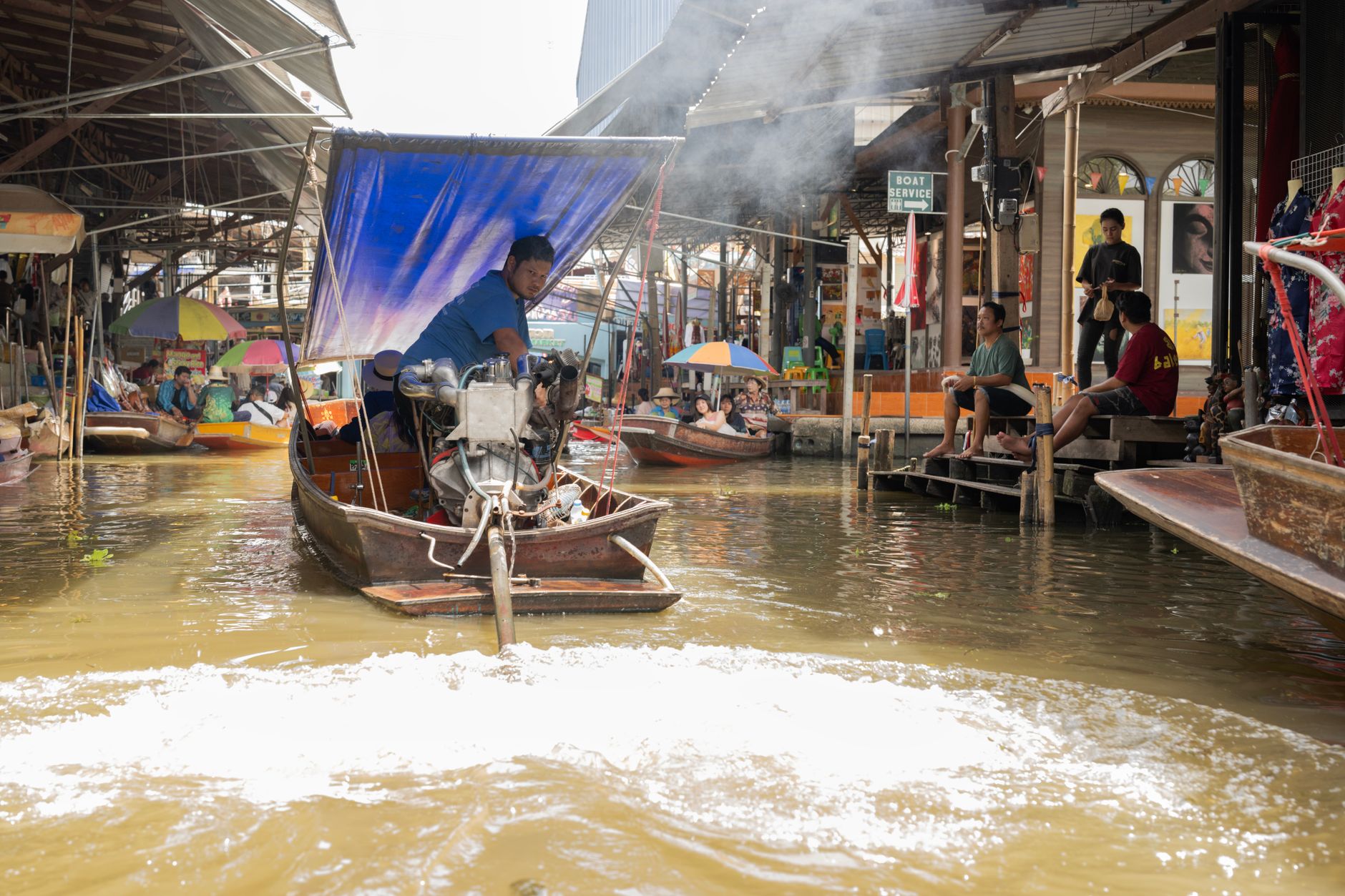
The canal was the colour of a used tea bag and the smell was something between river silt and the ghost of grilled meat. I’d been told to arrive at Khlong Toei pier by five in the morning, and for once the advice was correct. By five-thirty the first boats were already idling, their drivers smoking on the dock, and the light was still that muted grey that softens everything. A woman in a blue sarong was untying a bundle of morning glory from a wooden pole, her movements deliberate the way people move when they’ve done something five thousand times. She didn’t look up.
The floating markets everyone knows are Taling Chan and Damnoen Saduak. Damnoen Saduak, in particular, has become a kind of theme park of itself — vendors in matching hats, boats arranged for camera angles, prices that assume you’ll pay for the experience of being in a photograph. I’d been once, years earlier, and left feeling like I’d watched someone else’s vacation slides. The canals themselves, the actual working waterways of Bangkok, don’t look anything like that. They’re narrower, quieter, and the people on them are moving things — vegetables, propane tanks, schoolchildren — not selling keychains to tourists who showed up on a bus.
I’d arranged a boat through a man named Suchart, who runs a small garage near Bang Na and takes people out on weekends when the garage is closed. I found him through a forum post from 2019, the kind of thing most people would consider too old to trust. He doesn’t have a website. When I called, he asked if I could swim, which I took as a good sign. “Not because it’s dangerous,” he said. “Because if you can swim, you’re not worried, and if you’re not worried, you see more.” It was the most useful thing anyone told me about the canals. You remember that.
The route he took me on started at the edge of the city and worked inward through a network of khlongs that don’t appear on any tourist map. The first hour was mostly residential — houses on stilts, children waving from doorways, a man brushing his teeth on a concrete landing. A dog ran along the bank parallel to us for about ten minutes, barking at nothing in particular, before giving up and lying down. The water here was clearer than in the centre, and once I saw a monitor lizard slide off a root and disappear without a splash. Suchart pointed without slowing down. “Big one,” he said. “Maybe two metres. He lives under that house.”
I’d brought a small bag with water, sunscreen, and a package of dried mango that I’d bought at a convenience store near my hotel. It was not enough. By seven-thirty the sun was already sharp, and the humidity pressed down like a wet towel. Suchart pulled over at a floating platform where a woman was selling bowls of kuay-tiao — narrow rice noodles in a clear broth with pork, bean sprouts, and a spoonful of chilli vinegar. The bowl cost thirty baht. I sat on the edge of the platform with my feet hanging over the water and ate it while a cat circled my ankles. The broth was good enough that I asked for a second bowl, and the woman charged me twenty-five baht for the refill — a discount I didn’t understand and didn’t question. I didn’t argue either.
Most of the markets I visited that day had no English signage. At one, a collection of about a dozen boats tied to a sagging wooden pier, a woman was selling jackfruit that she’d cut open on the spot, the segments glistening like pale yellow organs in the heat. She held up a piece and said something in Thai that I didn’t catch, but the gesture was universal. I bought a bag for twenty baht and ate it standing up, the juice running down my wrist. A man on the next boat was grilling chicken skewers over a charcoal fire built into the hull of his boat, the smoke rising straight up in the still air. He had a system — a small rotating rack powered by a bicycle chain connected to a foot pedal. I watched him work for a while. He didn’t look up. The chicken was fifteen baht a stick, and it was the best thing I ate all day.
One of the mistakes I made that morning was not asking how long the trip would be. Suchart had said “six, seven hours” or something like that when I’d booked, which I’d interpreted loosely. By eleven I was starting to feel the heat in a way that wasn’t comfortable. The sun was directly overhead and the reflection off the water made it worse. I hadn’t brought a hat. I’d brought sunglasses, but they fogged up every time we passed through a patch of shade. Suchart, who had a wide-brimmed straw hat and a long-sleeved shirt, looked entirely comfortable. “You should have brought a hat,” he said, not unkindly, about three hours too late.
Around noon we stopped at a market that was almost entirely empty — a concrete platform with a corrugated roof, maybe fifteen stalls, most of them selling the same things: vegetables, dried fish, plastic buckets. A woman was selling iced coffee from a cart, and I bought one and stood in the shade of the roof, watching a barge drift past loaded with sand. A young man on the barge was asleep on top of the pile, his arm draped over his face. I pointed him out to Suchart, who shrugged. “That’s his job,” he said. “Wait, then sleep.”
The market I’d been most curious about was one called Khlong Lat Mayom — not because it’s hidden, exactly, but because it sits at a kind of hinge point between the tourist circuit and the real thing. It runs on weekends only, and the tourist buses from Bangkok tend to arrive around ten, stay an hour, and leave. I’d timed our arrival for two in the afternoon, which turned out to be a minor miscalculation: the market was sparse by then, with several stalls already packing up. But what remained was better. A woman selling coconut pancakes from a griddle, the batter poured into small rings and cooked until the edges were crisp. A man with a cooler full of cut fruit — pomelo, dragonfruit, papaya — arranged by colour in a way that looked accidental and was probably intentional. I bought a bag of mango slices for thirty baht and ate them leaning against a pillar, watching a group of Thai teenagers take selfies with their food. They weren’t tourists. They were just hungry.
Suchart told me about a canal that branches off the main khlong near the market, one that dead-ends after about a kilometre at a small temple that almost nobody visits. We went there. The canal narrowed until the branches on either side brushed the boat, and the water turned the colour of old tea again, and the engine noise echoed off the walls of vegetation in a way that made it sound like we were in a tunnel. The temple, when we reached it, was a single white building with a faded red roof and a bell hanging from a tree. Nobody was there. I rang the bell, which made a flat, unmusical sound that echoed for a second and then was gone. Suchart stood by the boat and smoked a cigarette. “This is the part they don’t show on television,” he said.
By three-thirty I was tired in a way that felt earned. My shoulders were pink despite the sunscreen, and the back of my neck was sore from twisting to look at things. Suchart’s boat had no cushioning on the seats — just wooden planks — and my backside had gone numb an hour earlier. He asked if I wanted to go back or keep going. I asked what was ahead. “More canals,” he said. “Same as these, but different.” I told him to keep going.
The final stretch of the day took us past a series of small factories — a tofu maker, a place that repaired boat engines, a building where women were sorting dried chillies into sacks. The air changed character from canal to canal: warm starch from the tofu, then diesel and grease, then a sharp, almost painful heat from the chillies that made my eyes water. A man at the engine repair shop waved as we passed, holding up a spark plug. Suchart waved back. I couldn’t tell if they knew each other or if that’s just what you do on the canals.
We got back to the pier at five-fifteen, eight hours after we’d left. I paid Suchart fifteen hundred baht, which was the price he’d quoted and which seemed impossibly cheap for what I’d seen. He gave me a bottle of water from his own cooler — the plastic sweating in the heat — and told me to come back in the dry season. “The water is lower,” he said. “You can see more of the houses.” I said I would.
I walked back to the nearest BTS station through a neighbourhood that was waking up to the evening — food carts appearing on corners, families setting up plastic chairs on the sidewalk, the smell of frying garlic following me for blocks. A woman sold me a bag of fried bananas from a cart, the bananas sliced thin and battered and crisp, and I ate them standing at the station platform, watching the light go orange through the gaps between buildings. The day had cost me, in total, somewhere around two thousand baht. I had a sunburn, a sore back, and the image of a man sleeping on a pile of sand, his arm draped over his face.

📷 Photos: Miguel Cuenca (Pexels), Alina Zhabynska (Pexels)